

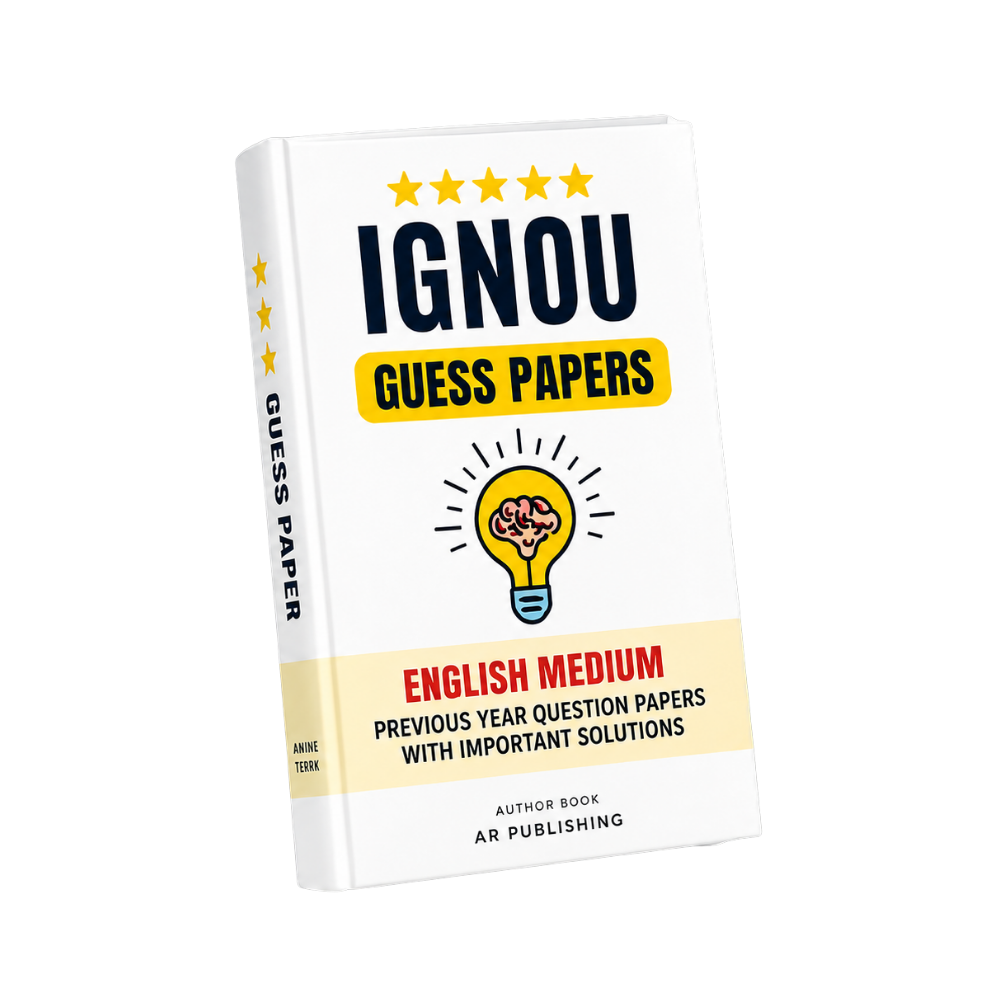
MED-8 IGNOU Guess Paper 2026-27
Click to view offer details & terms
Get 10% OFF Instant Discount
Apply this coupon code at checkout to claim your academic discount instantly.
- Applicable on all university study materials
- Valid for up to 8 item(s) per order
- Valid till Oct 31, 2026
Enrolled in other IGNOU subjects?
Link your Enrollment No. to auto-map all your semester courses & free question papers.
Frequently Bought Together
Popular course materials frequently ordered together
Syllabus & Overview
MED-8 IGNOU Guess Paper: Term-End Exam (TEE) Preparation Guide
This structured guess paper aligns with the official IGNOU Master’s Programme (M.A./M.Sc.) in Public Health syllabus for MED-8: Health Research Methodology and Biostatistics. It synthesizes trends from the last 10 years of June/Dec TEE sessions, emphasizing high-yield units and exam-pattern insights.
Key Syllabus Units & Expected Question Weightage
- Unit 1: Introduction to Health Research
- Focus areas: Definition, types, and objectives of health research (20-25% weight).
- Commonly asked: Case studies on community-based research (5-7% weight).
- Unit 2: Research Design and Sampling Techniques
- Prioritized topics: Experimental vs. observational studies, probability vs. non-probability sampling (25-30% weight).
- Frequent short-answer questions: Ethical considerations in sampling (5% weight).
- Unit 3: Biostatistics Fundamentals
- Critical topics: Descriptive vs. inferential statistics, measures of central tendency/dispersion (20-25% weight).
- Common numerical problems: Interpretation of chi-square tests and p-values (10-12% weight).
- Unit 4: Data Analysis and Interpretation
- Key focus: SPSS/Excel-based data analysis (15-20% weight).
- Frequent questions: Hypothesis testing scenarios (8-10% weight).
- Unit 5: Writing Research Proposals and Reports
- High-weight topics: Structure of research proposals, ethical clearance procedures (15-20% weight).
- Commonly tested: Case studies on grant writing (5-7% weight).
3-Hour Exam Time Management Tips
- Allocate 45 minutes for reading the question paper and planning answers.
- Prioritize short-answer questions (SAQs) (30-40 marks) over long answers (LAs) in the first hour.
- For numerical problems (e.g., biostatistics), show step-by-step calculations even if time is tight.
- Use bullet points for structured answers in LAs (e.g., research design units).
- Leave 10-15 minutes for review, focusing on incomplete sections or high-weightage units.
Subject-Specific FAQs
- Q: Are case studies mandatory for all units?
A: Case studies are mandatory for Units 1 and 5 (20-25% weight combined). Units 2-4 may include short case-based questions but are not exclusively case-study focused.
- Q: How should I approach biostatistics numericals?
Prioritize interpretation over raw calculations. For example, if asked to interpret a chi-square test result, explain statistical significance (p-value) and effect size clearly, even if calculations are complex.
Previous Year Paper Trends (June/Dec 2019-2024)
- SAQs (10-15 marks each): Focused on definitions, ethical guidelines, or step-by-step research design processes.
- LAs (20-25 marks each): Often required detailed explanations of sampling techniques, SPSS output interpretation, or proposal writing formats.
- Numericals: 50% involved descriptive statistics (mean, median, standard deviation), 30% inferential statistics (hypothesis testing), and 20% data visualization (graphs/charts).
Pro Tips for High Scores
- Memorize key formulas for biostatistics (e.g., standard deviation, confidence intervals) but focus on applied interpretation in answers.
- For Unit 5, practice writing a 1-page research proposal outline using IGNOU’s sample templates.
- Use past TEE papers (available on IGNOU’s official website) to identify recurring question patterns.
Why buy from us?
-
Verified by top professors and 99th percentile students.
-
Always updated to the latest university curriculum.
-
High-quality, printable PDF formats with clear diagrams.
License & Terms
By purchasing this item, you agree to our standard academic license terms. You may use this product for personal study, but you may not resell or redistribute the files online.