

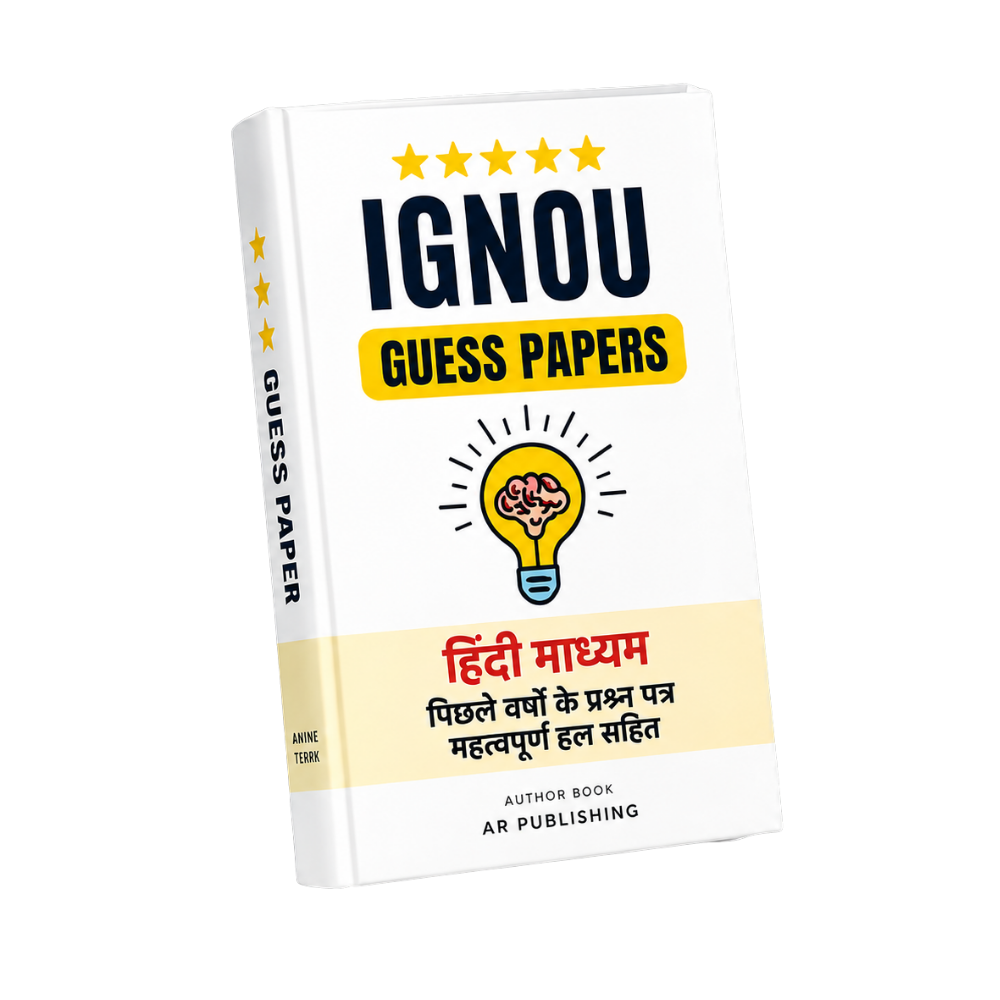
MEDS-048 IGNOU Guess Paper 2026-27
Click to view offer details & terms
Get 10% OFF Instant Discount
Apply this coupon code at checkout to claim your academic discount instantly.
- Applicable on all university study materials
- Valid for up to 8 item(s) per order
- Valid till Oct 31, 2026
Frequently Bought Together
Popular course materials frequently ordered together
Syllabus & Overview
MEDS-048 Guess Paper Term-End Exam (TEE) Strategy
This structured guess paper aligns with the IGNOU MAUS (Sustainable Development and Smart City) curriculum, prioritizing high-yield topics from past June/December sessions (2018–2023). Focus on chapter-wise weightage and 3-hour time management to maximize scoring.
Key Blocks & Topic Breakdown
- Block-1: Introduction to Sustainable Development
- Definitions and paradigms (e.g., Brundtland Report, triple bottom line)
- Case studies: Amsterdam’s circular economy or Copenhagen’s climate action plan
- Previous year focus: Short-answer questions on sustainable development goals (SDGs) (20-25% of Block-1 questions)
- Block-3: Society and Sustainable Development-I
- Social equity, inclusive growth, and urban poverty metrics
- Critiques of neoliberal urbanism vs. participatory planning
- High-scoring: long-answer questions on slum upgrading programs (e.g., India’s JNNURM)
- Block-5: Smart City-I
- Technologies: IoT, AI, and data governance in urban governance
- Challenges: digital divide and privacy concerns in smart infrastructure
- Pattern: 20% of questions on Smart City Mission (India) implementation
- Block-6: Smart City-II
- Economic models: public-private partnerships (PPPs) in smart cities
- Sustainable mobility: low-carbon transport policies
- Previous years: case studies on Bengaluru or Pune (30% of Block-6 questions)
Exam Time Management (3 Hours)
Phase 1 (45 mins): Attempt short-answer questions (SAQs) from Blocks 1, 3, and 5 (prioritize SDGs, social equity, and IoT basics).
Phase 2 (90 mins): Tackle long-answer questions (LAQs) from Blocks 4 (societal challenges) and 6 (economic models). Allocate 15 mins per LAQ.
Phase 3 (60 mins): Review Block-2 (Economy and Sustainable Development) numericals (e.g., carbon footprint calculations) and Block-4 (Society-II) policy critiques.
FAQs
- Q: Are case studies mandatory for scoring?
A: Yes. 20-30% of marks in past papers came from case studies (e.g., Amsterdam’s energy transition or Mumbai’s smart metro). Use real-world examples to answer LAQs.
- Q: How to balance theory and application?
For Blocks 1/2, focus on theoretical frameworks (e.g., define sustainable development). For Blocks 5/6, apply theories to Indian smart city projects (e.g., Aadhar-enabled payment systems).
Why buy from us?
-
Verified by top professors and 99th percentile students.
-
Always updated to the latest university curriculum.
-
High-quality, printable PDF formats with clear diagrams.
License & Terms
By purchasing this item, you agree to our standard academic license terms. You may use this product for personal study, but you may not resell or redistribute the files online.