

MEG-9 IGNOU Guess Paper 2026-27
Click to view offer details & terms
Get 10% OFF Instant Discount
Apply this coupon code at checkout to claim your academic discount instantly.
- Applicable on all university study materials
- Valid for up to 8 item(s) per order
- Valid till Oct 31, 2026
Enrolled in other IGNOU subjects?
Link your Enrollment No. to auto-map all your semester courses & free question papers.
Frequently Bought Together
Popular course materials frequently ordered together
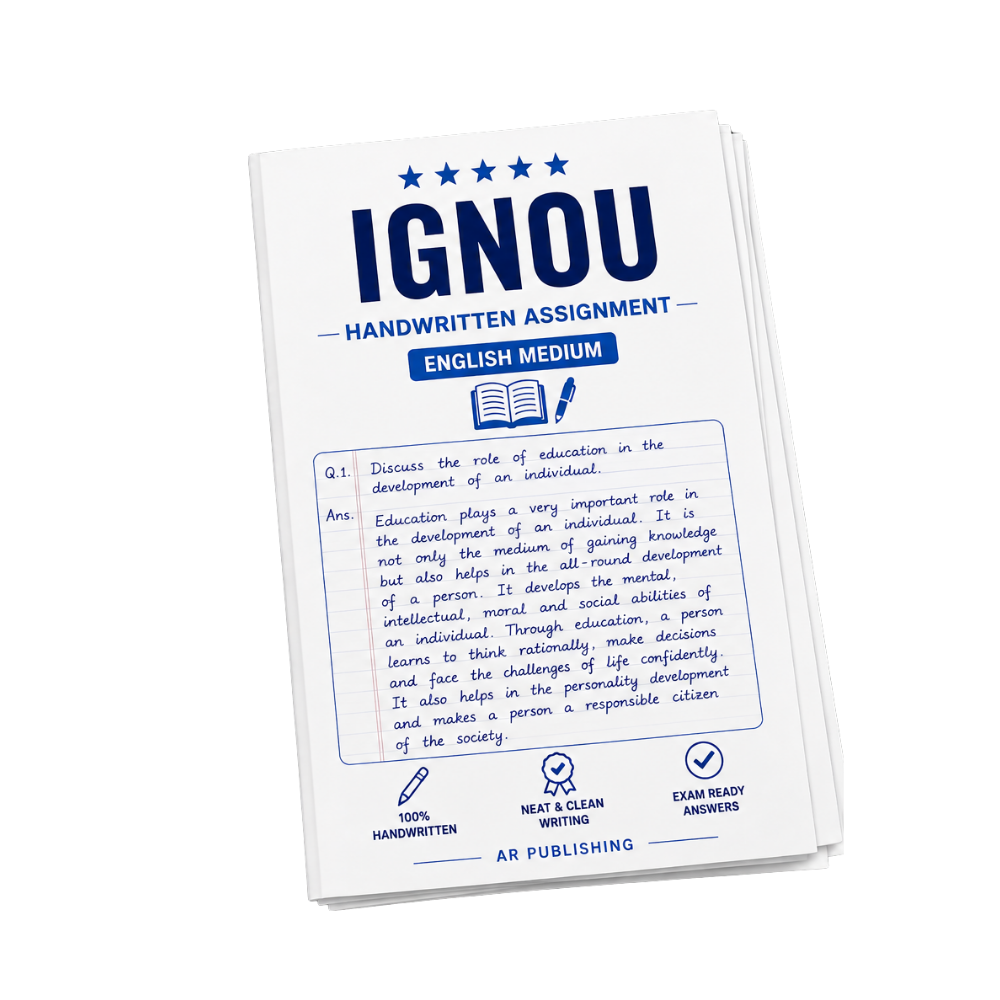
Syllabus & Overview
Course Scope & Syllabus Overview for MEG-9: Indian English Literature
MEG-9: Indian English Literature examines the evolution, thematic diversity, and cultural nuances of English-language writing produced in India from colonialism to contemporary times. This course, part of IGNOU’s Master’s Programme in English, critically engages with key texts that reflect India’s socio-political, philosophical, and linguistic transformations. Students explore how colonial influences, post-independence identities, and global diasporic experiences shape literary expression, while analyzing canonical and subaltern voices. The syllabus emphasizes close reading, contextual analysis, and interdisciplinary connections—preparing students to interpret literary works within broader historical and theoretical frameworks.Key Syllabus Units & Topics
- Unit 1: Colonial Discourse and Early Indian English Literature: Focuses on the emergence of English-language writing in India during the 18th and 19th centuries, analyzing works by early Indian authors like Toru Dutt and Bankim Chandra Chattopadhyay. Examines how colonialism influenced narrative structures, themes of resistance, and the negotiation of cultural identity.
- Unit 2: Post-Independence Literature and National Identity: Investigates major literary movements post-1947, including the works of Kamala Das, A.K. Ramanujan, and Mulk Raj Anand. Explores how writers grappled with nation-building, regionalism, and the complexities of a multicultural society.
- Unit 3: Themes of Migration and Diaspora in Contemporary Writing: Studies diasporic literature by authors like Amitav Ghosh, Jhumpa Lahiri, and Gita Mehta, highlighting how Indian English writers navigate identity, belonging, and cultural hybridity in global contexts.
- Unit 4: Feminist and Subaltern Perspectives in Indian English Literature: Analyzes feminist texts by authors like Mahasweta Devi and Shashi Deshpande, alongside subaltern narratives, to examine gender, caste, and marginalized voices within literary discourse.
- Unit 5: Experimental Forms and Postcolonial Theory: Explores innovative literary techniques in works by Salman Rushdie, Arundhati Roy, and others, while applying postcolonial theories to critique power structures in literature.
Frequently Asked Questions
Q: What is the marking scheme for MEG-9’s Term-End Examination (TEE), and how are questions distributed across units?
A: The TEE for MEG-9 carries 100 marks, with questions evenly distributed across all five units. Typically, 20–25% of the paper focuses on close reading and analysis of prescribed texts, while 30–35% tests theoretical understanding of postcolonial and literary criticism frameworks.
Q: Are there specific assignment guidelines for MEG-9, and how do they impact the final grade?
A: Assignments in MEG-9 account for 30% of the total marks and require critical analysis of literary excerpts or theoretical essays. Students must adhere to IGNOU’s submission deadlines and formatting guidelines to avoid deductions; assignments are evaluated on depth of analysis, adherence to academic standards, and originality.
Why buy from us?
-
Verified by top professors and 99th percentile students.
-
Always updated to the latest university curriculum.
-
High-quality, printable PDF formats with clear diagrams.
License & Terms
By purchasing this item, you agree to our standard academic license terms. You may use this product for personal study, but you may not resell or redistribute the files online.