

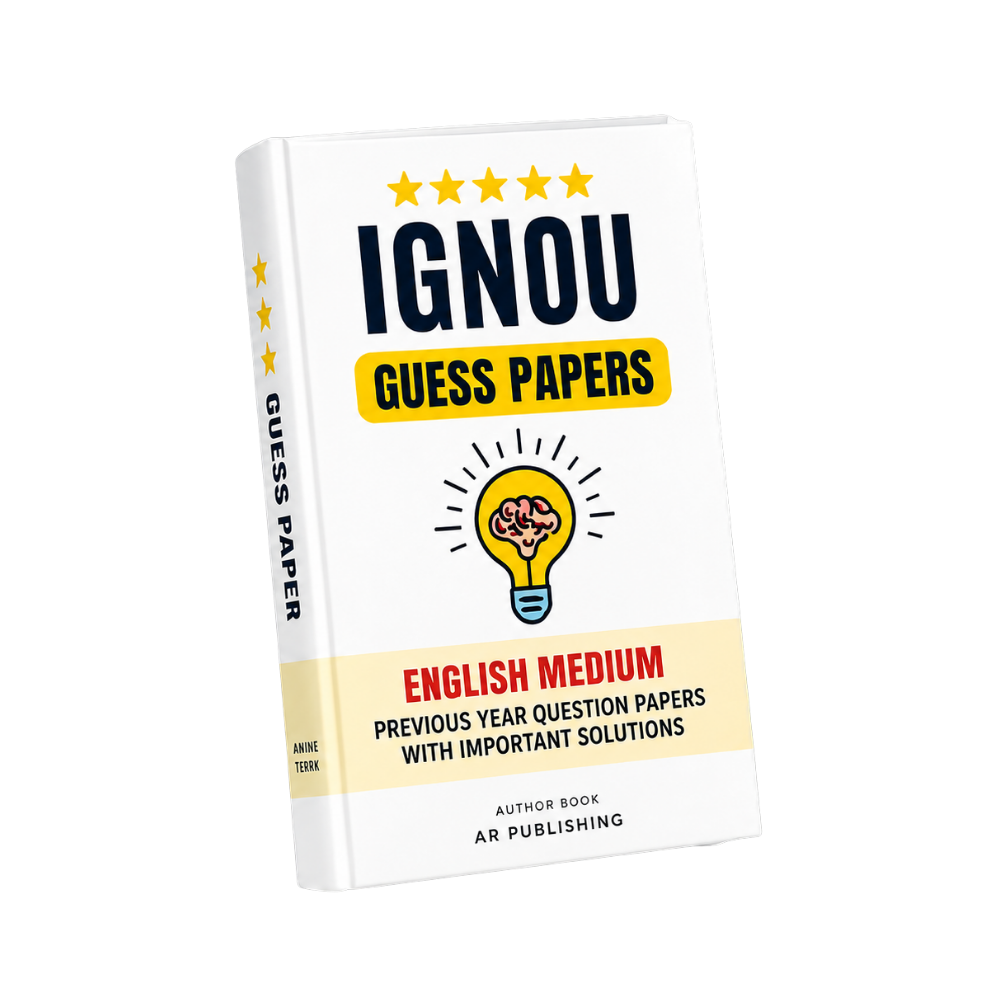
MFC-006 IGNOU Guess Paper 2026-27
Click to view offer details & terms
Get 10% OFF Instant Discount
Apply this coupon code at checkout to claim your academic discount instantly.
- Applicable on all university study materials
- Valid for up to 8 item(s) per order
- Valid till Oct 31, 2026
Enrolled in other IGNOU subjects?
Link your Enrollment No. to auto-map all your semester courses & free question papers.
Frequently Bought Together
Popular course materials frequently ordered together

Syllabus & Overview
MFC-006 Guess Paper: Term-End Exam (TEE) Preparation for Folklore: Canon, Multimediality, Interdisciplinarity and Social Epistemology
This structured guess paper aligns with IGNOU’s official MFC-006 syllabus, incorporating solved previous year questions (June/Dec sessions) and chapter-wise weightage. It prioritizes scoring topics from Blocks 1–4, time management strategies, and exam-specific patterns.
Key Blocks & Syllabus Focus Areas
- Block 1: Folklore as Canon
- Critical evaluation of Tylor’s and Lévi-Strauss’ definitions of folklore in canonical texts (e.g., The Golden Bough, Myth and Meaning).
- Oral tradition vs. written canon: Case studies of Panchatantra and Jataka tales in South Asian contexts.
- Previous years’ emphasis: 20-25% of questions on canonization processes and oral-literary hierarchies.
- Block 2: Folklore and Multimediality
- Multimedia adaptations of folklore: Analysis of Disney’s Moana vs. original Hawaiian oral narratives.
- Digital folklore archives: Role of Folklife databases and YouTube in preserving intangible heritage (weightage: 30%).
- Comparative study: Traditional puppet theater (e.g., Kathputli) vs. animated folklore films.
- Block 3: Folklore and Interdisciplinarity
- Folklore in Anthropology: Victor Turner’s liminality theory applied to ritual performances.
- Psychological folklore: Jungian archetypes in Indian folktales (e.g., Hanuman as a trickster figure).
- Previous exam trends: 25-30% of questions on interdisciplinary frameworks (e.g., folklore + linguistics, folklore + sociology).
- Block 4: Folklore and Social Epistemology
- Social epistemology critiques: Warren’s folklore as knowledge system vs. postcolonial revisions.
- Case study: Dalit folklore and subaltern epistemologies in Maharashtra.
- Exam focus: Critical essays on power dynamics in folklore preservation (weightage: 20%).
Exam-Specific Strategies
- Time Management: Allocate 45 minutes per section (Blocks 1–4). Prioritize short-answer questions (10 marks each) over long essays (20 marks).
- Question Patterns:
- Block 1: 2–3 short answers on canonical texts; 1 long essay on oral-literary debates.
- Block 2: 3–4 questions on multimedia case studies; 1 comparative analysis.
- Block 3: 2 interdisciplinary theory-based questions; 1 applied case study.
- Block 4: 1 critical essay on social epistemology; 2 short answers on subaltern perspectives.
- High-Yield Topics:
- Digital folklore archives (e.g., UNESCO’s Intangible Cultural Heritage listings).
- Postcolonial revisions of folklore canon (e.g., Gandhi’s influence on Indian oral traditions).
- Interdisciplinary models: Folklore + Linguistics (e.g., proverbs as cognitive tools).
Subject-Specific FAQs
- Q: Are there recurring themes in previous years’ TEE papers?
A: Yes. Multimedia adaptations (Block 2) and postcolonial critiques of folklore canon (Block 1) appear consistently. Focus on case studies (e.g., Ramayana in animation vs. oral epics) for higher marks.
- Q: How should I approach long-answer questions?
Use the PEEA framework: P aragraph on context, E xamples (2–3), E valuation (critical analysis), A pplication (link to real-world folklore practices). For Block 4, emphasize social epistemology frameworks (e.g., Warren’s folklore as knowledge).
Sample Question Breakdown (Previous Years’ Trends)
Section A (Short Answers 10 marks each)
- “Discuss the role of digital archives in preserving Adivasi folklore in Chhattisgarh.” (Block 2)
- “How does Jungian psychology interpret the trickster motif in Indian folktales?” (Block 3)
Section B (Long Answers 20 marks each)
- “Critically evaluate Tylor’s definition of folklore in light of postcolonial scholarship.” (Block 1)
- “Analyze the impact of social media on the transmission of urban folklore in India.” (Block 2)
Why buy from us?
-
Verified by top professors and 99th percentile students.
-
Always updated to the latest university curriculum.
-
High-quality, printable PDF formats with clear diagrams.
License & Terms
By purchasing this item, you agree to our standard academic license terms. You may use this product for personal study, but you may not resell or redistribute the files online.