

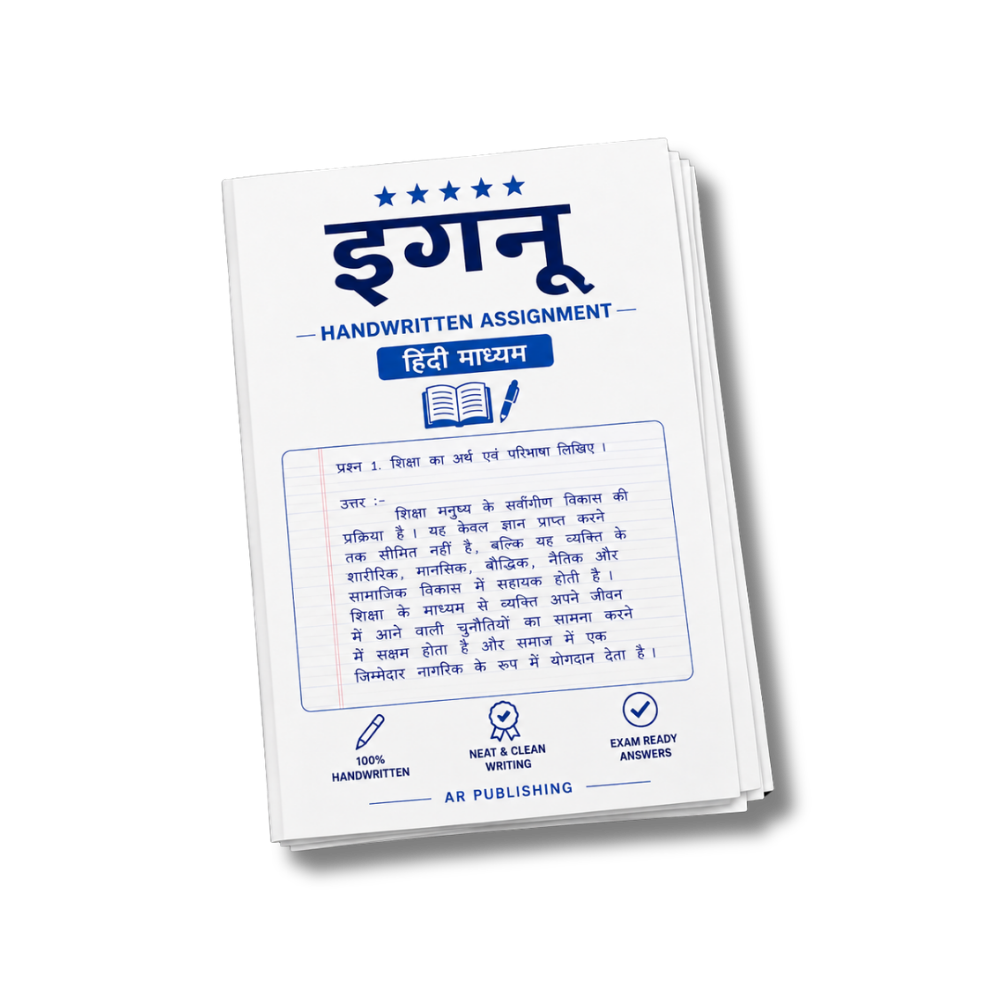
MGGE-002 IGNOU Handwritten Assignment 2026-27
Click to view offer details & terms
Get 10% OFF Instant Discount
Apply this coupon code at checkout to claim your academic discount instantly.
- Applicable on all university study materials
- Valid for up to 8 item(s) per order
- Valid till Oct 31, 2026
Enrolled in other IGNOU subjects?
Link your Enrollment No. to auto-map all your semester courses & free question papers.
Frequently Bought Together
Popular course materials frequently ordered together
Syllabus & Overview
Course Scope & Syllabus Overview for MGGE-002: Natural Resources Management
IGNOU’s MGGE-002: Natural Resources Management is a core component of the Master of Science in Geography (MSCGG) curriculum, designed to equip students with interdisciplinary knowledge of sustainable resource stewardship. This course bridges ecological, environmental, and socio-economic dimensions, emphasizing conservation strategies, policy frameworks, and practical management techniques. Through structured blocks, students analyze global and regional challenges—such as deforestation, soil degradation, and water scarcity—while exploring evidence-based solutions. The syllabus integrates field-relevant theories (e.g., ecosystem services, carrying capacity models) with real-world case studies, ensuring graduates develop analytical skills applicable to government, NGOs, and private sector roles.Key Syllabus Units & Topics
- Block-1: Introduction to Natural Resources Management: Covers foundational concepts including resource classification (renewable vs. non-renewable), spatial distribution of natural resources, and their role in economic development. Examines historical perspectives of resource exploitation and sustainability paradigms.
- Block-2: Conservation and Management of Natural Resources: Focuses on biodiversity conservation, habitat restoration, and invasive species mitigation. Discusses legal frameworks (e.g., Wildlife Protection Act, Forest Conservation Act) and participatory management models.
- Block-3: Management Strategies: Analyzes adaptive management techniques for forestry, fisheries, and agricultural lands. Includes GIS-based resource monitoring, remote sensing applications, and climate-resilient land-use planning.
- Block-4: Governance, Policy Making and Case Studies: Evaluates national and international policies (e.g., National Forest Policy, UN Sustainable Development Goals) through regional case studies. Explores stakeholder dynamics and conflict resolution in resource governance.
Frequently Asked Questions
Q: What is the marking scheme for MGGE-002 assignments, and how many marks are allocated to each block?
A: The assignment carries 20 marks in total, with each block (1–4) typically contributing 5 marks based on conceptual clarity, application of theories, and adherence to academic rigor. Partial marks are awarded for case study analysis and policy critique.
Q: Are there specific pass marks for MGGE-002, and how does the examination pattern differ from other geography courses?
A: The course follows a passing criterion of 40% for assignments and 50% for the term-end exam. Unlike descriptive courses, MGGE-002 emphasizes analytical questions (e.g., "Evaluate the role of community forestry in Odisha") and short-answer precision, requiring direct engagement with syllabus blocks.
Why buy from us?
-
Verified by top professors and 99th percentile students.
-
Always updated to the latest university curriculum.
-
High-quality, printable PDF formats with clear diagrams.
License & Terms
By purchasing this item, you agree to our standard academic license terms. You may use this product for personal study, but you may not resell or redistribute the files online.