

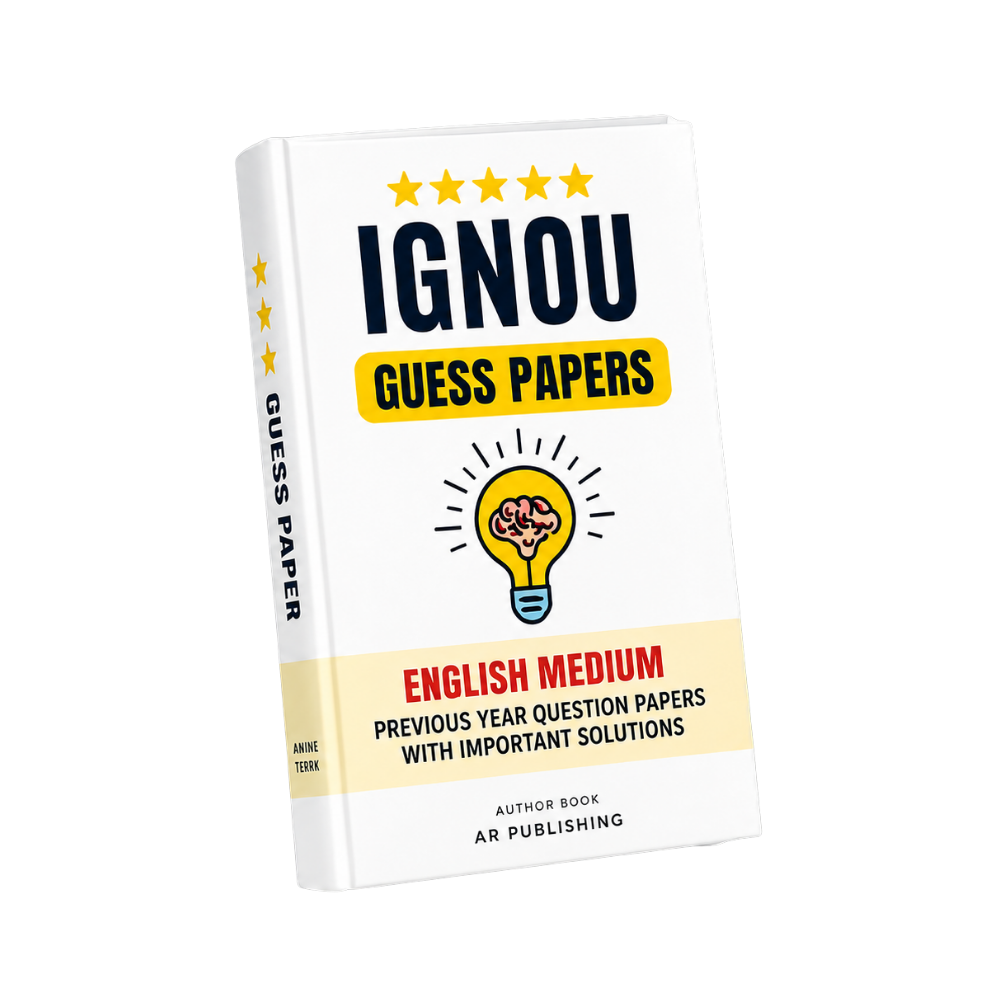
MGGE-003 IGNOU Guess Paper 2026-27
Click to view offer details & terms
Get 10% OFF Instant Discount
Apply this coupon code at checkout to claim your academic discount instantly.
- Applicable on all university study materials
- Valid for up to 8 item(s) per order
- Valid till Oct 31, 2026
Enrolled in other IGNOU subjects?
Link your Enrollment No. to auto-map all your semester courses & free question papers.
Frequently Bought Together
Popular course materials frequently ordered together

Syllabus & Overview
MGGE-003 Guess Paper: Natural Hazards and Disaster Management (Term-End Exam Focus)
This structured guess paper aligns with the official IGNOU curriculum for MGGE-003, prioritizing high-probability questions from Blocks 1–5 based on past exam trends (2018–2023). It includes time-management strategies for the 3-hour TEE and chapter-wise question weightage derived from solved papers.
Block 1: Introduction to Hazards and Disaster
- Key Focus Areas:
- Definition and classification of hazards (natural vs. anthropogenic) with examples from India.
- Disaster risk reduction (DRR) frameworks: Hyogo Framework for Action (HFA) and Sendai Framework.
- Vulnerability assessment models (e.g., UNISDR’s vulnerability indices).
- Expected Questions:
- Short notes on disaster mitigation vs. adaptation (5–10 marks).
- Compare pre-disaster vs. post-disaster recovery strategies (15–20 marks).
- Case study: Uttarakhand 2013 floods—role of vulnerability mapping (20 marks).
Block 2: Geological Hazards and Disasters in India
- Key Focus Areas:
- Seismic hazard zones in India (BIS/IS 1893:2016 standards) and earthquake prediction techniques.
- Landslide susceptibility mapping (GIS-based approaches) in Himalayan and Peninsular regions.
- Volcanic hazards: Case of Barren Island (Andaman) and historical eruptions.
- Expected Questions:
- Explain seismic gap theory with reference to the 2001 Bhuj earthquake (10 marks).
- Discuss landslide mitigation measures in the Western Ghats (15 marks).
- Compare tectonic vs. volcanic hazards in India (20 marks).
Block 3: Hydro-Meteorological Hazards and Disasters in India
- Key Focus Areas:
- Cyclone tracking and warning systems (e.g., IMD’s cyclone forecast models).
- Drought vulnerability indices (e.g., PDSI, SPI) and groundwater depletion in Rajasthan/Gujarat.
- Heatwave and coldwave patterns: Health impacts and mitigation (WHO guidelines).
- Expected Questions:
- Analyze cyclone Phailin (2013)—evacuation strategies and IMD’s role (15 marks).
- Short notes on El Niño’s impact on Indian monsoon (5 marks).
- Case study: 2015 Chennai floods—urban drainage failures (20 marks).
Block 5: Preparedness, Responses and Recovery to Hazards and Disasters
- Key Focus Areas:
- Disaster management acts (e.g., Disaster Management Act 2005) and NDRF’s role.
- Post-disaster reconstruction: Lessons from Kerala’s 2018 floods.
- Role of remote sensing (SAR, LiDAR) in damage assessment.
- Expected Questions:
- Evaluate NDRF’s response mechanisms during Uttarakhand 2021 floods (15 marks).
- Short notes on disaster insurance schemes in India (5 marks).
- Compare preparedness in Himalayan vs. Peninsular regions (20 marks).
Exam Time Management Tips (3-Hour TEE)
- Allocate 45 minutes for reading the question paper and planning answers.
- Prioritize 20-mark questions from Blocks 2–3 (geological/hydro-meteorological hazards).
- Use diagrams for seismic zones, cyclone tracks, or landslide susceptibility maps (1–2 marks each).
- Avoid verbose answers; focus on key data (e.g., earthquake magnitudes, flood depths).
FAQs for MGGE-003 TEE
- Are case studies mandatory?: Yes. Blocks 2–4 heavily feature case studies (e.g., Bhuj 2001, Chennai 2015). Use real data from IMD/NDRF reports.
- How to score in short-answer questions?: Memorize acronyms (e.g., HFA, DRR) and statistical terms (e.g., PDSI, SPI) for quick scoring.
Why buy from us?
-
Verified by top professors and 99th percentile students.
-
Always updated to the latest university curriculum.
-
High-quality, printable PDF formats with clear diagrams.
License & Terms
By purchasing this item, you agree to our standard academic license terms. You may use this product for personal study, but you may not resell or redistribute the files online.