

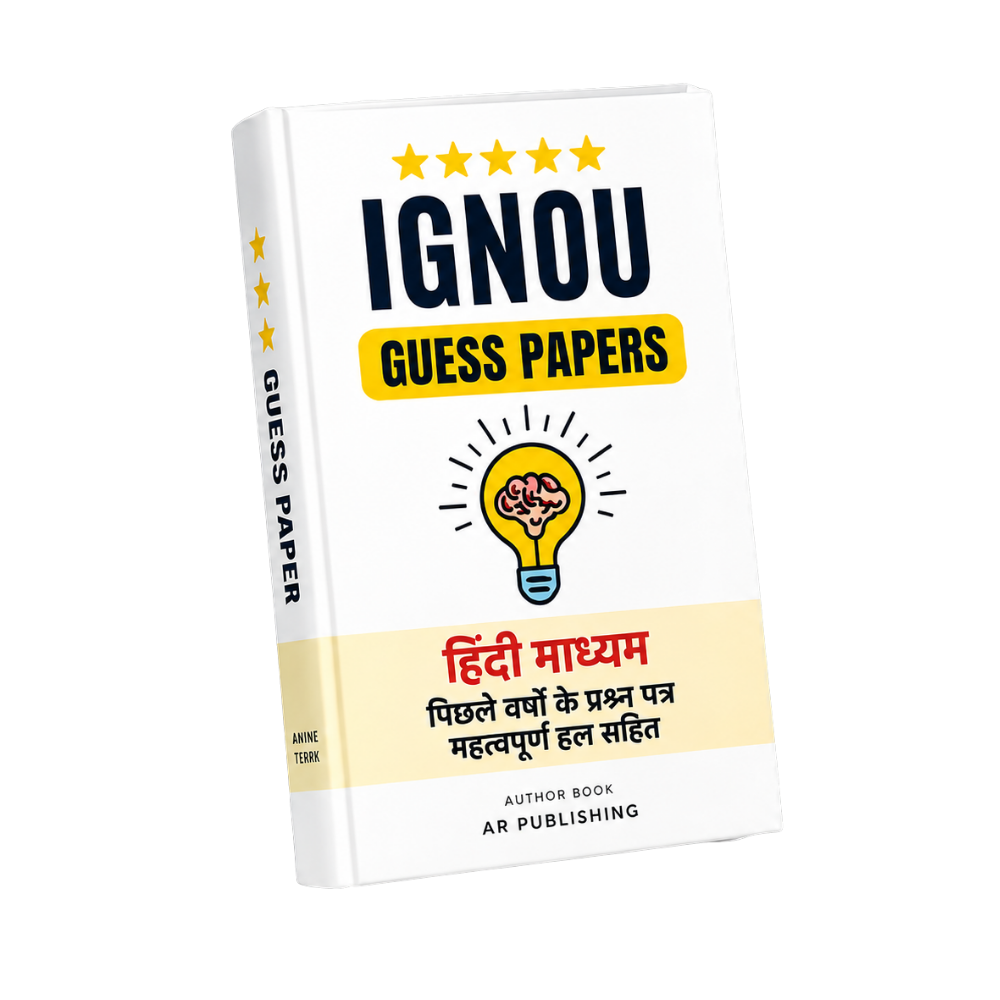
MGS-43 IGNOU Guess Paper 2026-27
Click to view offer details & terms
Get 10% OFF Instant Discount
Apply this coupon code at checkout to claim your academic discount instantly.
- Applicable on all university study materials
- Valid for up to 8 item(s) per order
- Valid till Oct 31, 2026
Enrolled in other IGNOU subjects?
Link your Enrollment No. to auto-map all your semester courses & free question papers.
Frequently Bought Together
Popular course materials frequently ordered together
Syllabus & Overview
MGS-43 Guess Paper: Term-End Exam (TEE) Preparation & Scoring Strategy
This structured guess paper for MGS-43 (Course Code MGS-43 IGNOU Academic Coursework for MGS-43) leverages previous year question trends (5-10 years) from June and December sessions to help students prioritize high-scoring topics. It includes chapter-wise weightage, 3-hour exam time management tips, and a focus on core syllabus blocks.
Key Syllabus Units & Expected Question Patterns
- Unit 1: Indian Political Thought and Social Movements
- Focus areas: Gandhian political philosophy, critiques of colonialism, and the role of social movements in shaping Indian democracy.
- Expected questions: Short-answer questions (SAQs) on key figures like Gandhi, Tilak, and B.R. Ambedkar; essay-type questions on the impact of movements like the Non-Cooperation Movement or Dalit rights struggles.
- Unit 2: Comparative Study of Political Systems
- Focus areas: Parliamentary vs. presidential systems, federalism in India vs. the U.S., and the role of civil society in political governance.
- Expected questions: Comparative analysis of political institutions, case studies on democratic backsliding, and debates on secularism vs. nationalism.
- Unit 3: Political Theory and Ideologies
- Focus areas: Liberalism, socialism, and Marxist critiques; application of political theories to contemporary Indian challenges (e.g., caste, gender, and economic inequality).
- Expected questions: Definitions and critiques of ideologies, application-based questions on policy debates (e.g., land reforms, labor rights).
- Unit 4: International Relations and Global Politics
- Focus areas: Realism vs. idealism in IR, India’s foreign policy, and the role of multilateral institutions (e.g., UN, BRICS).
- Expected questions: Case studies on India’s diplomatic relations, debates on non-alignment, and critiques of globalization.
- Unit 5: Public Administration and Governance
- Focus areas: Bureaucracy and democracy, decentralization (73rd/74th Amendments), and digital governance in India.
- Expected questions: Analytical questions on administrative reforms, critiques of corruption, and the role of technology in governance.
Exam Time Management (3-Hour Strategy)
- Allocate 45 minutes for reading the question paper and planning answers (prioritize high-weightage units like Unit 1: and Unit 2).
- For SAQs (20 marks), spend 10-12 minutes per question (focus on clarity, definitions, and examples).
- For long-answer questions (30 marks), allocate 25-30 minutes per question (structure answers with introduction, analysis, and conclusion).
- Avoid spending more than 5 minutes on a single sub-question in essay-type answers.
Subject-Specific FAQs
- Q: Are case studies from previous years’ papers relevant for MGS-43?
A: Yes. Case studies on movements (e.g., Chipko, Narmada Bachao Andolan) or political events (e.g., Emergency, 2G spectrum scandal) frequently appear. Review Units 1 and 4 for such examples.
- Q: How should I approach comparative analysis questions?
Use a structured format: Introduction (context), Comparison (2-3 key parameters), Conclusion (critique or implications). For example, compare India’s federalism with the U.S. under Unit 2.
Sample High-Weightage Topics (Based on Past Papers)
- Gandhi’s political philosophy vs. Marxist critiques of colonialism (Unit 1).
- Federalism in India: Challenges and solutions (Unit 2).
- Liberalism and socialism: Application to Indian economic policies (Unit 3).
- India’s foreign policy: Non-alignment in the 21st century (Unit 4).
- Digital governance: Opportunities and ethical dilemmas (Unit 5).
Why buy from us?
-
Verified by top professors and 99th percentile students.
-
Always updated to the latest university curriculum.
-
High-quality, printable PDF formats with clear diagrams.
License & Terms
By purchasing this item, you agree to our standard academic license terms. You may use this product for personal study, but you may not resell or redistribute the files online.