

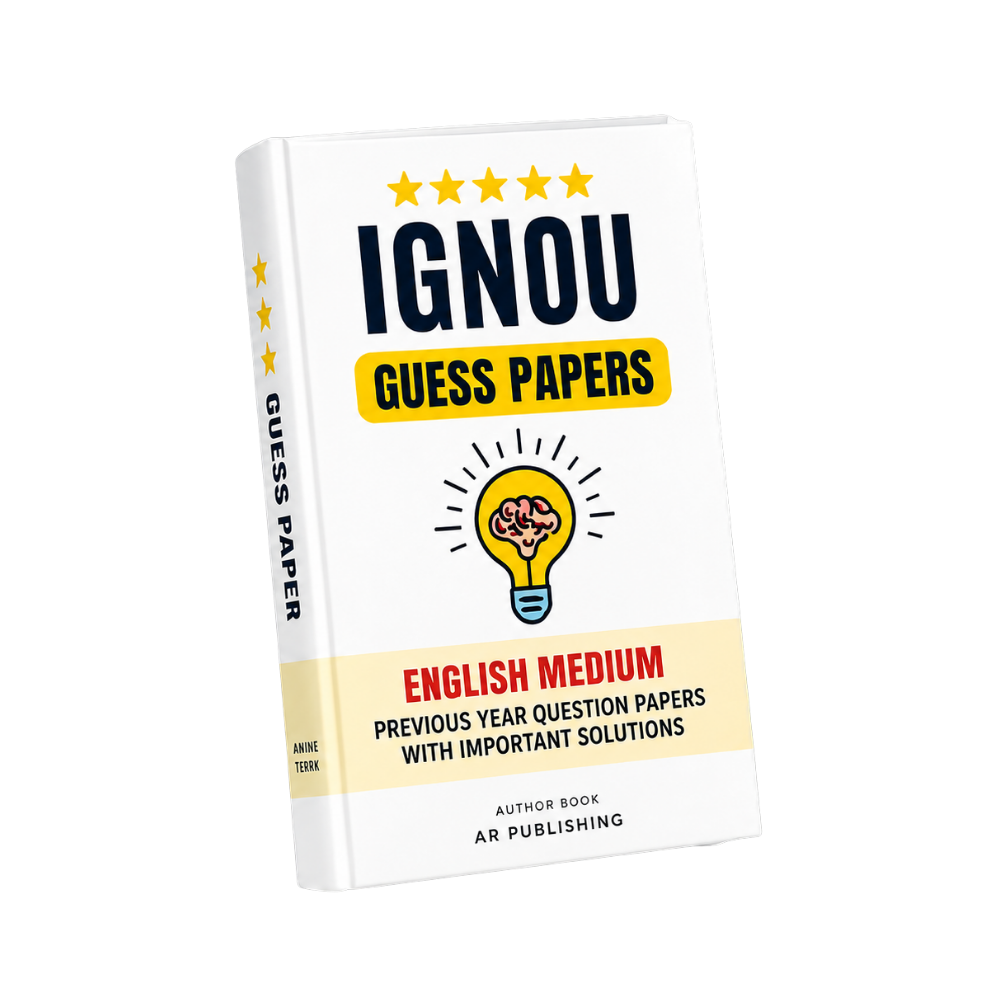
MHC-002 IGNOU Guess Paper 2026-27
Click to view offer details & terms
Get 10% OFF Instant Discount
Apply this coupon code at checkout to claim your academic discount instantly.
- Applicable on all university study materials
- Valid for up to 8 item(s) per order
- Valid till Oct 31, 2026
Enrolled in other IGNOU subjects?
Link your Enrollment No. to auto-map all your semester courses & free question papers.
Frequently Bought Together
Popular course materials frequently ordered together

Syllabus & Overview
MHC-002: A Strategic Guide to Mastering IGNOU’s Medical Anthropology Exam
MHC-002, Medical Anthropology: Theory and Practice, is a core course under IGNOU’s Master’s Programme in Anthropology, designed to explore the cultural, social, and historical dimensions of health, illness, and medical systems. The syllabus integrates theoretical frameworks (e.g., biomedical, holistic, and critical medical anthropology) with case studies from global contexts, emphasizing ethnographic methodologies and policy critiques. This guide distills the most relevant exam patterns, leveraging past term-end papers (June/December cycles) to highlight recurring themes—such as the biocultural approach, health disparities, and medical pluralism—while providing time-tested strategies for efficient revision.
Core Syllabus Units & Exam-Focused Topics
- Unit 1: Foundations of Medical Anthropology: Covers historical precursors (e.g., Malinowski’s The Sexual Life of Savages) and foundational theories like symbolic interactionism and structural functionalism, with a focus on how culture shapes healing practices and illness narratives.
- Unit 2: Biomedical vs. Alternative Healing Systems: Analyzes tensions between Western biomedicine and indigenous/traditional systems (e.g., Ayurveda, homeopathy), including critiques of ethnomedicine and biopower through Foucault’s lens.
- Unit 3: Health, Disease, and Social Inequality: Examines epidemiological transitions, global health inequities, and the role of gender, caste, and class in access to healthcare, with case studies from South Asia and Sub-Saharan Africa.
- Unit 4: Medicalization and Critiques of Modernity: Explores medicalization theory (e.g., Connell’s Gender and Health), pharmaceuticalization, and the ethical dilemmas of genetic determinism and mental health stigma.
- Unit 5: Anthropology of Mental Health and Disability: Focuses on cultural constructions of madness (e.g., possession disorders in Africa), disability studies, and the rights-based approach to mental healthcare, aligning with IGNOU’s emphasis on human rights frameworks.
Frequently Asked Questions
Q: How are numericals or case-study questions weighted in MHC-002’s TEE, and which units are most likely to appear?
A: Numerical or case-based questions (typically 20–25 marks) favor Units 3 (Health Inequality) and Unit 5 (Mental Health), where data interpretation (e.g., healthcare access statistics) and ethnographic examples (e.g., dhat syndrome in South Asia) are recurrent. Prioritize past papers from 2018–2023 for patterns.
Q: Are there specific assignment guidelines for MHC-002 that could impact exam preparation?
A: Assignments (e.g., Assignment 1: Compare two healing systems; Assignment 2: Critique a global health policy) often mirror exam questions. Focus on Unit 2 (Healing Systems) and Unit 4 (Medicalization) for assignment-relevant topics, as these directly translate to 15–20 marks in TEE.
Why buy from us?
-
Verified by top professors and 99th percentile students.
-
Always updated to the latest university curriculum.
-
High-quality, printable PDF formats with clear diagrams.
License & Terms
By purchasing this item, you agree to our standard academic license terms. You may use this product for personal study, but you may not resell or redistribute the files online.