

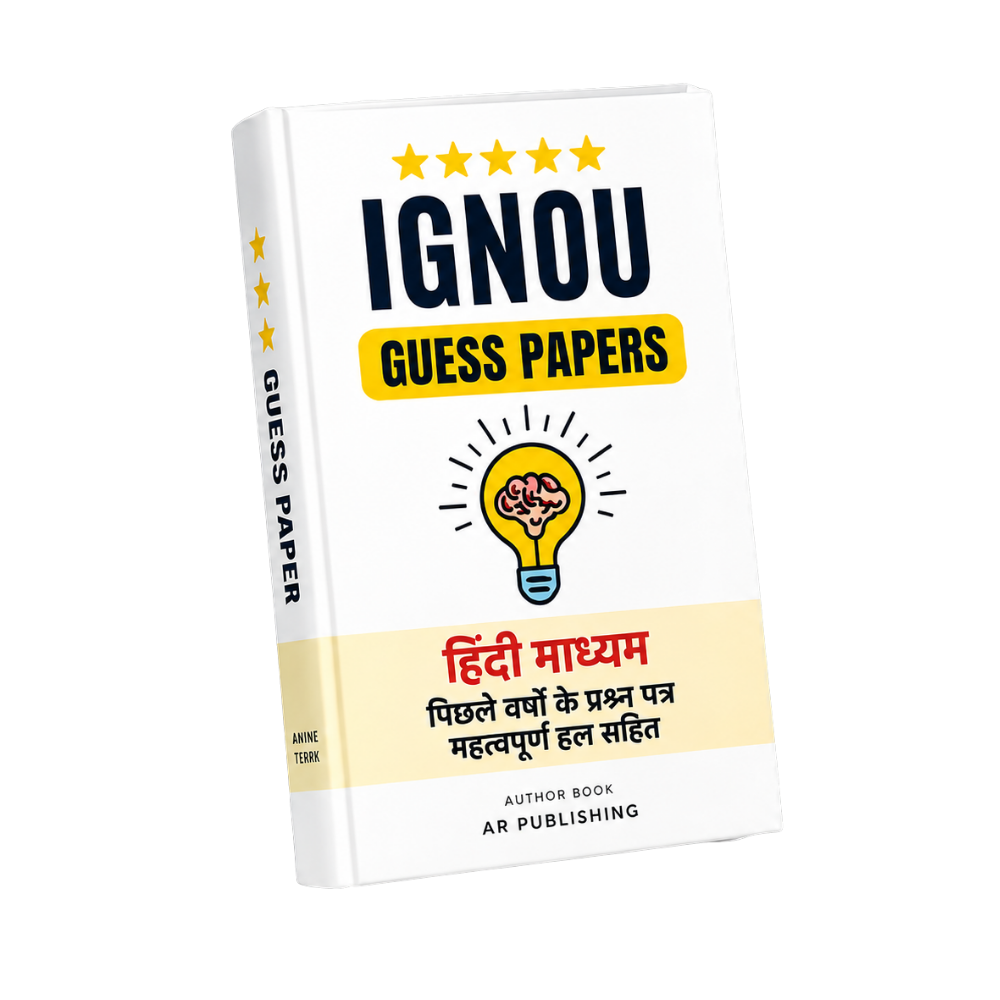
MHI-03 IGNOU Guess Paper 2026-27
Click to view offer details & terms
Get 10% OFF Instant Discount
Apply this coupon code at checkout to claim your academic discount instantly.
- Applicable on all university study materials
- Valid for up to 8 item(s) per order
- Valid till Oct 31, 2026
Frequently Bought Together
Popular course materials frequently ordered together
Syllabus & Overview
MHI-03 Historiography Guess Paper for Term-End Exam (TEE)
This structured guess paper aligns with IGNOU’s official MHI-03 syllabus, incorporating trends from the last five years of June and December TEE sessions. It prioritizes high-yield topics, question weightage, and time management strategies for a 3-hour exam.
Key Syllabus Blocks & Focus Areas
- Block-4: Approaches to History in Modern Times-I
- Critical evaluation of Ranajit Guha’s Subaltern Studies and its impact on subaltern historiography.
- Analysis of Marxist and post-colonial approaches in Indian historiography (e.g., Dipesh Chakrabarty’s Provincializing Europe).
- Comparison of Annales School and structuralist methodologies in historical analysis.
- Block-6: Approaches and Themes in Indian Historiography-I
- Role of oral traditions and folk memory in reconstructing pre-modern Indian history.
- Assessment of colonial historiography vs. indigenous perspectives (e.g., works of R.C. Majumdar vs. modern revisionists).
- Case studies on regional historiography (e.g., Tamil Nadu’s Sangam literature vs. Mughal chronicles).
- Block-1: Understanding History
- Definitions and epistemological foundations of historiography (e.g., Marc Bloch’s Apologie pour l’Histoire).
- Sources of history: Primary vs. secondary sources, their reliability, and limitations.
- Block-5: Approaches to History in Modern Times-II
- Post-colonial critiques of Indian historiography (e.g., Gayatri Spivak’s Can the Subaltern Speak?).
- Gender and caste in historical narratives (e.g., studies on sati, widow remarriage, and Dalit historiography).
Chapter-Wise Question Weightage (Approximate)
- Blocks 4 & 6: 35% (Essay-type questions on theoretical frameworks and case studies).
- Blocks 1 & 5: 25% (Short-answer questions on definitions, methodologies, and critiques).
- Objective-type questions (MCQs, match-the-following): 20% (Focus on authors, theories, and key dates).
- Source-based questions: 20% (Analysis of excerpts from primary texts like Akbarnama or colonial reports).
3-Hour Exam Time Management Tips
- Allocate 45 minutes for reading the question paper and planning answers (prioritize high-weightage blocks like 4 and 6).
- For essay questions (20 marks), spend 25-30 minutes per answer, ensuring structured arguments with examples from syllabus-relevant texts.
- Attempt short-answer questions (10-12 marks each) in 10-15 minutes—focus on concise yet precise definitions and analyses.
- Save 15-20 minutes for objective-type questions; use elimination techniques for MCQs.
- Leave 5 minutes for review—check for factual errors and ensure logical flow in answers.
Subject-Specific FAQs
- Q: Are there recurring themes in MHI-03 TEE papers?
A: Yes. Themes like colonial vs. indigenous historiography, subaltern agency, and epistemological debates (e.g., truth vs. narrative) frequently appear. Prioritize Blocks 4 and 6 for these.
- Q: How should I approach source-based questions?
A: For source analysis (common in Blocks 1 and 5), identify the author’s intent, historical context, and bias or limitations. Compare with other sources mentioned in the syllabus (e.g., compare a Mughal chronicle with a Portuguese travelogue).
Sample Question Patterns (Based on Previous Papers)
- Block-4 Example: “Evaluate the contributions of the Annales School to the study of long-duration history, with reference to its application in Indian historiography.”
- Block-6 Example: “How did colonial administrators shape Indian historiography? Discuss with examples from administrative records and indigenous responses.”
- Objective-Type Example: Match the following theorists with their key works:
- Ranajit Guha A Rule of Property for Bengal
- Dipesh Chakrabarty Provincializing Europe
- Sugata Bose Cobras and Kings
Why buy from us?
-
Verified by top professors and 99th percentile students.
-
Always updated to the latest university curriculum.
-
High-quality, printable PDF formats with clear diagrams.
License & Terms
By purchasing this item, you agree to our standard academic license terms. You may use this product for personal study, but you may not resell or redistribute the files online.