

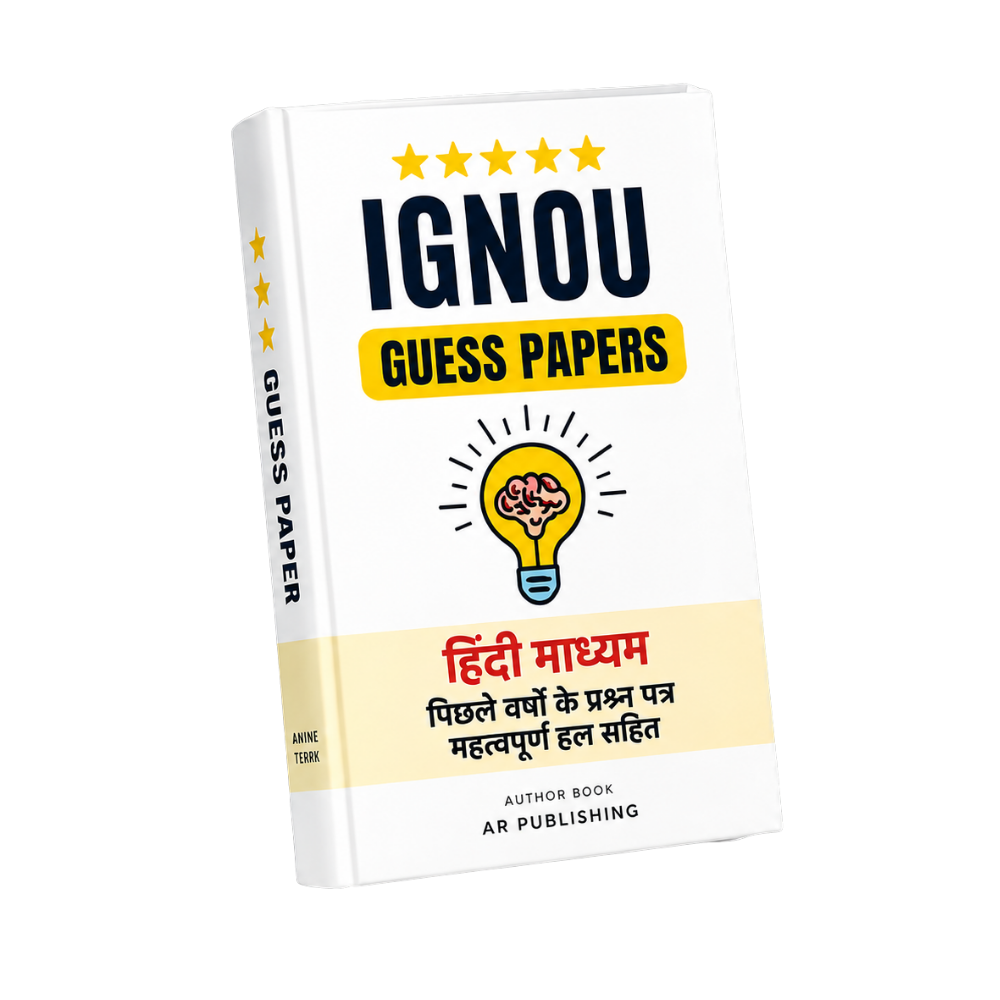
MHI-06 IGNOU Guess Paper 2026-27
Click to view offer details & terms
Get 10% OFF Instant Discount
Apply this coupon code at checkout to claim your academic discount instantly.
- Applicable on all university study materials
- Valid for up to 8 item(s) per order
- Valid till Oct 31, 2026
Frequently Bought Together
Popular course materials frequently ordered together
Syllabus & Overview
Course Scope and Syllabus Overview
MHI-06: Evolution of Social Structures in India through the Ages is a core course under the Master of Arts (History) (MAH) program, designed to explore the dynamic transformations in Indian societal formations from ancient to modern eras. This course, aligned with IGNOU’s CBCS curriculum, examines archaeological, anthropological, and historical evidence to trace the evolution of kinship systems, caste hierarchies, economic structures, and political institutions. Students analyze primary sources, theoretical frameworks, and regional variations to contextualize India’s social evolution within broader global historical trends. The curriculum emphasizes critical engagement with archaeological findings (e.g., Harappan urbanism) and textual records (e.g., Manusmriti, Ain-i-Akbari) to understand continuity and change across millennia.Key Syllabus Units and Topics
- Block-2: Cultures in Transition: Focuses on the transition from Indus Valley Civilization to Vedic societies, examining shifts in kinship structures, ritual practices, and the emergence of early Brahminical ideologies. Key topics include the role of the varna system in Vedic texts and the archaeological evidence of early urban centers.
- Block-3: Early Historic Societies (6th–4th Century A.D.): Analyzes the socio-political landscape during the Maurya and post-Maurya periods, with emphasis on Ashokan edicts, the growth of guilds (srenis), and the impact of Buddhism and Jainism on social stratification.
- Block-4: Early Medieval Societies: Covers the Gupta Empire’s socio-economic transformations, including the rise of agrarian communities, the manor system, and the codification of caste norms in texts like the Brihat Samhita. Regional variations in South India and North-East are also examined.
- Block-6: Society on the Eve of Colonialism: Investigates the socio-cultural milieu during the Mughal and Rajput eras, highlighting the zabti system, the jagirdari economy, and the role of Sufi and Bhakti movements in challenging hierarchical norms.
- Block-8: Social Questions Under Colonialism: Explores the impact of British colonial policies on Indian society, including the permanent settlement system, the land revenue reforms, and the emergence of early nationalist critiques of caste and gender hierarchies.
Frequently Asked Questions
Q: What is the marking scheme for MHI-06’s Term-End Examination (TEE), and how are internal assessments weighted?
A: The TEE for MHI-06 carries 100 marks, divided into two sections: Section A (20 marks) with short-answer questions, and Section B (80 marks) featuring long-answer questions. Internal assignments (e.g., Tutor Marked Assignments) contribute 20 marks to the final grade, requiring submission of two assignments worth 10 marks each.
Q: Which units in MHI-06’s syllabus have the highest frequency of repeated questions in past TEE papers?
A: Blocks 3 (Early Historic Societies) and 6 (Society on the Eve of Colonialism) consistently feature repeated questions, particularly on Ashokan administration, the zabti system, and the socio-economic impact of Mughal policies. Focus on case studies (e.g., Taxila, Bengal under Mughals) and theoretical debates (e.g., sangam literature vs. Brahminical texts) for high-yield preparation.
Why buy from us?
-
Verified by top professors and 99th percentile students.
-
Always updated to the latest university curriculum.
-
High-quality, printable PDF formats with clear diagrams.
License & Terms
By purchasing this item, you agree to our standard academic license terms. You may use this product for personal study, but you may not resell or redistribute the files online.