

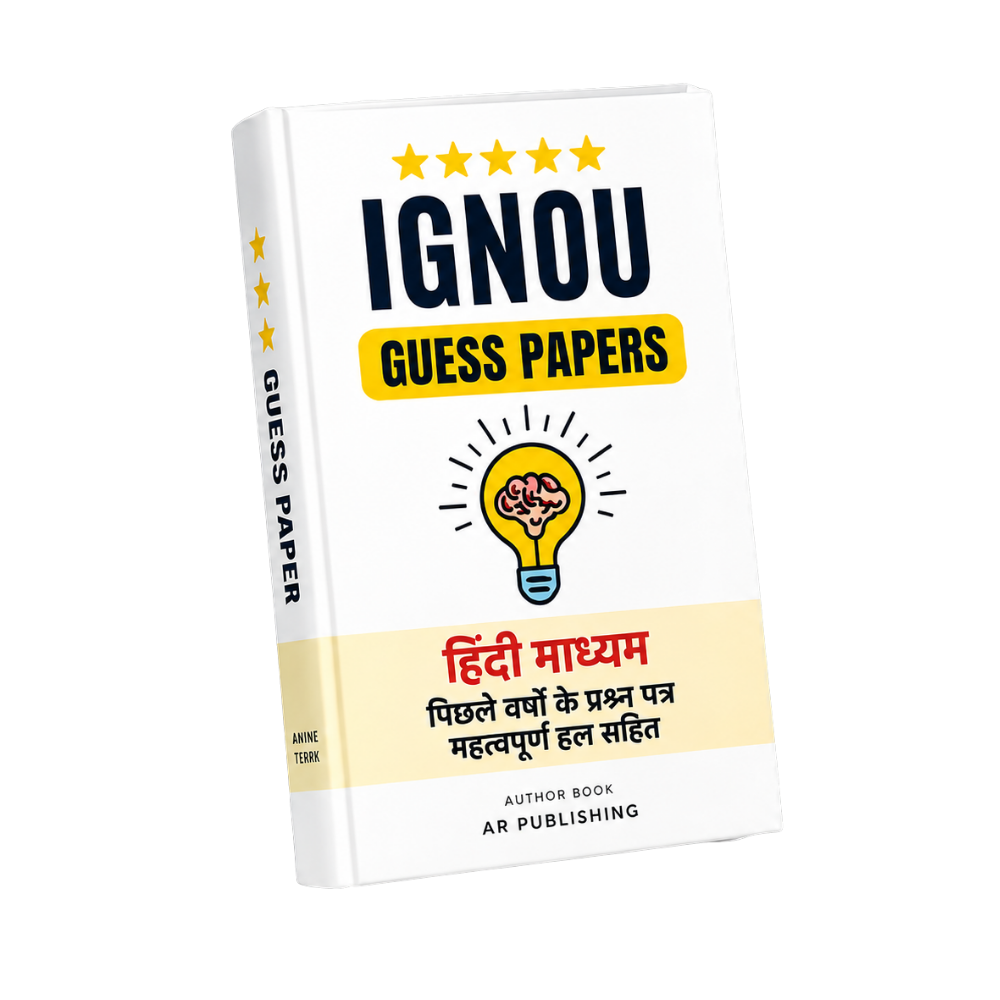
MHI-08 IGNOU Guess Paper 2026-27
Click to view offer details & terms
Get 10% OFF Instant Discount
Apply this coupon code at checkout to claim your academic discount instantly.
- Applicable on all university study materials
- Valid for up to 8 item(s) per order
- Valid till Oct 31, 2026
Frequently Bought Together
Popular course materials frequently ordered together
Syllabus & Overview
MHI-08 Guess Paper: History of Ecology and Environment India (Term-End Exam Focus)
The following structured breakdown aligns with the official IGNOU MHI-08 syllabus and previous year TEE patterns (June/Dec sessions). Prioritize these blocks for maximum scoring, with a 3-hour time management strategy included.
Key Blocks & Weightage (2026-27 Pattern)
- Block-1: Studying Ecology & Environment An Introduction
- Focus on definitions of ecology (Tansley vs. modern ecological systems) 10% weightage.
- Expect 1-2 short-answer questions (SAQs) on environmental history methodologies (e.g., oral histories, archaeological evidence).
- Solved TEE Insight: Previous papers often linked this block to Block-5 (Indian Philosophy) for comparative analysis.
- Block-3: Environment and Agricultural Societies
- Primary focus: Harappan civilization’s water management (Indus Valley cities, floodplain irrigation) 25% weightage.
- Case studies on medieval agricultural revolutions (e.g., Champa rice cultivation in Bengal) 15%.
- FAQ: Why is the Harappan water system considered a precursor to modern ecological planning? Answer: Their grid-based drainage systems and flood control mechanisms were adaptable to monsoon variability, a topic often tested in 5-mark questions.
- Block-6: Colonialism and Environment
- Critical theme: Deforestation under British rule (e.g., Chota Nagpur plateau, Assam tea plantations) 20% weightage.
- Compare forest laws (1878) with indigenous land-use practices (e.g., Adivasi shifting cultivation).
- Exam Tip: Use primary sources from IGNOU’s Reader for MHI-08 (e.g., extracts from Forest Reports, 1880s) for 20-mark essays.
- Block-7: Modern Concerns
- Focus areas: Green Revolution impacts (Punjab vs. Odisha case studies) and Chipko Movement (1970s) 15% weightage.
- Link to contemporary issues: urbanization and mangrove degradation (Sundarbans, Mumbai).
- FAQ: How did the Chipko Movement challenge colonial environmental policies? Answer: It revived pre-colonial communal forest management practices, directly opposing the British absolute ownership doctrine.
Time Management for 3-Hour Exam
- Section A (20 marks): Answer all 10 SAQs (2 marks each) in 30 minutes. Prioritize Blocks 1 and 3 for quick points.
- Section B (40 marks):
- Attempt one 10-mark question from Blocks 6 or 7 (essay format).
- For the 20-mark question, choose Harappan water systems (Block 3) or colonial deforestation (Block 6)—both have high repeatability.
- Section C (40 marks): Allocate 1 hour 30 minutes to the 30-mark essay (e.g., ‘Evaluate the role of Indian philosophy in sustainable resource use’—link Block-5 with Block-7).
Sample High-Scoring Topics from Previous Papers
- Block-5 (Indian Philosophy):
- Analyze Chandogya Upanishad’s forest symbolism vs. Arthashastra’s state-controlled resource policies.
- Compare Vedantic ahimsa with Jain ecology (ahinsā as environmental ethics).
- Block-4 (Appropriation of Environment):
- Discuss pastoral nomadism in Rajasthan and its conflict with colonial grazing bans.
- Case study: Kulu-Manali’s glacial retreat and Himalayan ecology (link to modern concerns).
Why buy from us?
-
Verified by top professors and 99th percentile students.
-
Always updated to the latest university curriculum.
-
High-quality, printable PDF formats with clear diagrams.
License & Terms
By purchasing this item, you agree to our standard academic license terms. You may use this product for personal study, but you may not resell or redistribute the files online.