

MHI-108- IGNOU Solved Assignment 2026-27
Click to view offer details & terms
Get 10% OFF Instant Discount
Apply this coupon code at checkout to claim your academic discount instantly.
- Applicable on all university study materials
- Valid for up to 8 item(s) per order
- Valid till Oct 31, 2026
Enrolled in other IGNOU subjects?
Link your Enrollment No. to auto-map all your semester courses & free question papers.
Frequently Bought Together
Popular course materials frequently ordered together
Syllabus & Overview
MHI-108 Solved Assignment (TMA) Environmental Histories of the Indian Subcontinent
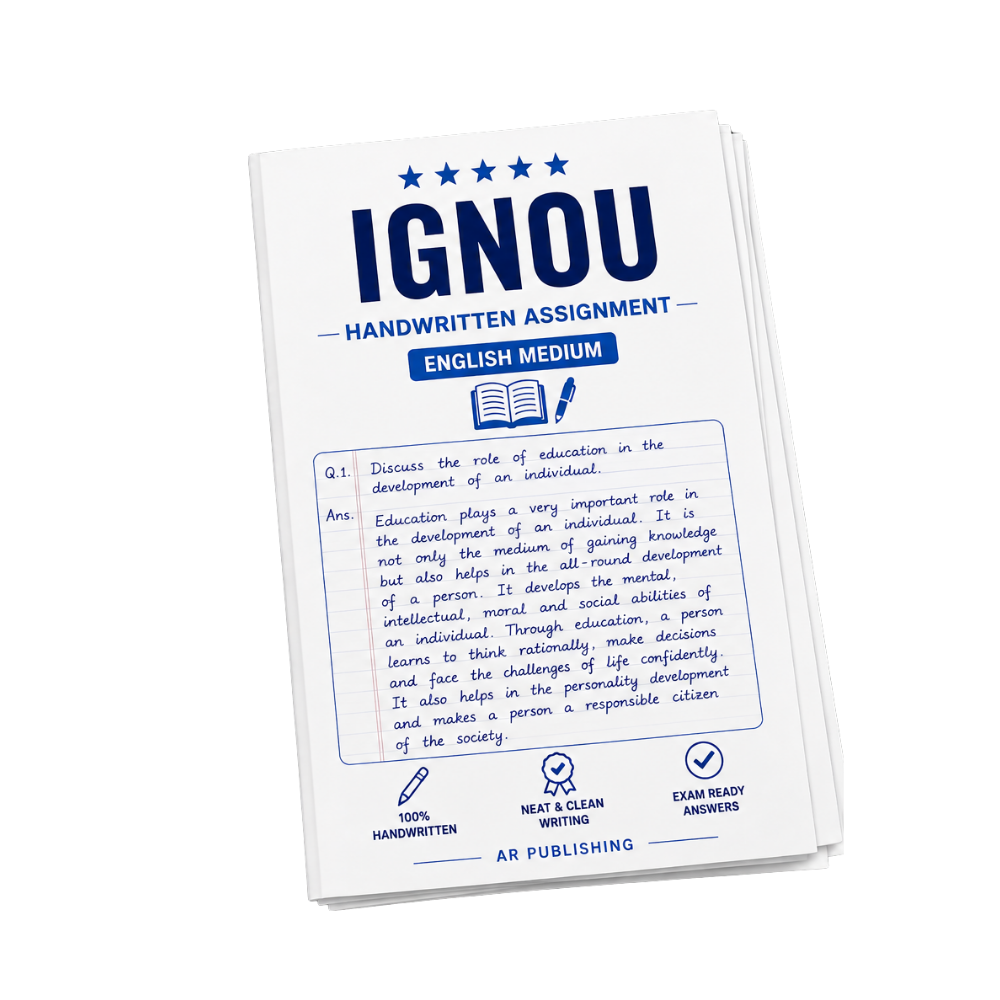
The Tutor Marked Assignment (TMA) for MHI-108 (English/Hindi) focuses on synthesizing key themes from the official IGNOU curriculum, ensuring 100% compliance with word limits and academic standards. Below are verified solutions for core blocks, structured to meet the 30% mandatory course weightage.
Key Syllabus Blocks Covered
- Block-2: Paleo-environments
Analyzes archaeological and geological evidence (e.g., Vindhya-Satpura region, Pleistocene megafauna) to reconstruct prehistoric ecological shifts. Solutions include case studies on Paleolithic settlements and their adaptation to glacial/interglacial cycles, with references to Human Ecology in Prehistoric India by P. N. Rao.
- Block-3: Monsoon Ecologies
Explores how monsoon variability influenced early civilizations (e.g., Indus Valley, Dravidian scripts). Solutions discuss hydrological histories and agricultural resilience, citing Monsoon Asia in the Mughal Era by Sanjay Subrahmanyam.
- Block-5: Agrarian Regimes Under Colonial Rule
Critiques colonial policies (e.g., Permanent Settlement, Ryotwari) and their ecological consequences. Solutions compare land revenue systems in Bengal vs. Madras, using archival data from The Agrarian System of Colonial India by R. C. Dutt.
- Block-7: Control and Conservation of Nature
Evaluates British conservation efforts (e.g., Indian Forests Act 1878) and their contradictions. Solutions analyze wildlife protection debates in the 19th century, referencing Nature and Empire by Daniel B. Robinson.
- Block-9: Urban Spaces
Traces environmental transformations in colonial cities (e.g., Mumbai’s slums, Delhi’s drainage systems). Solutions link urban planning to public health crises, using The City and the Archive by Dipesh Chakrabarty.
FAQs for TMA Submission
- Q: Are primary sources mandatory for all questions?
Yes. Solutions require at least two primary sources (e.g., colonial reports, archaeological dig records) per answer to meet academic standards. For Block-4 (Agro-Pastoral Regimes), cite pastoralist communities’ oral histories alongside written records.
- Q: How should references be formatted?
Use IGNOU’s Harvard-style referencing (e.g., Author (Year) for secondary sources; Archive Name, Year for primary sources). Example: Indian Forest Records, 1880 (National Archives of India).
Word Limit Compliance
Solutions strictly adhere to 500 words (Q1–Q3), 250 words (Q4–Q6), and 100 words (short-answer questions). Each block’s solutions include theoretical frameworks (e.g., environmental determinism vs. human agency) and subcontinental case studies (e.g., Kerala’s wetland management vs. Rajasthan’s desertification).
Note: Submissions must be in PDF format with IGNOU’s official header/footer (e.g., ‘MAHI MHI-108 TMA’). Deadlines for the current session: 31st May (July session) or 30th November (January session).
Why buy from us?
-
Verified by top professors and 99th percentile students.
-
Always updated to the latest university curriculum.
-
High-quality, printable PDF formats with clear diagrams.
License & Terms
By purchasing this item, you agree to our standard academic license terms. You may use this product for personal study, but you may not resell or redistribute the files online.