

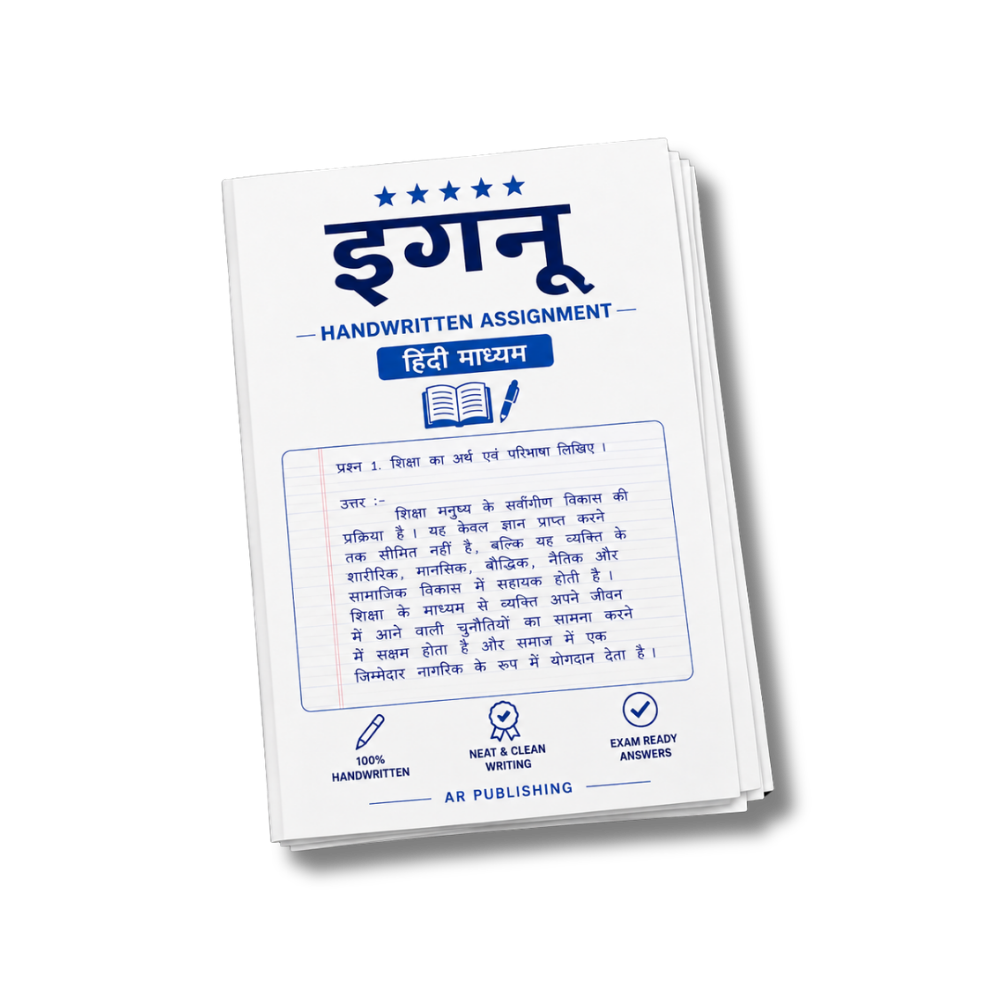
MHI-110- IGNOU Handwritten Assignment 2026-27
Click to view offer details & terms
Get 10% OFF Instant Discount
Apply this coupon code at checkout to claim your academic discount instantly.
- Applicable on all university study materials
- Valid for up to 8 item(s) per order
- Valid till Oct 31, 2026
Enrolled in other IGNOU subjects?
Link your Enrollment No. to auto-map all your semester courses & free question papers.
Frequently Bought Together
Popular course materials frequently ordered together
Syllabus & Overview
Course Scope and Academic Rigour of MHI-110: Urbanisation in India-1 (From the Earliest Times to c.1300)
MHI-110 is a foundational course within IGNOU’s Master of Arts (History) programme, designed to critically examine the evolution of urban centres in the Indian subcontinent from prehistoric settlements to the early medieval period. This course integrates archaeological evidence, epigraphic records, and textual sources to analyse the socio-economic and cultural dynamics shaping early Indian cities. Students engage with primary data—ranging from Indus Valley urban planning to the urban networks of the Gupta and Chalukya eras—to develop a nuanced understanding of how urbanisation influenced political hierarchies, trade networks, and religious practices. The curriculum adheres to the School of Social Sciences’ CBCS framework, ensuring alignment with contemporary historiographical debates while fostering analytical skills essential for advanced historical research.Core Syllabus Units and Thematic Focus
- Block-1: Introduction to Urban History: This foundational block explores methodological frameworks for studying urbanisation, distinguishing between settlement patterns, administrative structures, and cultural artefacts. It critically evaluates theoretical models like the "urban revolution" thesis and contextualises them within South Asian archaeological contexts.
- Block-2: The Earliest Cities in the Subcontinent: A deep dive into the Indus Valley Civilisation, analysing urban infrastructure (e.g., Mohenjo-Daro’s drainage systems), socio-economic stratification, and the decline theories rooted in archaeological stratigraphy and textual references.
- Block-3: Early Historic Cities: North India: Examines major urban centres like Pataliputra, Taxila, and Ujjain, tracing their roles in trade (e.g., Silk Road connections), political centralisation under Mauryan and Kushan dynasties, and the integration of Buddhist monastic complexes into urban landscapes.
- Block-4: Early Historic Cities: Deccan and South India: Focuses on the urbanisation of regions like the Deccan Plateau and Tamil Nadu, highlighting the rise of Chalukyan cities (e.g., Badami) and the Dravidian temple towns (e.g., Mahabalipuram), with emphasis on their architectural innovations and maritime trade networks.
- Block-5: Patterns of Early Medieval Urbanisation: Investigates the transition to medieval urban forms, analysing the growth of towns like Kannauj and Thanjavur, the impact of religious pilgrimage centres, and the evolving role of guilds in urban governance during the 7th–13th centuries.
Frequently Asked Questions
Q: What is the weightage of assignments in the MHI-110 final examination, and how many assignments are typically assigned?
A: Assignments contribute 30% to the total marks for MHI-110, with a total of four assignments (each worth 7.5%) distributed across the course blocks. Students must submit all assignments to qualify for examination; late submissions are penalised as per IGNOU’s academic regulations.
Q: Are there recommended reference books for MHI-110 beyond the course material, and should they be prioritised for exam preparation?
A: While the course material (Block Notes and Study Guides) is mandatory, supplementary references like The Indus Civilisation (R.S. Sharma) for Block-2 or Medieval Indian Urbanisation (Rajeshwari Pandey) for Block-5 can enhance understanding. However, exam preparation should primarily rely on the prescribed syllabus and solved assignment samples provided by IGNOU.
Why buy from us?
-
Verified by top professors and 99th percentile students.
-
Always updated to the latest university curriculum.
-
High-quality, printable PDF formats with clear diagrams.
License & Terms
By purchasing this item, you agree to our standard academic license terms. You may use this product for personal study, but you may not resell or redistribute the files online.