

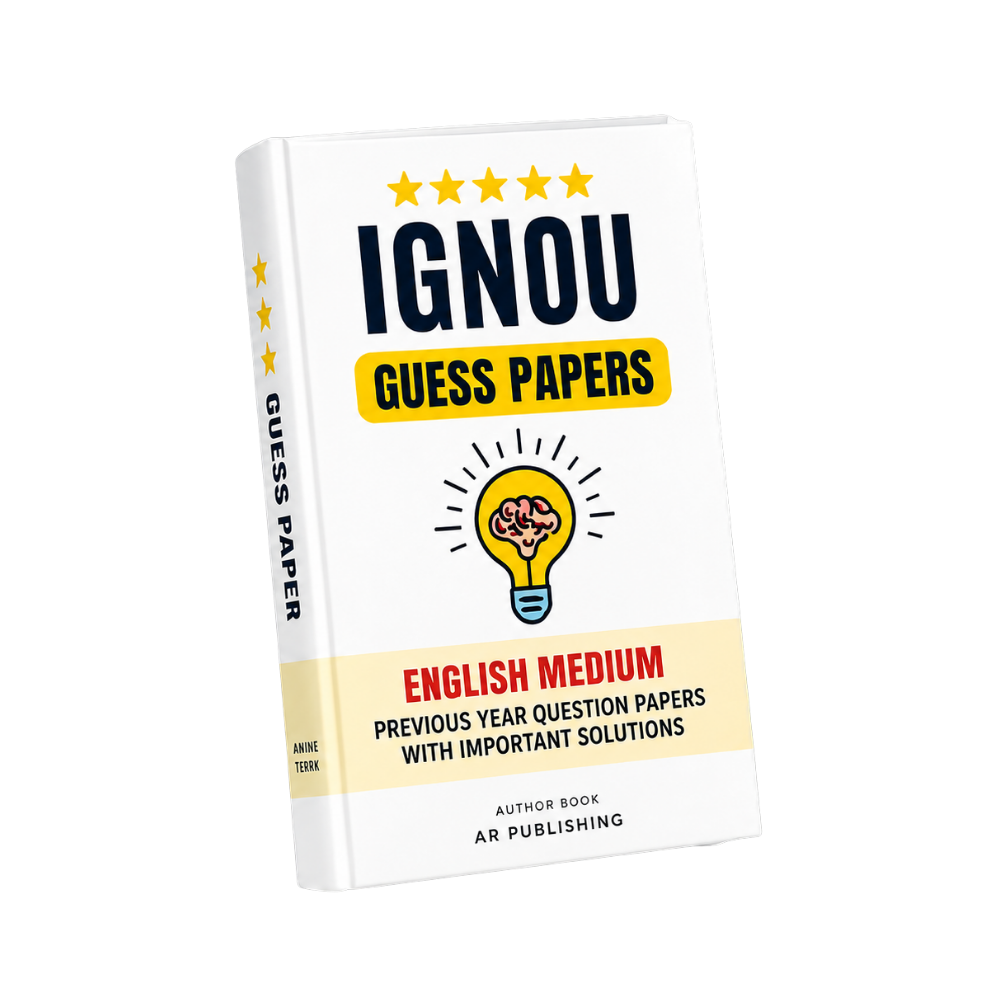
MHI-3 IGNOU Guess Paper 2026-27
Click to view offer details & terms
Get 10% OFF Instant Discount
Apply this coupon code at checkout to claim your academic discount instantly.
- Applicable on all university study materials
- Valid for up to 8 item(s) per order
- Valid till Oct 31, 2026
Enrolled in other IGNOU subjects?
Link your Enrollment No. to auto-map all your semester courses & free question papers.
Frequently Bought Together
Popular course materials frequently ordered together
Syllabus & Overview
MHI-3 IGNOU Guess Paper: Term-End Exam (TEE) Preparation Guide
This structured guess paper for MHI-3 (Master’s in History) is designed to align with the official IGNOU curriculum, focusing on high-weightage topics from previous years' TEE papers (June/Dec sessions). It includes chapter-wise breakdowns, exam time management tips, and subject-specific FAQs for optimal preparation.
Key Syllabus Units for MHI-3 (Term-End Exam Focus)
- Unit 1: Medieval Indian Society and Culture
- Social structure, caste system, and religious syncretism (e.g., Bhakti and Sufi movements).
- Key figures: Chaitanya, Kabir, Nanak, and their contributions to cultural synthesis.
- Previous year questions often test understanding of caste dynamics and regional variations.
- Unit 2: Political and Administrative Systems
- Centralized vs. decentralized governance (e.g., Delhi Sultanate vs. Vijayanagara Empire).
- Role of military commanders (e.g., Nizam-ul-Mulk, Todar Mal) and their policies.
- Focus on administrative reforms and their impact on regional economies.
- Unit 3: Economic Conditions
- Agrarian practices, trade networks (e.g., Silk Route, Deccan trade), and taxation systems.
- Previous years emphasized case studies like the Chola dynasty’s economic policies.
- Compare pre-Mughal and Mughal economic strategies (e.g., land revenue systems).
- Unit 4: Cultural Developments
- Literature (e.g., Amir Khusro, Tulsidas), architecture (e.g., Qutub Minar, Vijayanagara temples), and arts.
- IGNOU often tests cross-referencing cultural developments with political events.
- Highlight regional variations (e.g., Maratha vs. Rajput cultural contributions).
- Unit 5: Regional Histories
- Focus on Vijayanagara, Bahmani Sultanate, and Maratha Confederacy (e.g., Shivaji’s administrative innovations).
- Previous years included map-based questions on regional power dynamics.
- Analyze how regional histories influenced pan-Indian political narratives.
Exam Time Management Tips (3-Hour Strategy)
- Allocate 45 minutes for reading questions and planning answers (prioritize high-weightage units).
- For short-answer questions (20 marks), focus on Units 1, 2, and 5 (society, politics, and regional histories).
- Allocate 1 hour for long-answer questions (30 marks), prioritizing Units 3 and 4 (economics and culture).
- Use bullet points for clarity in descriptive answers (IGNOU prefers structured responses).
- Leave 15 minutes for review—check for factual errors and coherence.
Subject-Specific FAQs
- Q: Are case studies from previous years still relevant?
A: Yes. IGNOU often repeats case studies (e.g., Chola administration, Maratha military tactics) with slight variations. Review solved papers for patterns.
- Q: How to score well in comparative questions?
Use a Venn diagram format to highlight similarities/differences (e.g., compare Delhi Sultanate and Mughal land revenue systems).
Chapter-Wise Question Weightage (Based on Past Papers)
- Society and Culture (Unit 1): 25% (Short + Long answers)
- Political Systems (Unit 2): 20% (Focus on administrative reforms)
- Economic Conditions (Unit 3): 20% (Trade, taxation, agrarian systems)
- Cultural Developments (Unit 4): 15% (Literature, arts, regional variations)
- Regional Histories (Unit 5): 20% (Vijayanagara, Marathas, Bahmani Sultanate)
Why buy from us?
-
Verified by top professors and 99th percentile students.
-
Always updated to the latest university curriculum.
-
High-quality, printable PDF formats with clear diagrams.
License & Terms
By purchasing this item, you agree to our standard academic license terms. You may use this product for personal study, but you may not resell or redistribute the files online.