

MHN-006 IGNOU Solved Assignment 2026-27
Click to view offer details & terms
Get 10% OFF Instant Discount
Apply this coupon code at checkout to claim your academic discount instantly.
- Applicable on all university study materials
- Valid for up to 8 item(s) per order
- Valid till Oct 31, 2026
Enrolled in other IGNOU subjects?
Link your Enrollment No. to auto-map all your semester courses & free question papers.
Frequently Bought Together
Popular course materials frequently ordered together
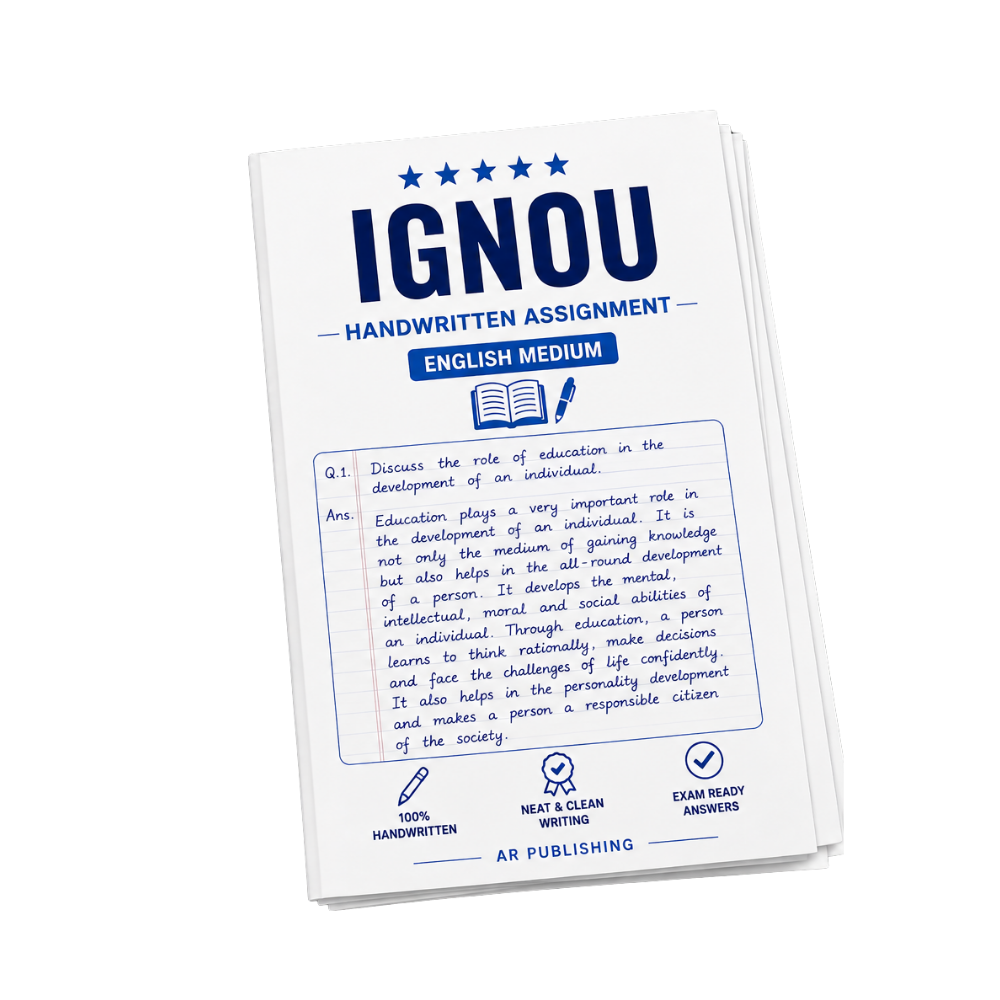
Syllabus & Overview
Exploring the Foundations of Sanskrit Language and Literature in IGNOU’s MAHN Curriculum
MHN-006: serves as the cornerstone for students pursuing the M.A. in Hindu Studies under IGNOU’s School of Humanities. This course meticulously bridges the gap between modern academic frameworks and the timeless richness of Sanskrit, offering a structured introduction to its linguistic intricacies and literary traditions. Through critical analysis of classical texts, phonetic evolution, and grammatical frameworks, students develop a nuanced understanding of Sanskrit’s role as both a linguistic artifact and a cultural legacy. The curriculum aligns with IGNOU’s CBCS guidelines, ensuring alignment with contemporary scholarly discourse while preserving the authenticity of traditional scholarship.Core Syllabus Units and Key Topics
- Unit 1: Introduction to Sanskrit Language and Its Historical Development: This unit examines the origins of Sanskrit, its classification within Indo-European languages, and its phonetic and morphological evolution from Vedic to Classical periods, emphasizing primary sources like the Pāṇiniya Dīpikā and Aṣṭādhyāyī.
- Unit 2: Sanskrit Grammar and Syntax: A rigorous exploration of Pāṇinian grammar, including sandhi (phonetic assimilation), sandhi-vivaraṇa (phonetic rules), and the intricacies of verb conjugation, with practical exercises to reinforce theoretical constructs.
- Unit 3: Literary Forms and Genres in Sanskrit: Analysis of major literary genres—kāvya (poetry), nāṭaka (drama), and kathā (prose)—through case studies of works like Kālidāsa’s Meghadūta and Bāṇabhaṭṭa’s Hārṣacarita, highlighting thematic and stylistic innovations.
- Unit 4: Sanskrit Dictionaries and Lexicography: A critical survey of foundational dictionaries (Amara-Kośa, Rajatarangini) and their methodologies, alongside modern lexicographical challenges in preserving and translating Sanskrit terminology.
- Unit 5: Sanskrit in Contemporary Scholarship and Digital Humanities: Examination of digital tools (e.g., Sanskrit Concordance Project) and their role in revitalizing Sanskrit studies, alongside debates on its relevance in modern academic and cultural contexts.
Frequently Asked Questions
Q: What is the word count requirement for Section B of the TMA in MHN-006, and how does it differ from Section A?
A: Section B of the TMA requires concise answers totaling 250 words (split across two questions), while Section A demands 500 words for each of the two essay-type questions, adhering strictly to IGNOU’s 2026–27 submission guidelines.
Q: Are there any specific marking criteria for the TMA in MHN-006, particularly regarding linguistic accuracy or adherence to Sanskrit conventions?
A: The TMA is evaluated on clarity, accuracy of Sanskrit terminology, logical flow, and adherence to prescribed word counts, with up to 10% weightage allocated to proper use of grammatical structures and lexicon as per the Aṣṭādhyāyī framework.
Why buy from us?
-
Verified by top professors and 99th percentile students.
-
Always updated to the latest university curriculum.
-
High-quality, printable PDF formats with clear diagrams.
License & Terms
By purchasing this item, you agree to our standard academic license terms. You may use this product for personal study, but you may not resell or redistribute the files online.