

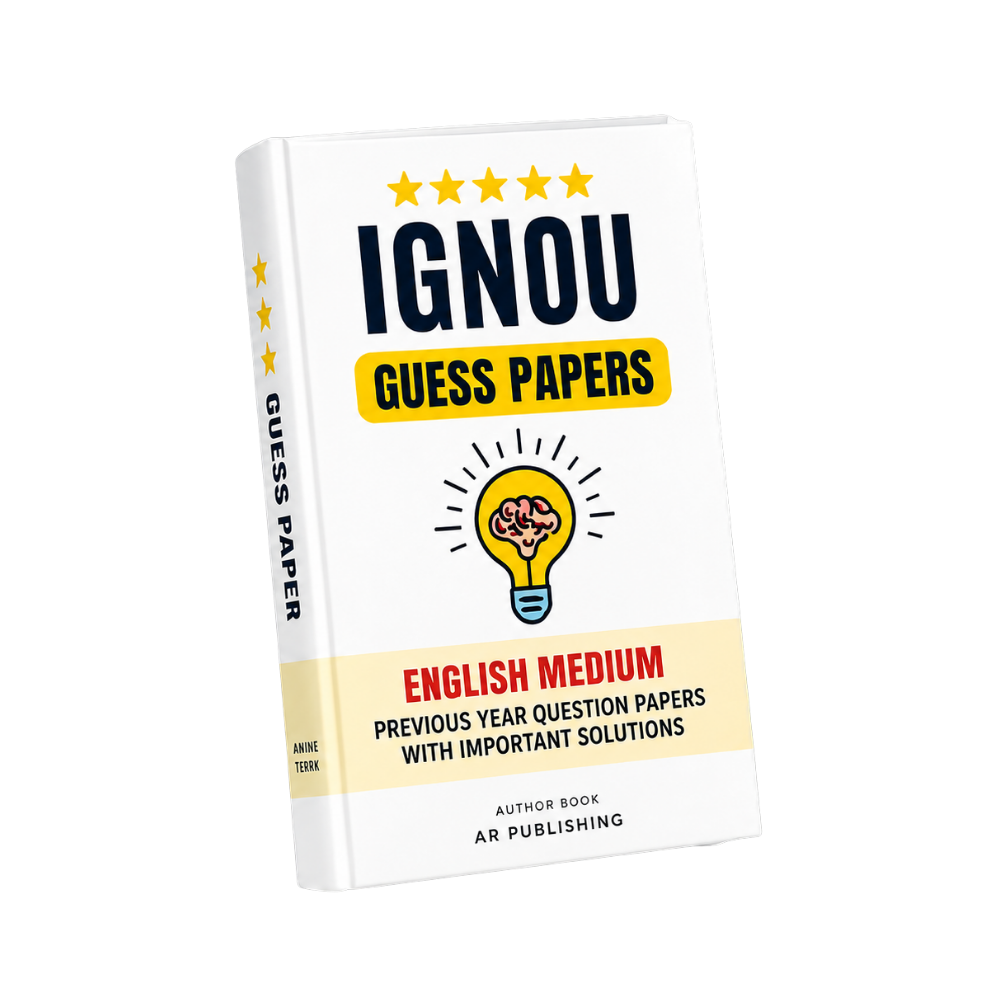
MJM-026 IGNOU Guess Paper 2026-27
Click to view offer details & terms
Get 10% OFF Instant Discount
Apply this coupon code at checkout to claim your academic discount instantly.
- Applicable on all university study materials
- Valid for up to 8 item(s) per order
- Valid till Oct 31, 2026
Enrolled in other IGNOU subjects?
Link your Enrollment No. to auto-map all your semester courses & free question papers.
Frequently Bought Together
Popular course materials frequently ordered together
Syllabus & Overview
MJM-026 Print Media Guess Paper (Digital PDF) for Term-End Exam (TEE)
This structured guess paper reflects the official IGNOU curriculum for MJM-026 Print Media (MAJMC English), incorporating solved previous year questions (5-10 years) and exam patterns. It emphasizes scoring topics, chapter-wise weightage, and time management strategies for a 3-hour exam.
Key Syllabus Blocks & Focus Areas
- Block-1: Specialised Reporting
- In-depth feature writing techniques (e.g., investigative, human-interest, and profile pieces).
- Case studies on ethical dilemmas in reporting (e.g., source confidentiality, bias, and accuracy).
- Previous year emphasis: 25-30% of questions from this block (e.g., 2022 June TEE: 3 questions on investigative reporting).
- Block-2: Development Journalism
- Coverage of sustainable development goals (SDGs) in print media (e.g., rural development, poverty alleviation).
- Analytical writing on government schemes and their media portrayal (e.g., Swachh Bharat Abhiyan, Beti Bachao Beti Padhao).
- Weightage: 20-25% (e.g., 2021 Dec TEE: 2 questions on SDG reporting).
- Block-3: Specialised Writing
- Technical writing for print media (e.g., editorials, reviews, and opinion pieces).
- Style and structure of print journalism (e.g., AP style vs. Reuters style, headline writing).
- Pattern: 15-20% (e.g., 2023 June TEE: 2 questions on editorial crafting).
- Block-4: Digital Technology in Print Media
- Integration of digital tools in print journalism (e.g., data journalism, multimedia storytelling).
- Impact of AI and automation on print media workflows (e.g., fact-checking tools, SEO optimization).
- Focus area: 15-20% (e.g., 2022 Dec TEE: 2 questions on digital ethics).
Exam Time Management Tips (3-Hour Strategy)
- Allocate 45 minutes for reading the question paper and planning answers (prioritize high-weightage blocks).
- Divide time equally for 3-4 questions (e.g., 45 minutes per question for 20 marks each).
- For descriptive answers, use bullet points for clarity (e.g., in Block-2, list SDG examples with brief explanations).
- Avoid lengthy introductions; jump directly to key points (e.g., in Block-1, focus on investigative techniques over background theory).
Subject-Specific FAQs
- Q: How do I differentiate between investigative reporting and feature writing in Block-1?
A: Investigative reporting involves fact-based, in-depth research (e.g., exposing corruption), while feature writing focuses on narrative storytelling (e.g., human-interest profiles). Use case studies from past exams (e.g., 2021 June TEE) to practice distinctions.
- Q: Are there specific government resources for Block-2 (Development Journalism)?
Yes. Refer to NITI Aayog reports, Ministry of Rural Development publications, and UN SDG indicators for data-driven answers. Past papers often quote these sources (e.g., 2020 Dec TEE).
Previous Year Question Patterns (June & Dec Sessions)
- Block-1 (Specialised Reporting): 3-4 questions (20 marks each) on techniques, ethics, and case studies.
- Block-2 (Development Journalism): 2-3 questions (15-20 marks) on SDGs, government schemes, and media portrayal.
- Block-3 (Specialised Writing): 2 questions (15 marks) on editorials, reviews, or style guidelines.
- Block-4 (Digital Technology): 2 questions (15 marks) on tools, ethics, or multimedia integration.
Why buy from us?
-
Verified by top professors and 99th percentile students.
-
Always updated to the latest university curriculum.
-
High-quality, printable PDF formats with clear diagrams.
License & Terms
By purchasing this item, you agree to our standard academic license terms. You may use this product for personal study, but you may not resell or redistribute the files online.