

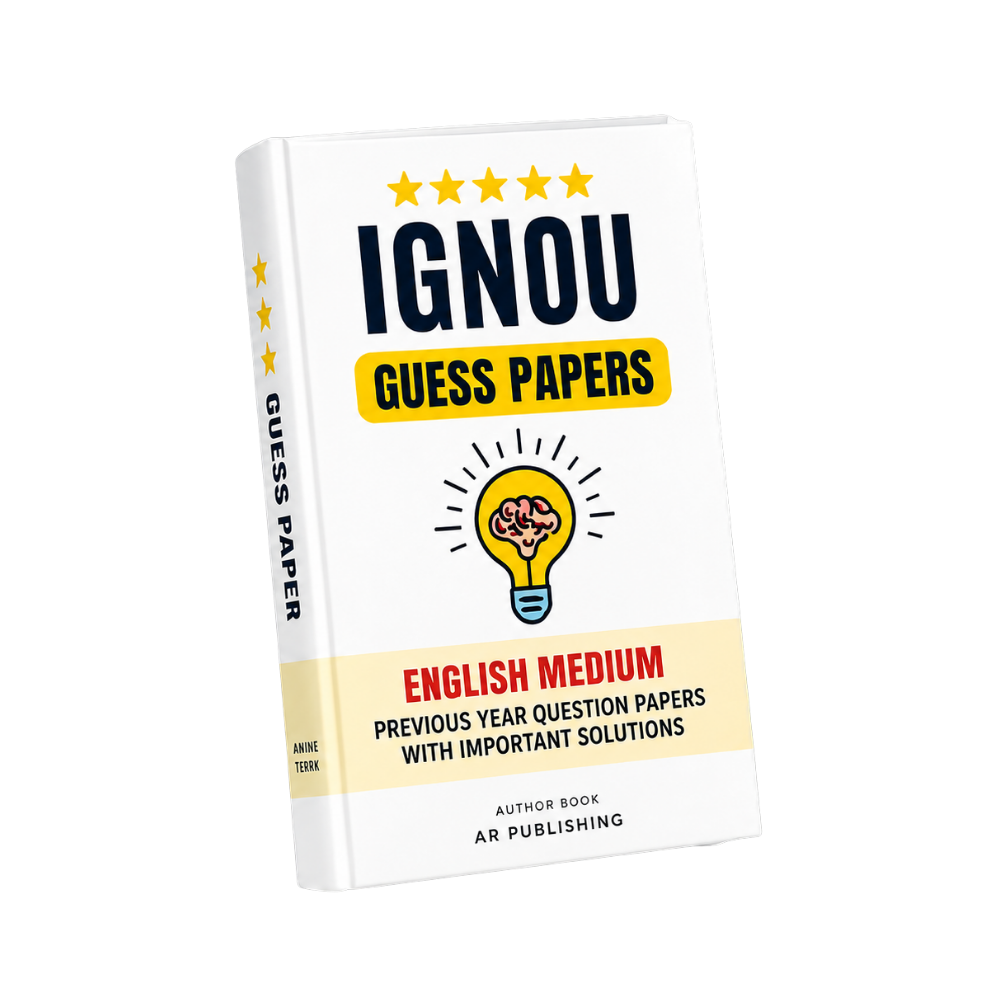
MLIE-105 IGNOU Guess Paper 2026-27
Click to view offer details & terms
Get 10% OFF Instant Discount
Apply this coupon code at checkout to claim your academic discount instantly.
- Applicable on all university study materials
- Valid for up to 8 item(s) per order
- Valid till Oct 31, 2026
Enrolled in other IGNOU subjects?
Link your Enrollment No. to auto-map all your semester courses & free question papers.
Frequently Bought Together
Popular course materials frequently ordered together

Syllabus & Overview
Course Scope & Syllabus Overview: MLIE-105 Informetrics and Scientometrics
MLIE-105: Informetrics and Scientometrics is a core component of IGNOU’s Master’s Degree in Library and Information Science (MLIS), designed to equip students with analytical tools for measuring information production, dissemination, and impact. This course bridges quantitative methods with social science research, enabling students to evaluate scholarly communication patterns, citation networks, and research productivity. Aligned with the IGNOU CBCS curriculum, it fosters critical thinking about data-driven insights in academic and policy-making contexts, preparing students for roles in research assessment, library science, and information policy.Key Syllabus Units & Topics
- Block-1 Foundation of Informetrics and Scientometrics: Introduces core principles of quantitative analysis in information science, including bibliometrics, citation analysis, and the history of informetric theories like Lotka’s Law and Bradford’s Law.
- Block-2 Informetrics: Elements and Applications: Explores statistical techniques for analyzing document production, journal impact factors, and information retrieval efficiency, with applications in academic library management.
- Block-3 Scientometrics: Elements and Applications: Focuses on measuring scientific output, collaboration networks, and research frontiers, using tools like co-citation analysis and h-index calculations.
- Block-4 Techniques and Modelling in Informetrics and Scientometrics: Covers advanced methodologies such as social network analysis, time-series modeling, and predictive analytics for forecasting research trends.
Frequently Asked Questions
Q: How is the MLIE-105 examination structured, and what is the weightage of internal and external assessments?
A: The TEE for MLIE-105 carries 100 marks, divided into objective (30%) and subjective (70%) questions, while assignments contribute 30% to the final grade. Focus on understanding core concepts for subjective sections.
Q: Are there specific chapters or units in MLIE-105 that frequently appear in repeated exam questions?
A: Blocks 2 and 3 (Informetrics and Scientometrics applications) consistently feature in past papers, particularly citation analysis and bibliometric indicators. Prioritize these for revision.
Why buy from us?
-
Verified by top professors and 99th percentile students.
-
Always updated to the latest university curriculum.
-
High-quality, printable PDF formats with clear diagrams.
License & Terms
By purchasing this item, you agree to our standard academic license terms. You may use this product for personal study, but you may not resell or redistribute the files online.