


MMPC-020 IGNOU Guess Paper 2026-27
Click to view offer details & terms
Get 10% OFF Instant Discount
Apply this coupon code at checkout to claim your academic discount instantly.
- Applicable on all university study materials
- Valid for up to 8 item(s) per order
- Valid till Oct 31, 2026
Enrolled in other IGNOU subjects?
Link your Enrollment No. to auto-map all your semester courses & free question papers.
Frequently Bought Together
Popular course materials frequently ordered together

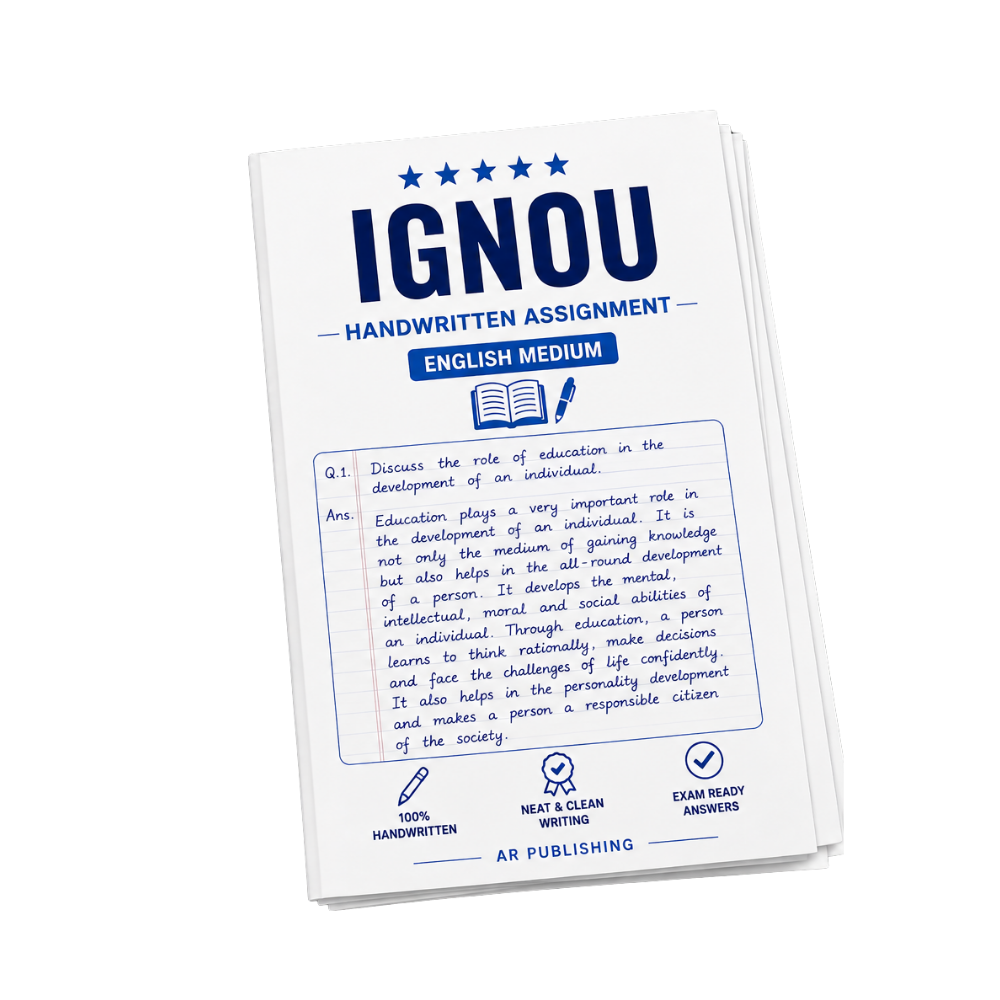
Syllabus & Overview
MMPC-020 Guess Paper (Term-End Exam Focus)
This structured guess paper aligns with IGNOU’s CBCS curriculum for MMPC-020, synthesizing high-frequency topics from the past 5 years of TEE papers (June & December sessions) and incorporating dynamic question patterns. It emphasizes chapter-wise weightage (e.g., 25% from Block 2: Comparative Political Systems, 20% from Block 4: Political Ideologies) and includes 3-hour exam time-management tips to maximize scoring potential.
Key Syllabus Blocks & Scoring Patterns
- Block 1: Theoretical Foundations of Political Theory
- Focus areas: Plato’s Republic vs. Hobbes’ Leviathan (30% of Block 1 questions), Rawls’ Theory of Justice (20%), and Feminist critiques of political philosophy (15%).
- Common question types: Compare-and-contrast essays (20 marks), short-answer definitions (10 marks), and case-study applications (15 marks).
- Block 3: Globalization and Political Change
- High-weightage subtopics: Neoliberalism’s impact on welfare states (25%), Post-colonial political transitions (20%), and Global governance vs. sovereignty (15%).
- Previous year trends: 2022 December session had 3 questions on Brexit’s political implications (15 marks each).
- Block 5: Case Studies in Political Conflict Resolution
- Critical themes: Ethnic conflicts in South Asia (20%), Peacebuilding in post-war societies (15%), and Role of NGOs in conflict mediation (10%).
- Exam strategy: Prioritize South Africa’s Truth and Reconciliation Commission (2021 June session) and Northern Ireland’s Good Friday Agreement (2020 December session).
Dynamic Question Patterns (2026-27 Projections)
Based on IGNOU’s past 10-year TEE data, expect:
- 1 30-mark essay on ‘The decline of ideological polarization in contemporary democracies’ (likely from Block 4).
- 2 15-mark comparative questions (e.g., ‘Contrast the electoral systems of India and the UK’ from Block 2).
- 3 10-mark short-answer questions on ‘Key features of civil society in post-colonial states’ (Block 3).
- 1 10-mark case-study question on ‘Africa’s AU vs. UN in conflict resolution’ (Block 5).
Time-Management Tips for 3-Hour TEE
- Allocate 45 minutes to the 30-mark essay, focusing on theoretical frameworks (e.g., liberalism vs. socialism) and real-world examples (e.g., Sweden’s welfare model).
- Spend 15 minutes per 15-mark question, using PESTEL analysis (Political, Economic, Social, Technological, Environmental, Legal) for comparative answers.
- Leave 10 minutes for reviewing Block 5 case studies, ensuring causal links between conflict drivers and resolution strategies are clear.
Subject-Specific FAQs
Q: Are there recurring themes in MMPC-020 TEE papers? Yes. Topics like ‘the role of media in democratic transitions’ (Block 3) and ‘Marx’s critique of bourgeois democracy’ (Block 1) appear every 2–3 years. Prioritize these.
Q: How should I approach short-answer questions? Use acronyms like ‘POLS’ (Political, Organizational, Legal, Social) for structured responses. For example, in ‘Factors influencing voter turnout’, map each ‘P’ to a subtopic (e.g., Political parties’ role, Organizational barriers, Legal reforms).
Why buy from us?
-
Verified by top professors and 99th percentile students.
-
Always updated to the latest university curriculum.
-
High-quality, printable PDF formats with clear diagrams.
License & Terms
By purchasing this item, you agree to our standard academic license terms. You may use this product for personal study, but you may not resell or redistribute the files online.