


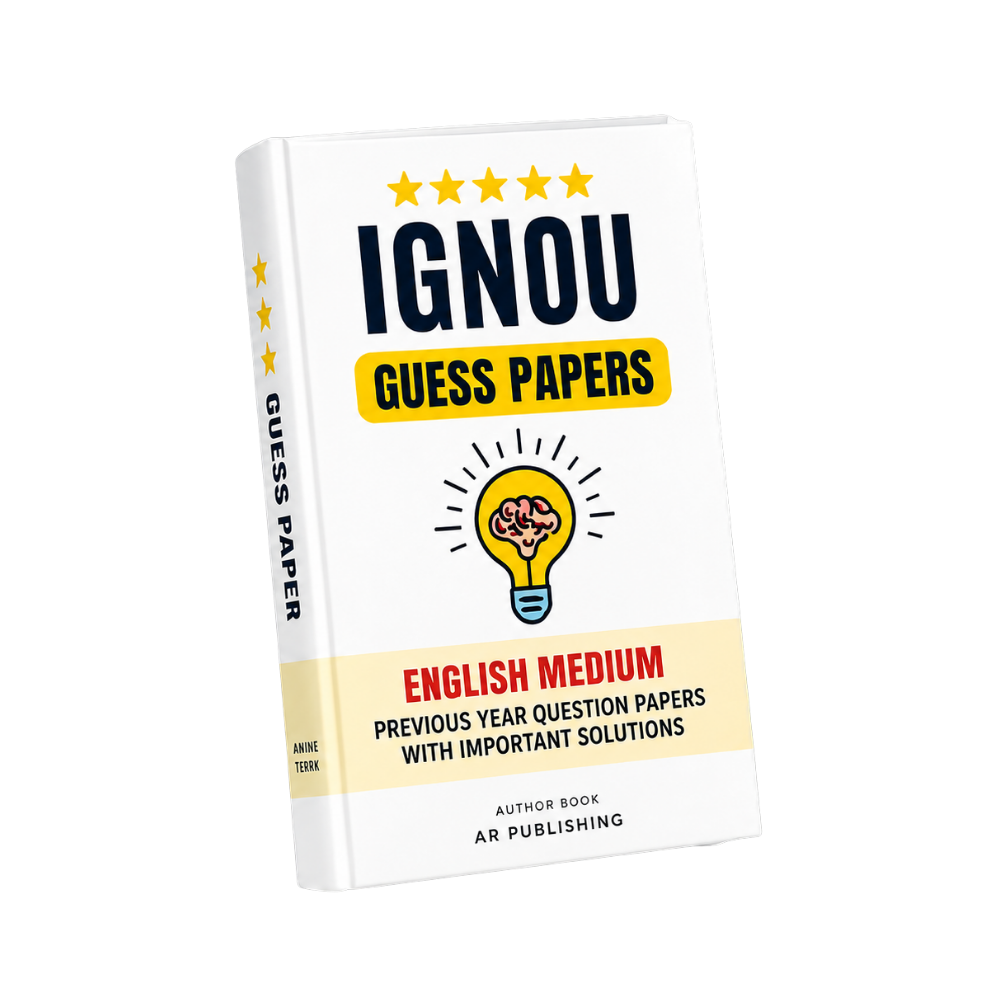
MPCE-033 IGNOU Guess Paper 2026-27
Click to view offer details & terms
Get 10% OFF Instant Discount
Apply this coupon code at checkout to claim your academic discount instantly.
- Applicable on all university study materials
- Valid for up to 8 item(s) per order
- Valid till Oct 31, 2026
Frequently Bought Together
Popular course materials frequently ordered together
Syllabus & Overview
MPCE-033 Guess Paper: Organisational Development (OD) Term-End Exam (TEE) Focus
This structured guess paper is designed to align with the official IGNOU curriculum for MPCE-033 (Organisational Development (OD)), covering key scoring areas from previous year papers and exam patterns. It includes chapter-wise weightage, time management strategies, and FAQs to optimize preparation for the 3-hour exam.
Exam Structure & Weightage
The TEE for MPCE-033 typically carries 100 marks and includes:
- Section A (20 marks): Short-answer questions (2-3 marks each) from Blocks 1-4, focusing on definitions, OD models, and core concepts.
- Section B (40 marks): Medium-length questions (10-15 marks each) on OD interventions, behavioral change theories, and case studies.
- Section C (40 marks): Long-answer questions (20 marks each) requiring detailed analysis of OD processes, ethical dilemmas, or comparative evaluations of interventions.
Block-Wise Key Topics (Previous Year Focus)
Block-1: Introduction
- Definition and scope of Organisational Development (OD) with reference to Lewin’s change model.
- Historical evolution of OD: T-groups, survey feedback, and action research.
- OD vs. Organizational Change: Key differences and interrelations.
Block-2: Assumptions, Beliefs, and Values in OD
- Human relations theory: Maslow’s hierarchy, McGregor’s Theory X/Y, and their OD implications.
- Cultural dimensions in OD: Hofstede’s framework and its impact on organizational behavior.
- Ethical considerations in OD interventions (e.g., confidentiality, power dynamics).
Block-3: Analysing and Managing the OD Process
- OD diagnosis: Methods (survey feedback, interviews, observation) and their applications.
- Change resistance: Sources (individual, group, organizational) and strategies to overcome it.
- OD planning: Phases (unfreezing, changing, refreezing) and tools (force field analysis).
Block-4: OD Interventions
- Intervention types: Team building, process consultation, and survey feedback.
- Technology-assisted OD: Role of data analytics in behavioral change (excluding programming).
- Evaluating OD success: Kirkpatrick’s four-level model and its limitations.
Time Management Tips for 3-Hour Exam
- Allocate 30 minutes for Section A (20 marks) to ensure accuracy.
- For Section B, prioritize questions on OD interventions (Block-4) and diagnostic tools (Block-3), as they carry higher weightage.
- Save 45-60 minutes for Section C, focusing on case-based analysis of OD processes (Blocks 1-3).
- Use bullet points for clarity in long answers and cite theories/models (e.g., Lewin, McGregor) to score full marks.
Subject-Specific FAQs
Q: How do I differentiate between OD and Organizational Change?OD is a planned, systematic approach to improve organizational health through behavioral science principles, while Organizational Change refers to broader shifts (e.g., restructuring) that may or may not use OD methods. OD emphasizes participative processes and cultural alignment.
Q: Are case studies important for MPCE-033?Yes. Case studies from Blocks 1-3 (e.g., diagnosing resistance to change) and Block-4 (e.g., implementing team-building interventions) are frequently tested. Practice analyzing real-world scenarios using OD frameworks (e.g., Lewin’s model).
Why buy from us?
-
Verified by top professors and 99th percentile students.
-
Always updated to the latest university curriculum.
-
High-quality, printable PDF formats with clear diagrams.
License & Terms
By purchasing this item, you agree to our standard academic license terms. You may use this product for personal study, but you may not resell or redistribute the files online.