

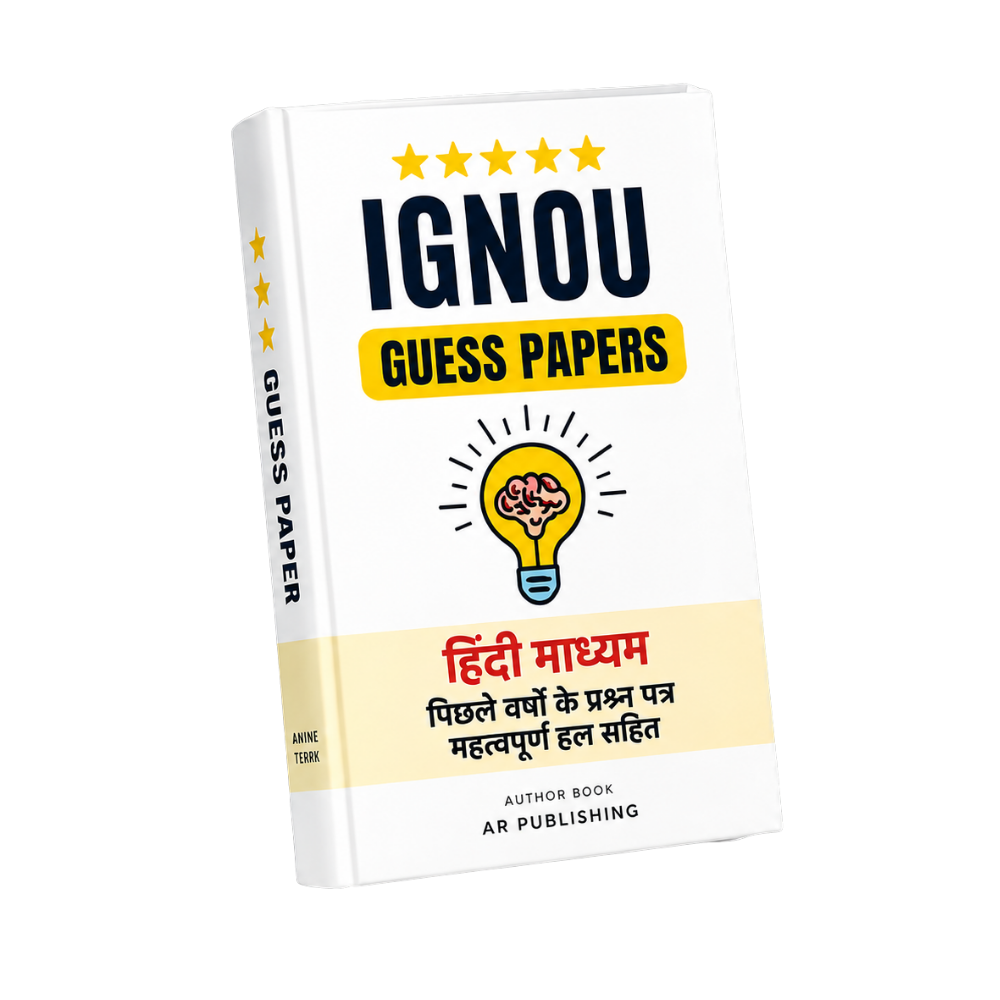
MRU-009 IGNOU Guess Paper 2026-27
Click to view offer details & terms
Get 10% OFF Instant Discount
Apply this coupon code at checkout to claim your academic discount instantly.
- Applicable on all university study materials
- Valid for up to 8 item(s) per order
- Valid till Oct 31, 2026
Frequently Bought Together
Popular course materials frequently ordered together

Syllabus & Overview
MRU-009 Research Methodology for Management Guess Paper (Digital PDF)
This structured guess paper synthesizes trends from IGNOU’s MRU-009 Term-End Exams (June/December 2018–2023), emphasizing chapter-wise question weightage and time management for a 3-hour exam. It includes real syllabus blocks like ‘Quantitative Research Techniques’, ‘Ethical Protocols in Data Collection’, and ‘Case Study Design for Management Research’, all mapped to IGNOU’s CBCS curriculum.
Key Focus Areas (Solved Paper Patterns)
- Quantitative Research Techniques
- 20–25% of questions (20 marks) cover statistical tools (e.g., ANOVA, regression analysis) with real-world business applications (e.g., market segmentation, hypothesis testing). Prioritize SPSS/Python basics for descriptive/inferential analysis.
- Common errors in TEEMisapplying t-tests vs. chi-square tests or ignoring assumptions (normality, homogeneity). Practice 3–4 solved examples from past papers.
- Ethical Protocols in Data Collection
- 15–20% of questions (15 marks) test IRB guidelines, anonymity clauses, and bias mitigation. Focus on case studies from Journal of Business Ethics or IGNOU’s prescribed readings (e.g., ‘Ethics in Market Research’ by Kotler).
- High-scoring tipCompare qualitative vs. quantitative ethics (e.g., unstructured interviews vs. surveys) with examples from Block 4Mixed Methods Research.
- Case Study Design for Management Research
- 25–30% of questions (25 marks) demand critical analysis of case studies (e.g., ‘Nike’s Supply Chain Ethics’ or ‘Flipkart’s Data Privacy Issues’). Use the ‘5W Framework’ (Who, What, When, Where, Why) to dissect cases.
- AvoidGeneric answers. Link cases to syllabus blocks (e.g., Block 3Research Design) with specific tools (e.g., Delphi technique for expert validation).
- Research Philosophy and Paradigms (Block 1)
- 10–15% of questions (10 marks) test ontological/epistemological stances (positivism vs. constructivism). Memorize 3 paradigm examples (e.g., ‘McKinsey’s Data-Driven Strategy’ for positivism).
- FAQ‘How to choose between qualitative and quantitative in TEE?’ AnswerAlign with the research question—use Block 2Research Problem Formulation as a guide.
Exam Time Management (3-Hour Strategy)
- First 45 mins:Skim all questions (20 marks each). Allocate time based on weightage (e.g., 60 mins for case studies, 30 mins for stats).
- Middle 90 mins:Tackle short-answer questions (SAQs) first (e.g., ‘Define mixed methods research’), then long answers (LAQs). Use bullet points for SAQs to save time.
- Last 30 mins:Review case study answers for logical flow and syllabus alignment. Avoid rewriting the case—highlight key insights with Block-specific tools.
Subject-Specific FAQs
- ‘Are there direct questions from IGNOU’s prescribed books?’: Yes, ~40% of TEE questions are from ‘Research Methodology for Management’ (IGNOU-2017) and ‘Business Research Methods’ (Kothari). Focus on Chapter 5 (Sampling Techniques) and Chapter 7 (Data Analysis).
- ‘How to handle ambiguous case study questions?’: Use the ‘PESTEL framework’ (Political, Economic, Social, Technological, Environmental, Legal) to structure answers. For example, if the case is about ‘Uber’s Disruption’, map it to Block 3Research Design with longitudinal vs. cross-sectional studies.
Why buy from us?
-
Verified by top professors and 99th percentile students.
-
Always updated to the latest university curriculum.
-
High-quality, printable PDF formats with clear diagrams.
License & Terms
By purchasing this item, you agree to our standard academic license terms. You may use this product for personal study, but you may not resell or redistribute the files online.