

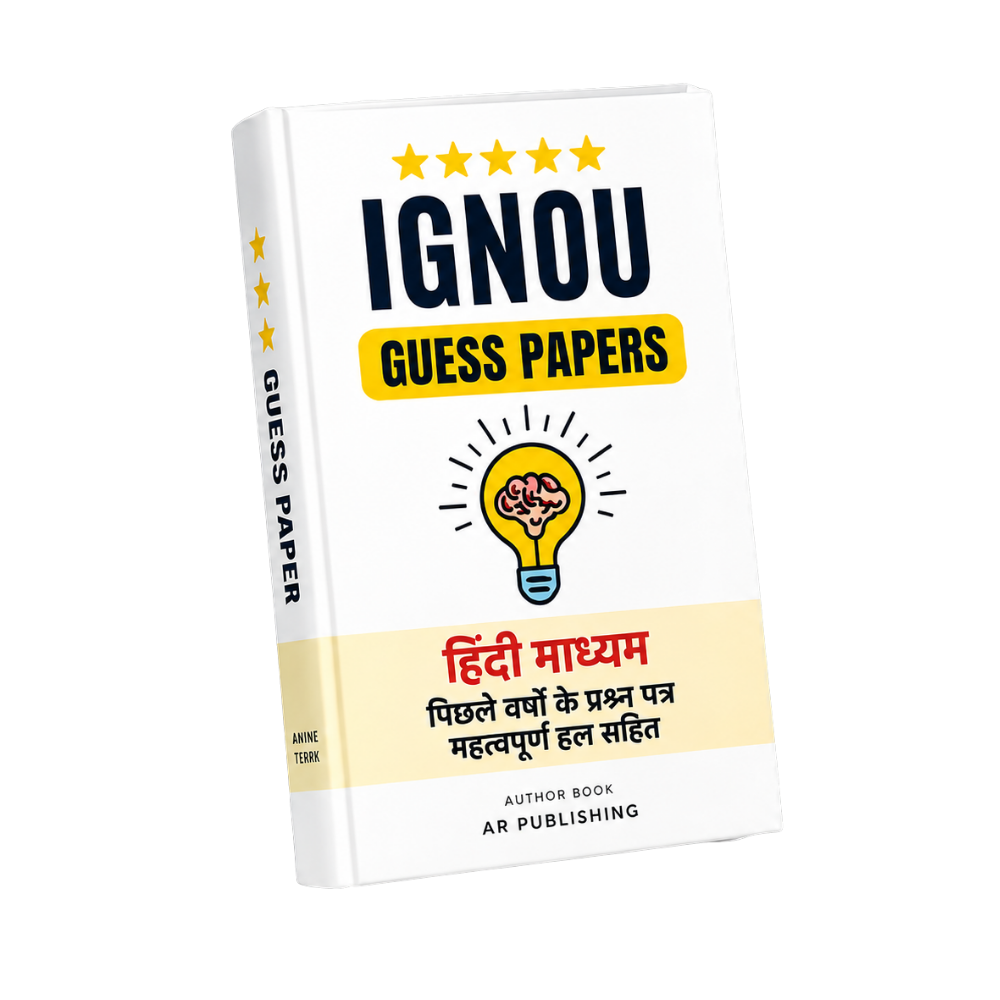
MS-26 IGNOU Guess Paper 2026-27
Click to view offer details & terms
Get 10% OFF Instant Discount
Apply this coupon code at checkout to claim your academic discount instantly.
- Applicable on all university study materials
- Valid for up to 8 item(s) per order
- Valid till Oct 31, 2026
Enrolled in other IGNOU subjects?
Link your Enrollment No. to auto-map all your semester courses & free question papers.
Frequently Bought Together
Popular course materials frequently ordered together
Syllabus & Overview
MS-26 Guess Paper (Organisational Dynamics) Term-End Exam (TEE) Focus
This structured guess paper for MS-26 (Organisational Dynamics) leverages solved previous year TEE questions (June & December sessions) and IGNOU’s official curriculum for Blocks 1–5. It emphasizes scoring patterns, chapter-wise weightage, and exam time-management techniques to ensure optimal preparation for the 3-hour exam.
Key Scoring Blocks & Topics (Based on IGNOU Syllabus)
Block 1: Group Dynamics
- Group formation and development stages (Tuckman’s model, punctuated equilibrium theory)
- Group cohesion and norms (Factors influencing cohesion, deviant behavior, conformity)
- Group decision-making processes (Brainstorming, nominal group technique, groupthink)
Block 2: Role Dynamics
- Role perception and conflict (Role ambiguity, role overload, role strain)
- Organisational roles and their impact on behavior (Formal vs. informal roles, role expectations)
- Interpersonal role dynamics (Leadership roles, follower roles, power dynamics in roles)
Block 3: Power Dynamics
- Sources of power in organisations (French and Raven’s bases of power, legitimate vs. expert power)
- Power and influence tactics (Persuasion, coercion, exchange, legitimation)
- Power structures and organisational politics (Centralisation vs. decentralisation, political behavior)
Block 4: Organisational Dynamics
- Organisational culture and climate (Schein’s levels of culture, organisational socialization)
- Change management and organisational dynamics (Lewin’s change model, resistance to change)
- Organisational structure and design (Mechanistic vs. organic structures, contingency theory)
Block 5: Inter-Organisational Dynamics
- Strategic alliances and partnerships (Joint ventures, franchising, strategic collaborations)
- Networks and alliances in business (Vertical vs. horizontal integration, supply chain dynamics)
- Globalisation and inter-organisational relationships (Mergers and acquisitions, cross-border alliances)
Exam Time-Management Tips (3-Hour Strategy)
- Allocate 45 minutes per block (15–20 mins per topic within blocks, prioritizing high-weightage areas like power dynamics and role conflicts).
- Attempt case studies first (Blocks 2–5 often feature case-based questions; allocate 1 hour for these).
- Short-answer questions (SAQs) in 30–40 mins (Focus on Blocks 1 and 3 for quick scoring).
- Review and cross-check answers (Last 15–20 mins for clarity and coherence).
Subject-Specific FAQs
- Q: Which block has the highest weightage in TEE?
A: Blocks 2 (Role Dynamics) and 3 (Power Dynamics) consistently carry 30–35% of total marks due to their application-based nature (case studies, essays, and short answers).
- Q: How can I differentiate between group dynamics and organisational dynamics?
A: Group dynamics (Block 1) focuses on small teams/units, while organisational dynamics (Block 4) examines broader systems, culture, and structural changes. Block 4 questions often require macro-level analysis.
Why buy from us?
-
Verified by top professors and 99th percentile students.
-
Always updated to the latest university curriculum.
-
High-quality, printable PDF formats with clear diagrams.
License & Terms
By purchasing this item, you agree to our standard academic license terms. You may use this product for personal study, but you may not resell or redistribute the files online.