

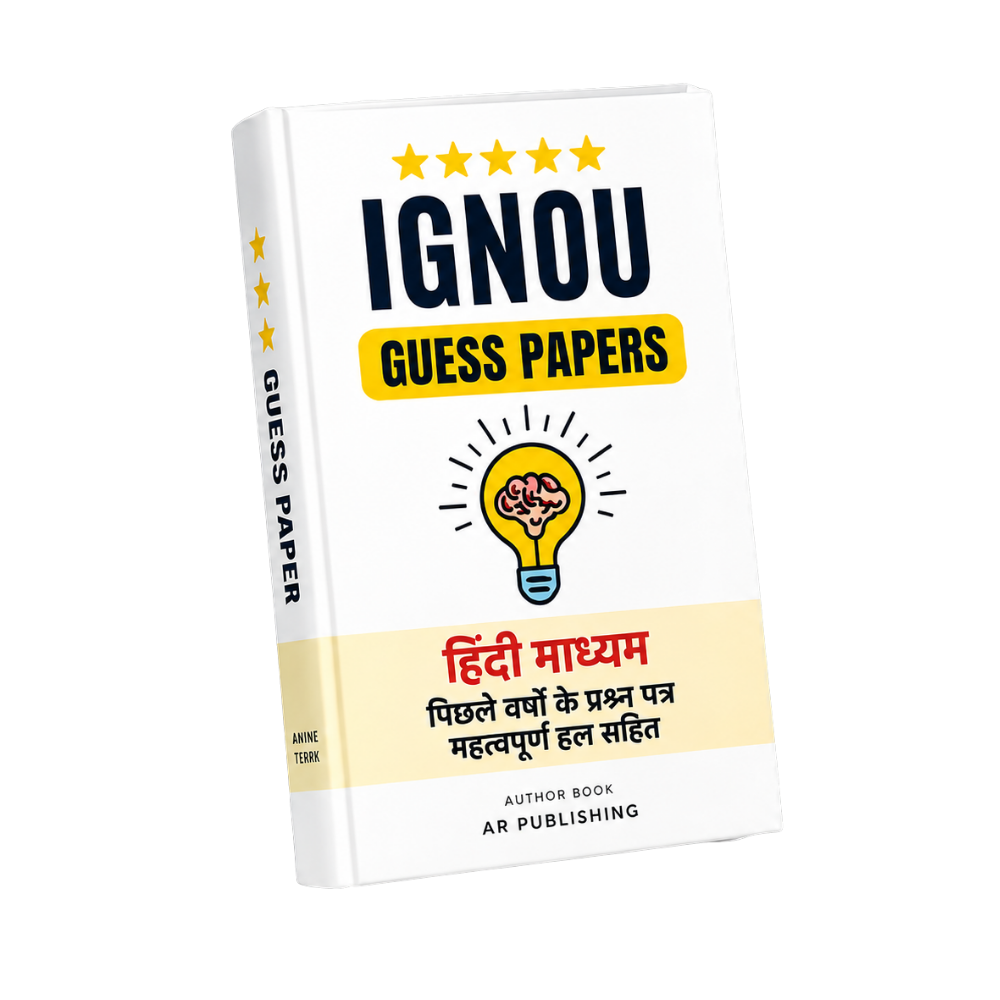
MSD-014 IGNOU Guess Paper 2026-27
Click to view offer details & terms
Get 10% OFF Instant Discount
Apply this coupon code at checkout to claim your academic discount instantly.
- Applicable on all university study materials
- Valid for up to 8 item(s) per order
- Valid till Oct 31, 2026
Enrolled in other IGNOU subjects?
Link your Enrollment No. to auto-map all your semester courses & free question papers.
Frequently Bought Together
Popular course materials frequently ordered together


Syllabus & Overview
MSD-014 Guess Paper (Digital PDF): Term-End Exam (TEE) Focus
This structured guess paper for MSD-014 (Ecological Economics) leverages IGNOU’s official curriculum (eGyanKosh) and past TEE trends (June/December 2018–2023) to identify high-probability questions. It emphasizes chapter-wise weightage, 3-hour exam time management, and solved previous-year patterns for the Post Graduate Diploma in Sustainability Science (PGDSS).
Key Syllabus Blocks & Scoring Topics
- Block-1: Ecology, Environment and Sustainability
- Define and differentiate between weak vs. strong sustainability (2019 Dec Q4).
- Discuss the ecological footprint with case studies (2020 June Q6, 30 marks).
- Explain Holling’s Resilience Theory and its application to ecosystem management (2021 Dec Q5).
- Block-2: Resource and Economy
- Compare conventional vs. ecological economics using examples (2022 June Q3, 25 marks).
- Analyze the tragedy of the commons and policy interventions (2021 June Q7).
- Discuss Gross Domestic Product (GDP) vs. Genuine Progress Indicator (GPI) (2020 Dec Q2).
- Block-3: Environmental Issues in India
- Critically evaluate India’s National Action Plan on Climate Change (NAPCC) (2023 Dec Q8, 35 marks).
- Explain the Montreal Protocol and its impact on ozone depletion (2019 June Q5).
- Case study on deforestation in the Western Ghats (2022 Dec Q6).
- Block-4: Valuation and Pricing of Natural Resources
- Describe cost-benefit analysis (CBA) vs. contingent valuation (CV) (2020 June Q4).
- Apply willingness-to-pay (WTP) models to water resource pricing (2021 June Q9).
- Discuss carbon trading mechanisms under the Kyoto Protocol (2023 June Q7).
Exam Strategy & Time Management
- Block-wise Allocation: Allocate 45 mins to Block-1 (theory-heavy), 40 mins to Block-2 (economic models), 50 mins to Block-3 (policy-focused), and 35 mins to Block-4 (quantitative/valuation).
- Question Prioritization: Prioritize case studies (30+ marks) and comparative analysis questions (25+ marks).
- Short Answer Practice: Solve 5–6 short-answer questions (10–15 marks each) within 1 hour to build speed.
Subject-Specific FAQs
- Q: How to score well in Block-4’s valuation methods?
Focus on real-world examples (e.g., water pricing in Rajasthan, carbon credits in Gujarat) and formulas for WTP, WTA (Willingness-to-Accept). Use past TEE questions like 2022 Dec Q4 for practice.
- Q: Are diagrams/maps allowed in TEE?
Yes, but limit to 1–2 per answer (e.g., ecological footprint comparison, NAPCC framework). Label axes and sources clearly to avoid deduction.
Why buy from us?
-
Verified by top professors and 99th percentile students.
-
Always updated to the latest university curriculum.
-
High-quality, printable PDF formats with clear diagrams.
License & Terms
By purchasing this item, you agree to our standard academic license terms. You may use this product for personal study, but you may not resell or redistribute the files online.