

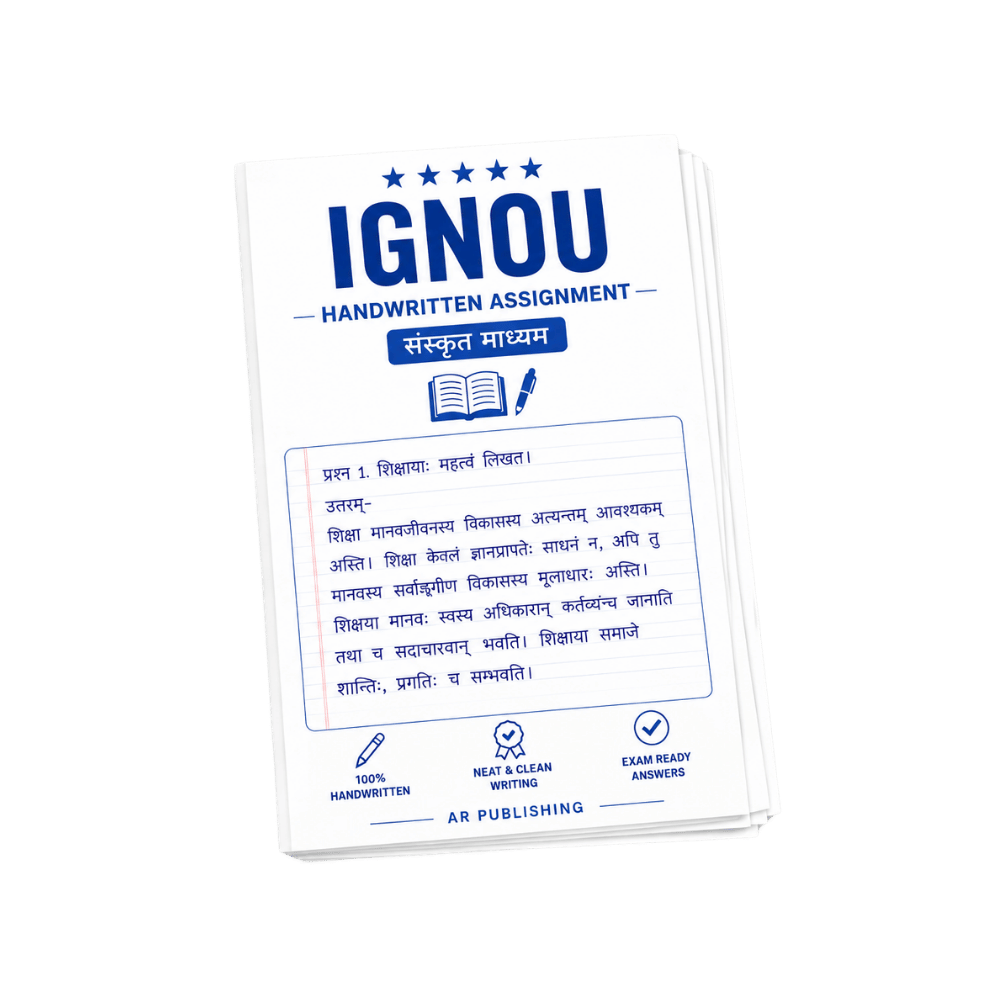
MSK-022 IGNOU Handwritten Assignment 2026-27
Click to view offer details & terms
Get 10% OFF Instant Discount
Apply this coupon code at checkout to claim your academic discount instantly.
- Applicable on all university study materials
- Valid for up to 8 item(s) per order
- Valid till Oct 31, 2026
Enrolled in other IGNOU subjects?
Link your Enrollment No. to auto-map all your semester courses & free question papers.
Frequently Bought Together
Popular course materials frequently ordered together
Syllabus & Overview
Course Scope & Syllabus Overview
MSK-022: is a specialized course under the PGSKT program, designed to explore the intersection of Sanskrit literature with foundational scientific theories. This course meticulously examines how ancient Sanskrit texts—particularly from the realms of philosophy, grammar, and natural sciences—articulated principles in physics, linguistics, mathematics, and metaphysics. Through a structured analysis of canonical works like the Nyāya-Sūtras, Pāṇini’s Aṣṭādhyāyī, and treatises on astronomy (e.g., Aryabhaṭīya), students gain insights into the systematic reasoning of classical Indian intellectual traditions. The curriculum emphasizes critical reading, comparative analysis, and contextual understanding, equipping learners to appreciate the depth of Sanskrit thought as a precursor to modern scientific inquiry.Key Syllabus Units & Topics
- -1 : This unit dissects the Nyāya-Vaiśeṣika and Vedānta schools’ metaphysical frameworks, analyzing their epistemological foundations and how they addressed causality, perception, and logic. Key texts include the Nyāya-Sūtras and Bhāṣya commentaries, where students explore theories of inference, analogy, and the nature of reality.
- -2 : Focused on Aryabhaṭa’s contributions, this segment covers algebraic methods, trigonometric principles, and astronomical calculations as documented in the Aryabhaṭīya. Students analyze the mathematical notations and their applications in celestial mechanics, bridging ancient computational techniques with modern mathematical paradigms.
- -3 : Pāṇini’s Aṣṭādhyāyī is scrutinized for its generative grammar rules, phonetic analysis, and morphological structures. The unit examines how this foundational text laid the groundwork for linguistic theory, influencing later traditions in descriptive linguistics and computational syntax.
- -4 : This block examines treatises like the Sāṃkhya-Kārikā and the Brhadāraṇyaka Upaniṣad for their discussions on atomic theory, elemental composition, and the philosophy of matter. Students evaluate how these texts conceptualized physical phenomena, comparing them with early Western scientific models.
Frequently Asked Questions
Q: What is the marking scheme for the internal assessment in MSK-022, and how much weightage does the handwritten assignment carry?
A: The internal assessment for MSK-022 comprises 30% of the total marks, with the handwritten assignment contributing 15 marks. It is mandatory to submit the assignment in the prescribed format to qualify for internal assessment evaluation.
Q: Are there any specific pass marks required for the handwritten assignment in MSK-022, and how is it evaluated?
A: The handwritten assignment must secure a minimum of 50% of the allocated 15 marks to be considered passed. Evaluation criteria include adherence to the question paper format, clarity of handwriting, logical presentation, and correctness of answers as per the prescribed syllabus.
Why buy from us?
-
Verified by top professors and 99th percentile students.
-
Always updated to the latest university curriculum.
-
High-quality, printable PDF formats with clear diagrams.
License & Terms
By purchasing this item, you agree to our standard academic license terms. You may use this product for personal study, but you may not resell or redistribute the files online.