

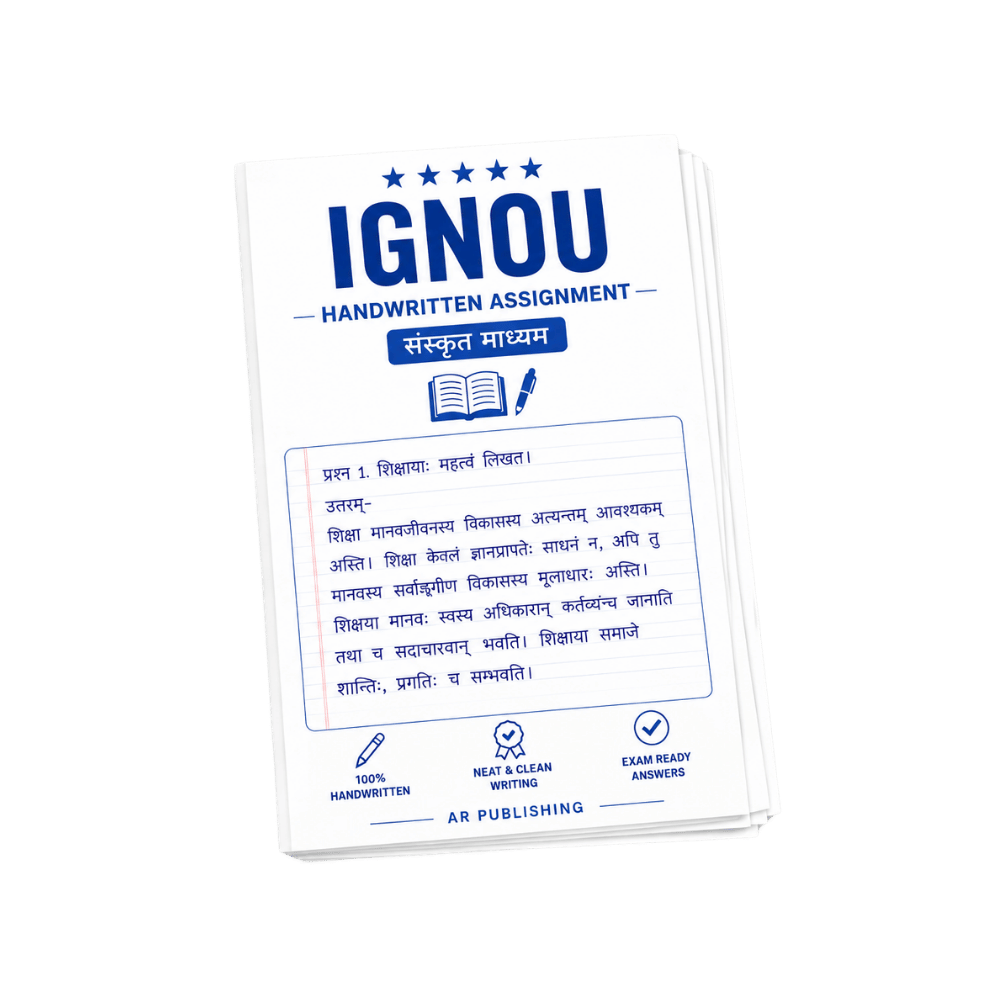
MSK-023 IGNOU Handwritten Assignment 2026-27
Click to view offer details & terms
Get 10% OFF Instant Discount
Apply this coupon code at checkout to claim your academic discount instantly.
- Applicable on all university study materials
- Valid for up to 8 item(s) per order
- Valid till Oct 31, 2026
Enrolled in other IGNOU subjects?
Link your Enrollment No. to auto-map all your semester courses & free question papers.
Frequently Bought Together
Popular course materials frequently ordered together
Syllabus & Overview
MSK-023: Practical Application of Chemistry, Metallurgy, Medicine, and Botany in Sanskrit Handwritten Assignment Overview
MSK-023, titled , is a specialized module under IGNOU’s PGSKT curriculum, designed to bridge classical Sanskrit literature with empirical scientific disciplines. This course explores the practical dimensions of chemistry, metallurgy, medicine, and botany as documented in ancient Sanskrit texts, emphasizing hands-on understanding through experimental and theoretical frameworks. Students analyze original Sanskrit treatises on alchemy (rasaśāstra), metallurgy (dhātuvidya), medicinal botany (bhāṣajya), and herbal pharmacology (aṣṭāṅgahrdaya), fostering interdisciplinary learning aligned with IGNOU’s CBCS structure.Key Syllabus Units & Topics
- -1 : Covers experimental alchemy (rasaśāstra) with practical applications of mercury (lohita), sulfur (śukra), and mineral preparations (bhasma) as described in texts like the Rasaratna Samuccaya, including distillation (tāpa), sublimation (dhūma), and chemical reactions (yoga) in Sanskrit terminology.
- -2 : Examines metallurgical processes (dhātuvidya) such as smelting (kāṣṭhā), alloying (sādhana), and purification (śodhana) of metals like gold (hiṃsa), silver (rajata), and copper (tāmra), referencing Nighaṇṭu and Bhavaprakāśa methodologies.
- -3 : Focuses on herbal pharmacology (aṣṭāṅgahrdaya) and Ayurvedic formulations, detailing preparation techniques (pāka) of decoctions (kāśāya), powders (bhūṣaṇa), and ointments (lepa), with case studies from Caraka Saṃhitā and Sushruta Saṃhitā.
- -4 : Investigates botanical taxonomy (vṛkṣaśāstra) and medicinal plant identification (bhāṣajya), including practical exercises on classifying āśvagandhā, brahmi, and haritāki based on Bhavaprakāśa and Kaiyadeva Nighaṇṭu criteria.
Frequently Asked Questions
Q: What is the marking scheme for the MSK-023 assignment, and how many questions are typically included in the handwritten submission?
A: The MSK-023 assignment carries 30% weightage in the final grade, comprising 5–7 questions (theoretical + practical) based on the prescribed syllabus blocks. Students must answer all questions in a structured, handwritten format with clear Sanskrit terminology and references to original texts.
Q: Are there any specific pass marks or criteria for submission of the handwritten assignment for MSK-023?
A: The assignment must score a minimum of 40% to be considered passed. Submissions must include a pre-filled IGNOU cover page, printed question paper, and legible handwriting on 80 GSM ruled paper; incomplete or digitally altered copies will be rejected.
Why buy from us?
-
Verified by top professors and 99th percentile students.
-
Always updated to the latest university curriculum.
-
High-quality, printable PDF formats with clear diagrams.
License & Terms
By purchasing this item, you agree to our standard academic license terms. You may use this product for personal study, but you may not resell or redistribute the files online.