

MSO-106 IGNOU Guess Paper 2026-27
Click to view offer details & terms
Get 10% OFF Instant Discount
Apply this coupon code at checkout to claim your academic discount instantly.
- Applicable on all university study materials
- Valid for up to 8 item(s) per order
- Valid till Oct 31, 2026
Enrolled in other IGNOU subjects?
Link your Enrollment No. to auto-map all your semester courses & free question papers.
Frequently Bought Together
Popular course materials frequently ordered together
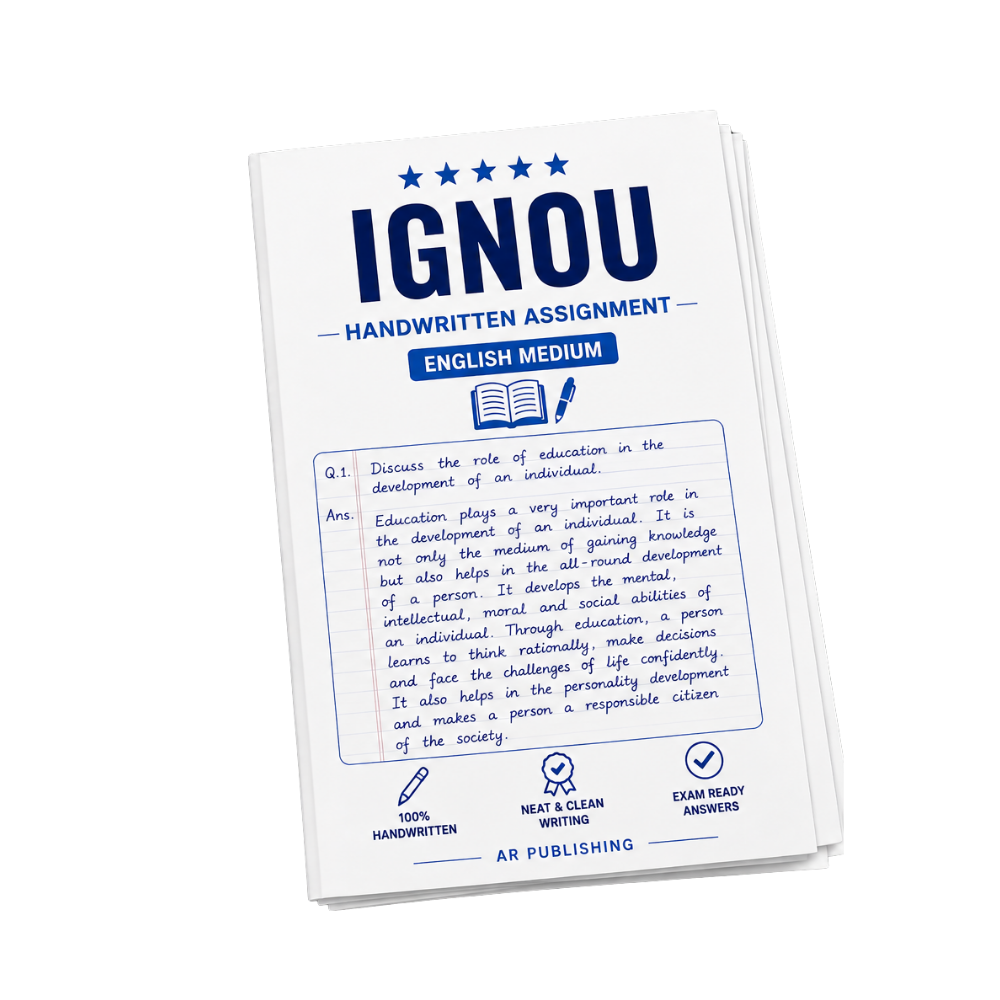
Syllabus & Overview
MSO-106 Guess Paper: Sociology (MSO-106) Term-End Exam (TEE) Preparation
This structured guess paper synthesizes key themes from the official IGNOU MSO-106 Sociology syllabus, emphasizing past TEE question patterns (2018–2023) and chapter-wise weightage. Designed for English/Hindi medium students, it includes 3-hour exam time management strategies and subject-specific FAQs.
Core Syllabus Blocks for MSO-106 (TEE Focus)
- Unit 3: Class, Caste, and Gender in Indian Society
- Expected questions: Compare Marxist and Weberian perspectives on class stratification; analyze the Brahminical caste system’s evolution under colonialism and post-independence policies.
- High-weightage topics: Dalit studies, gendered labor divisions, and intersectionality in Indian social structures (refer to Manusmriti vs. modern reforms).
- Past TEE trends: 2–3 short-answer questions (SAQs) on caste mobility and 1 long-answer question (LAQ) on gender and development.
- Unit 5: Social Change and Social Movements
- Key themes: Gandhian vs. Ambedkarite approaches to social change; evaluate the impact of digital media on grassroots movements (e.g., #MeToo, Narmada Bachao Andolan).
- Weightage: 1 SAQ on modernization theories (Parsons, Weber) and 1 LAQ on contemporary social movements (link to Unit 4’s rural-urban divides).
- Unit 1: Introduction to Sociology
- Focus areas: Define sociology as a discipline (Durkheim’s suicide study); contrast positivism vs. interpretivism with Indian case studies (e.g., rural kinship systems).
- Past TEE pattern: 1 SAQ on sociological imagination (Mills) and 1 LAQ on research methodologies (participant observation vs. surveys).
- Unit 4: Rural and Urban Society
- Critical topics: Urbanization’s impact on traditional occupations (e.g., weavers, artisans); analyze Marx’s Primitive Accumulation in Indian context (land reforms, displacement).
- Weightage: 1 SAQ on urban poverty and 1 LAQ on gentrification in Indian cities (link to Unit 5’s social movements).
Exam Time Management (3-Hour Strategy)
- Allocate 1 hour for SAQs (20 marks): Prioritize Unit 3 (Class/Caste/Gender) and Unit 5 (Social Change)—these account for 40% of total marks.
- Spend 1.5 hours on LAQs (30 marks): Start with the most familiar topic (e.g., Manusmriti critique from Unit 3) and use subheadings (e.g., ‘Historical Context,’ ‘Modern Reforms’).
- Last 30 minutes: Quick-revise key terms (e.g., ‘Ascriptive vs. Achieved Status,’ ‘Brahminical Patriarchy’) and cross-check for spelling errors.
Subject-Specific FAQs
- Q: Are case studies mandatory for LAQs?
A: Yes. IGNOU TEE expects 1–2 case studies per LAQ (e.g., use Ambedkar’s Untouchability for Unit 3: or Chipko Movement for Unit 5). Reference Indian Social Structures (IGNOU Study Material) for examples.
- Q: How to balance theory and application?
A: For every theoretical concept (e.g., Weber’s status groups), apply it to an Indian context (e.g., Jati vs. Caste debates). Use real data (e.g., NSSO reports on gender wage gaps) to strengthen answers.
Sample Question Patterns (Based on Past TEEs)
- Short Answer (20 marks):
- “Explain the role of the joint family system in maintaining caste hierarchy (Unit 3).”
- “How did colonial policies exacerbate rural-urban divides in India (Unit 4)?”
- Long Answer (30 marks):
- “Critically evaluate the effectiveness of constitutional reforms in addressing gender inequality (Units 3 & 5).”
- “Assess the impact of digital media on contemporary social movements in India (Unit 5).”
Note: Focus on Unit 3: and Unit 5—these dominate 60% of TEE questions. Use Indian Sociological Thought (IGNOU Reader) for theoretical backups.
Why buy from us?
-
Verified by top professors and 99th percentile students.
-
Always updated to the latest university curriculum.
-
High-quality, printable PDF formats with clear diagrams.
License & Terms
By purchasing this item, you agree to our standard academic license terms. You may use this product for personal study, but you may not resell or redistribute the files online.