

MST-017 IGNOU Guess Paper 2026-27
Click to view offer details & terms
Get 10% OFF Instant Discount
Apply this coupon code at checkout to claim your academic discount instantly.
- Applicable on all university study materials
- Valid for up to 8 item(s) per order
- Valid till Oct 31, 2026
Enrolled in other IGNOU subjects?
Link your Enrollment No. to auto-map all your semester courses & free question papers.
Frequently Bought Together
Popular course materials frequently ordered together
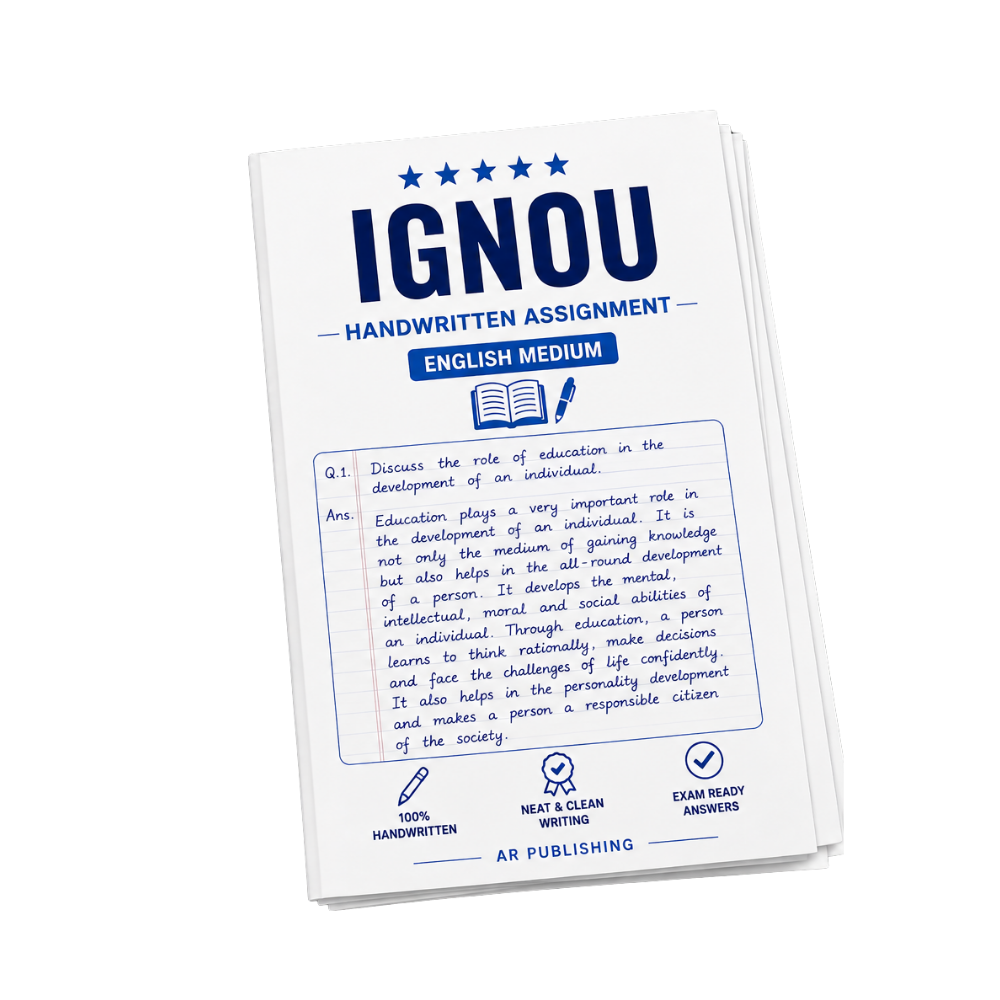
Syllabus & Overview
Course Scope and Syllabus Overview for MST-017: Applied Regression Analysis
MST-017: Applied Regression Analysis is a core component of the M.Sc. (Applied Statistics) curriculum under IGNOU’s School of Sciences, designed to equip students with rigorous statistical tools for modeling relationships between variables. This course bridges theoretical regression principles with practical applications, emphasizing hypothesis testing, model diagnostics, and real-world data interpretation. Students gain proficiency in constructing, validating, and applying regression models to solve problems in experimental and observational studies, aligning with the CBCS framework’s emphasis on analytical rigor and interdisciplinary problem-solving.Key Syllabus Units and Topics
- Block-1 Linear Regression Model: Covers foundational concepts of simple and multiple linear regression, including model formulation, parameter estimation via least squares, and interpretation of coefficients. Students explore assumptions of linearity, independence, homoscedasticity, and normality, alongside residual analysis techniques.
- Block-2 Model Adequacy Checking: Focuses on diagnostic tools such as residual plots, influence measures (e.g., Cook’s distance), and goodness-of-fit tests (e.g., R², adjusted R²) to assess model validity. This block also introduces methods for detecting outliers and influential observations.
- Block-3 Diagnostics of Model Assumptions and Variable Selection: Delves into advanced diagnostics for violations of regression assumptions, including transformations (e.g., log, polynomial) and robust regression techniques. Variable selection strategies, such as forward/backward elimination and stepwise regression, are examined for parsimonious model building.
- Block-4 Regression Models for Qualitative Response: Extends regression analysis to categorical outcomes via logistic regression, covering odds ratios, maximum likelihood estimation, and model validation metrics like the Hosmer-Lemeshow test. Practical applications in binary and multinomial response scenarios are emphasized.
Frequently Asked Questions
Q: What is the marking scheme for the MST-017 Term-End Examination (TEE), and how are internal assignments weighted?
A: The TEE for MST-017 carries 100 marks, with assignments contributing 30% of the total evaluation (10 marks each for Assignments 1–3). The remaining 70 marks are allocated to the TEE, which includes both objective and descriptive questions, with a pass mark of 40% overall.
Q: How can students prioritize revision for high-weightage topics in MST-017, given the repeated questions in past TEE papers?
A: Focus on Blocks 1 and 4, as these consistently feature in TEE papers, particularly linear regression assumptions (Block 1) and logistic regression applications (Block 4). Analyze solved guess papers to identify recurring numerical problems and theoretical questions, allocating 60% of revision time to these high-yield areas.
Why buy from us?
-
Verified by top professors and 99th percentile students.
-
Always updated to the latest university curriculum.
-
High-quality, printable PDF formats with clear diagrams.
License & Terms
By purchasing this item, you agree to our standard academic license terms. You may use this product for personal study, but you may not resell or redistribute the files online.