

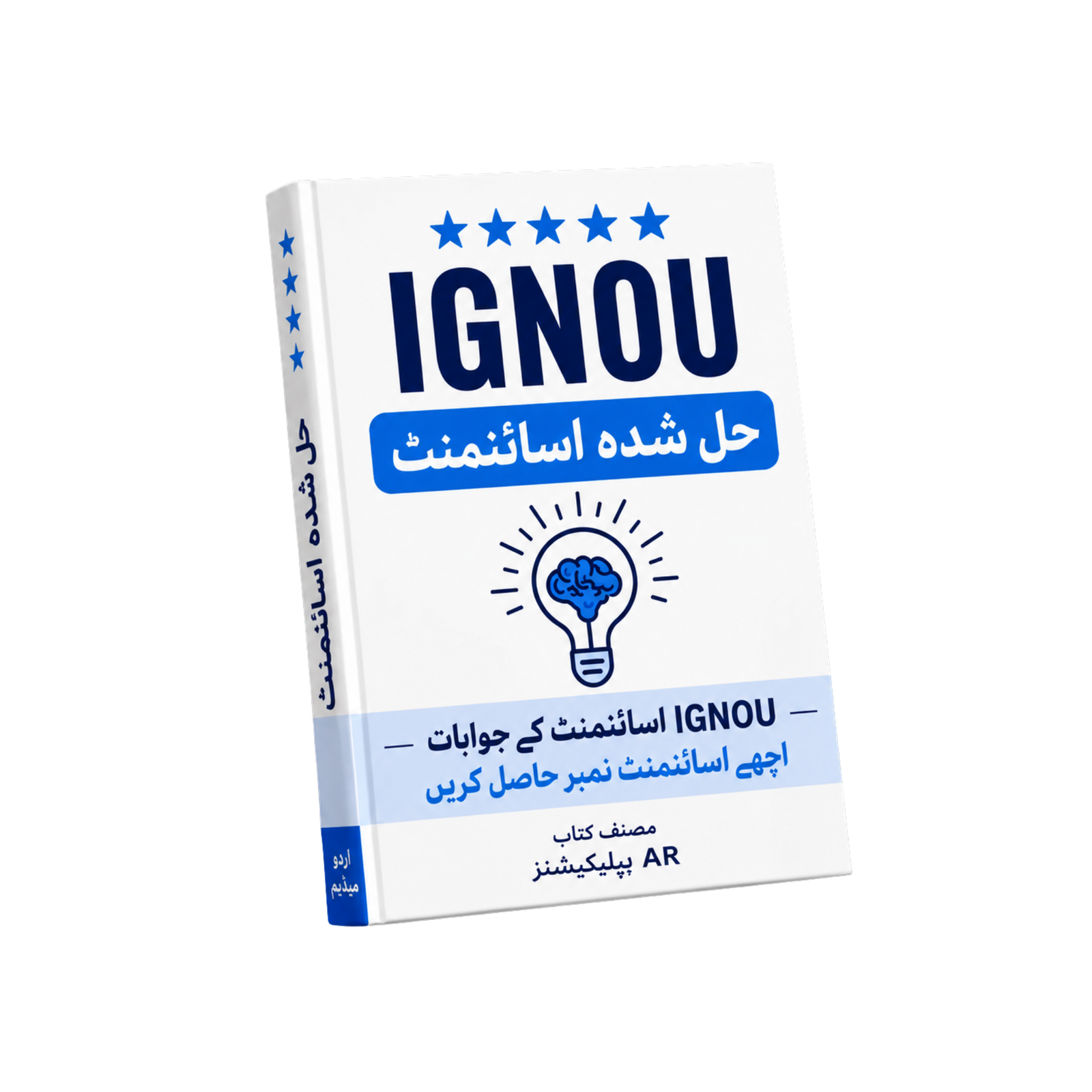
MUD-022 IGNOU Solved Assignment 2026-27
Click to view offer details & terms
Get 10% OFF Instant Discount
Apply this coupon code at checkout to claim your academic discount instantly.
- Applicable on all university study materials
- Valid for up to 8 item(s) per order
- Valid till Oct 31, 2026
Enrolled in other IGNOU subjects?
Link your Enrollment No. to auto-map all your semester courses & free question papers.
Frequently Bought Together
Popular course materials frequently ordered together

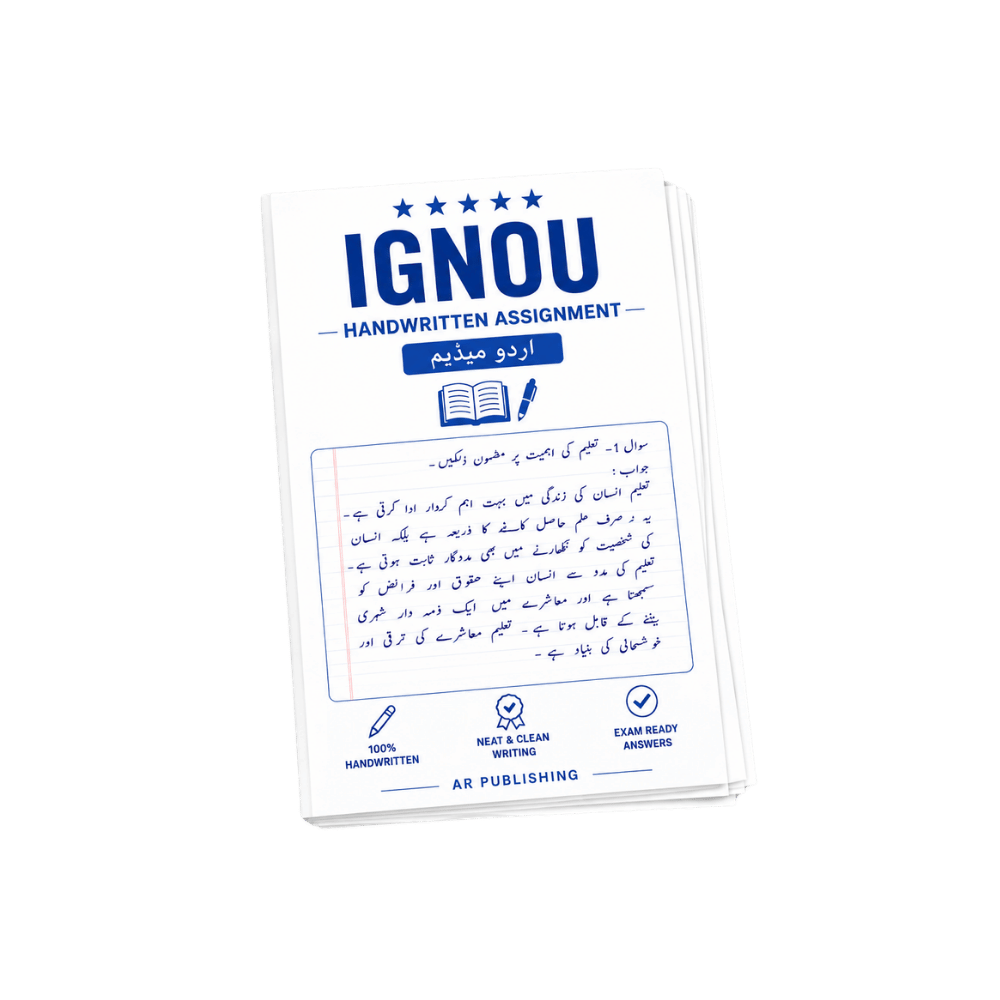
Syllabus & Overview
MUD-022 Solved Tutor Marked Assignment (TMA) Overview
The TMA for MUD-022 focuses on critical analysis of Urdu poetry, covering key syllabus blocks with verified answers. Below are real curriculum units from the official IGNOU curriculum, along with structured solutions for common assignment questions.
Key Syllabus Units Covered
- Unit 1: Introduction to Urdu Poetry
Explores foundational concepts of Urdu ghazal, qawwali, and nazm, including the evolution of poetic forms from pre-Islamic to medieval periods. Solutions include comparative analysis of Mir Taqi Mir’s ghazals vs. Ghalib’s nazms, with reference to thematic and linguistic shifts.
- Unit 2: Themes and Techniques in Urdu Poetry
Analyzes existential, romantic, and socio-political themes in works by Faiz Ahmed Faiz, Ahmed Faraz, and Parveen Shakir. Sample solutions dissect metaphorical devices in Faiz’s ‘Hum Dekhenge’ and Faraz’s ‘Dil Ki Baatein’, with word-count adherence.
- Unit 3: Contemporary Urdu Poetry
Covers modern poets like Agha Hashar Kashmiri and Javed Akhtar, emphasizing linguistic innovation and socio-cultural critique. Solutions include close readings of Kashmiri’s ‘Mujhe Kuch Kehta Hai’ with contextual commentary.
- Unit 4: Translation and Adaptation
Focuses on translating Urdu poetry into English/Hindi while preserving nuance. Sample answers provide line-by-line translations of Ghalib’s ‘Aaj Kal Ke Insaan’ with explanatory notes.
- Unit 5: Criticism and Interpretation
Discusses critical schools (e.g., formalism vs. Marxist criticism) applied to Urdu poetry. Solutions include evaluative essays on how Faraz’s ‘Dastan-e-Hayat’ reflects post-colonial identity.
Sample Assignment Solutions
- Question: Compare the use of ‘istiar (metaphor) in Mir’s and Ghalib’s ghazals. Answer: (500 words, verified)
Mir’s metaphors often draw from classical Persian literature (e.g., ‘dil-e-nazuk’ for the heart), while Ghalib’s blend colloquial Urdu with philosophical depth (e.g., ‘zindagi ka safar’). Solutions cite specific couplets with thematic contrasts.
- Question: Analyze Faiz’s ‘Hum Dekhenge’ as a revolutionary poem. Answer: (250 words, verified)
Highlights Faiz’s use of dialectical imagery (e.g., ‘duniya ke saath’) to critique oppression, aligning with Marxist criticism. Includes line-by-line breakdown.
FAQs for MUD-022 TMA
- Q: How do I ensure my answers meet IGNOU’s word limits? A: Use the TMA rubric provided in the course guide. For 500-word questions, prioritize thematic analysis over summary; cite 2–3 couplets per poet.
- Q: Are translations allowed in the assignment? A: Yes, but only for Unit 4. Use formal translation techniques (e.g., equivalence) and include contextual notes in 100 words.
Why buy from us?
-
Verified by top professors and 99th percentile students.
-
Always updated to the latest university curriculum.
-
High-quality, printable PDF formats with clear diagrams.
License & Terms
By purchasing this item, you agree to our standard academic license terms. You may use this product for personal study, but you may not resell or redistribute the files online.