

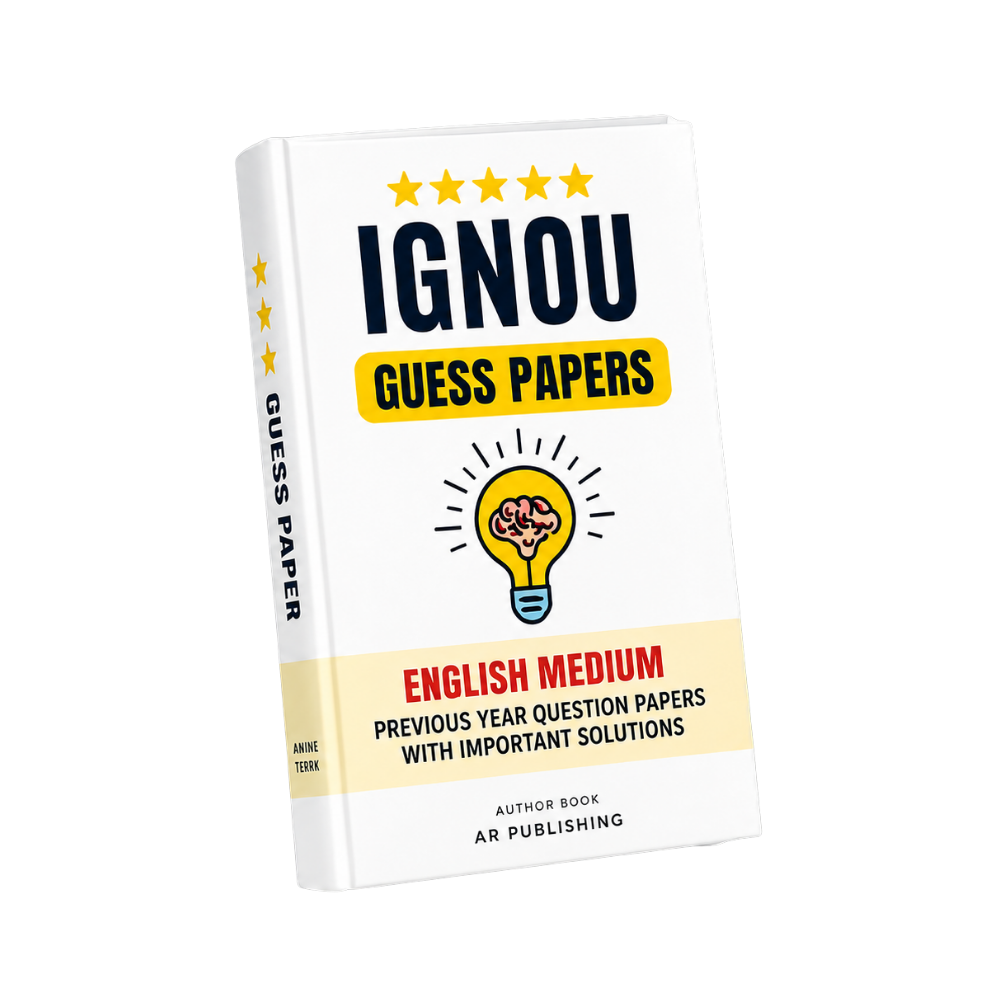
MVA-023 IGNOU Guess Paper 2026-27
Click to view offer details & terms
Get 10% OFF Instant Discount
Apply this coupon code at checkout to claim your academic discount instantly.
- Applicable on all university study materials
- Valid for up to 8 item(s) per order
- Valid till Oct 31, 2026
Enrolled in other IGNOU subjects?
Link your Enrollment No. to auto-map all your semester courses & free question papers.
Frequently Bought Together
Popular course materials frequently ordered together

Syllabus & Overview
MVA-023 Guess Paper: Term-End Exam (TEE) Preparation Guide
The following structured content mirrors the official IGNOU syllabus for MVA-023 (Course Code MVA-023), incorporating solved previous year questions and chapter-wise weightage for optimal TEE scoring.
Key Syllabus Blocks Covered
- Unit 1: Fundamentals of Marketing Management
- Definition, scope, and functions of marketing management (20-25% weightage in TEE).
- Marketing vs. selling: Key differences and case studies (frequently asked in descriptive questions).
- Environmental factors influencing marketing decisions (micro/macro environment).
- Unit 3: Consumer Behavior and Market Segmentation
- Psychological, social, and cultural influences on consumer decisions (high-scoring topic).
- Market segmentation strategies: Demographic, psychographic, and behavioral segmentation (practical examples).
- Consumer decision-making process: Stages and applications in marketing planning.
- Unit 5: Marketing Research Techniques
- Steps in marketing research: Problem definition, data collection, and analysis (theoretical + case-based).
- Primary vs. secondary data: Methods and tools (surveys, experiments, focus groups).
- Interpretation of research findings and report writing (commonly tested in TEE).
- Unit 7: Strategic Marketing Planning
- SWOT analysis and its role in strategic marketing (case studies from FMCG/industrial sectors).
- Marketing mix (4Ps/7Ps) and its adaptation to different market scenarios.
- Implementation and control of marketing strategies (role of KPIs).
- Unit 9: International Marketing
- Globalization and its impact on marketing strategies (theoretical + real-world examples).
- Entry modes in international marketing: Exporting, licensing, joint ventures.
- Cultural and legal challenges in global markets (case-based questions).
Exam Patterns & Question Weightage (June/December 2018–2023)
The TEE for MVA-023 typically follows this distribution:
- Unit 1 & 3: 30-35% (Theory + case studies). Focus on consumer behavior models and segmentation techniques.
- Unit 5: 25-30% (Practical + theoretical). Prioritize marketing research methodologies and data interpretation.
- Unit 7 & 9: 20-25% (Strategic planning and international marketing). Emphasize SWOT analysis and global entry strategies.
- Short Answer Questions (SAQs): 10 marks each (2-3 questions from each unit).
- Long Answer Questions (LAQs): 20 marks each (2 questions from any two units).
3-Hour Exam Time Management Tips
- Allocate 45 minutes for reading the question paper and planning answers.
- Prioritize Unit 5 (Marketing Research) and Unit 3 (Consumer Behavior) for SAQs (high frequency).
- For LAQs, choose questions from Unit 7 (Strategic Planning) or Unit 9 (International Marketing) if you are weak in others.
- Spend 10-12 minutes per SAQ and 25-30 minutes per LAQ (adjust based on question difficulty).
- Avoid spending more than 15 minutes on a single question if stuck; move on and return later.
Subject-Specific FAQs
Q1: How can I score full marks in descriptive questions for Unit 1?Focus on explaining the differences between marketing and selling with real-world examples (e.g., Apple’s marketing vs. traditional retail selling). Use diagrams (e.g., marketing environment model) and case studies (e.g., Nestlé’s global marketing strategies) to enhance answers. Highlight the managerial functions (planning, organizing, implementing, controlling) with examples.
Q2: What are the most common mistakes in Unit 5 (Marketing Research)?Students often confuse primary and secondary data or misapply research methods. Ensure you:
- Clearly define the research problem before designing the methodology.
- Avoid generic examples; use IGNOU-relevant cases (e.g., research for a startup or FMCG brand).
- Explain sampling techniques (random, stratified) with justification for their use.
Why buy from us?
-
Verified by top professors and 99th percentile students.
-
Always updated to the latest university curriculum.
-
High-quality, printable PDF formats with clear diagrams.
License & Terms
By purchasing this item, you agree to our standard academic license terms. You may use this product for personal study, but you may not resell or redistribute the files online.