

MWG-107 IGNOU Guess Paper 2026-27
Click to view offer details & terms
Get 10% OFF Instant Discount
Apply this coupon code at checkout to claim your academic discount instantly.
- Applicable on all university study materials
- Valid for up to 8 item(s) per order
- Valid till Oct 31, 2026
Enrolled in other IGNOU subjects?
Link your Enrollment No. to auto-map all your semester courses & free question papers.
Frequently Bought Together
Popular course materials frequently ordered together
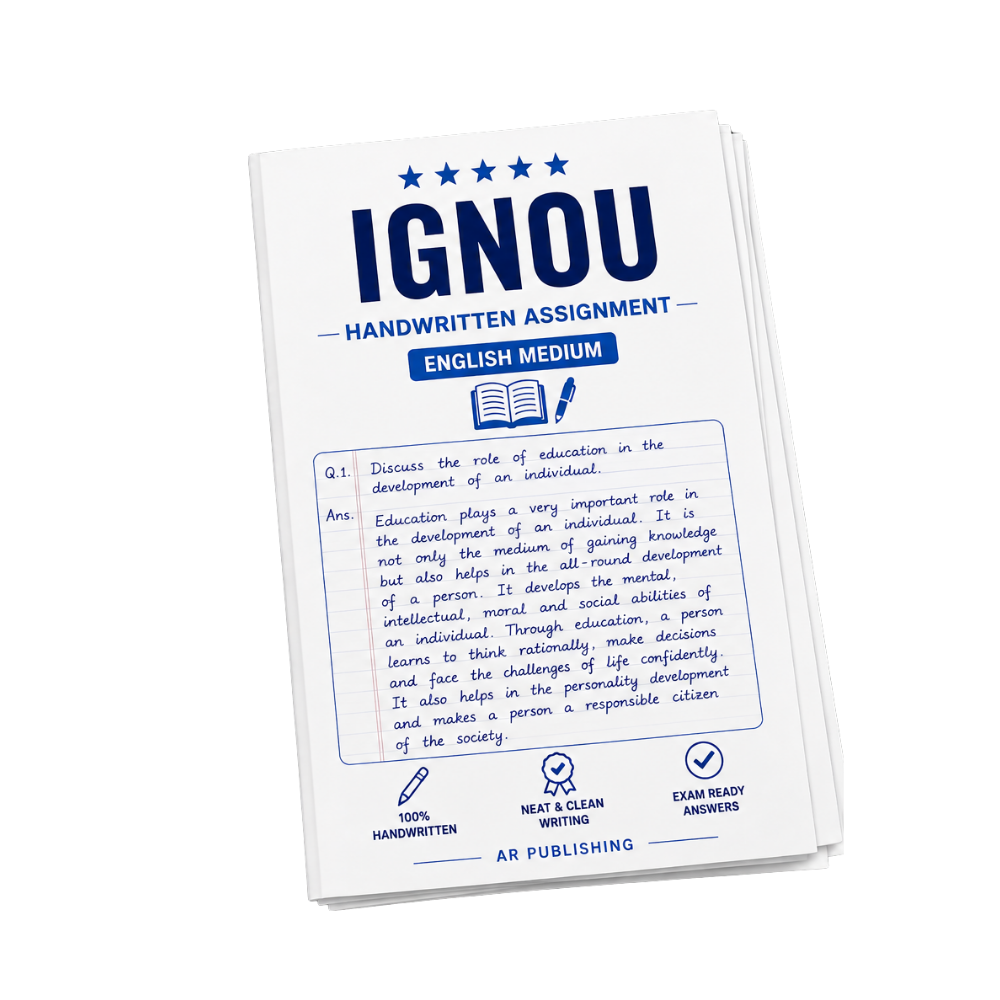
Syllabus & Overview
MWG-107: A Strategic Guide to Mastering Indian Government and Politics for IGNOU’s Term-End Examination
MWG-107 under IGNOU’s CBCS curriculum examines the institutional framework, policy dynamics, and socio-political challenges of modern India. This guide distills the core syllabus—spanning constitutional governance, federalism, and administrative reforms—into actionable insights. By analyzing past examination trends, it bridges theoretical knowledge with practical application, ensuring students can articulate nuanced responses on topics like the role of the Election Commission or the impact of the 73rd and 74th Amendments. The structured approach aligns with IGNOU’s assessment criteria, prioritizing analytical depth over rote memorization.Core Syllabus Units & Exam Focus Areas
- Unit 1: Constitutional Framework and Governance: Covers the Preamble, fundamental rights, and directive principles, with emphasis on their judicial interpretations (e.g., Kesavananda Bharati vs. State of Kerala). Highlights include the evolution of federalism and the role of the Supreme Court in political stability.
- Unit 3: Administrative Reforms and Public Policy: Explores the Mandal Commission, Lokpal Act, and digital governance initiatives, linking them to contemporary debates on transparency and efficiency in bureaucracy.
- Unit 5: Comparative Governance and Global Models: Analyzes India’s political system against federal democracies like the US or Germany, focusing on decentralization and participatory mechanisms under the 73rd Amendment.
- Unit 7: Electoral Politics and Party Systems: Examines voter behavior, anti-defection laws, and the influence of regional parties, with case studies on coalition dynamics in states like Kerala or Punjab.
Frequently Asked Questions
Q: How are numerical questions (e.g., on electoral turnout or constitutional amendments) weighted in MWG-107’s TEE, and which years’ papers should I prioritize for practice?
A: Numerical data questions account for 15–20% of marks, often sourced from the Election Commission’s annual reports or official government publications. Focus on June 2020 and December 2021 papers, as they feature recurring datasets on state-wise voter participation and amendment timelines.
Q: Are there specific chapters in MWG-107 where students frequently score full marks, and how can I identify high-yield topics for last-minute revision?
A: Units 2 (Judicial Activism) and 4 (Local Self-Governance) consistently yield high marks due to their direct alignment with current affairs (e.g., recent Supreme Court verdicts on Article 14 or implementation gaps in Panchayati Raj). Prioritize subtopics like the 10th Schedule’s anti-defection provisions and their judicial rulings.
Why buy from us?
-
Verified by top professors and 99th percentile students.
-
Always updated to the latest university curriculum.
-
High-quality, printable PDF formats with clear diagrams.
License & Terms
By purchasing this item, you agree to our standard academic license terms. You may use this product for personal study, but you may not resell or redistribute the files online.