

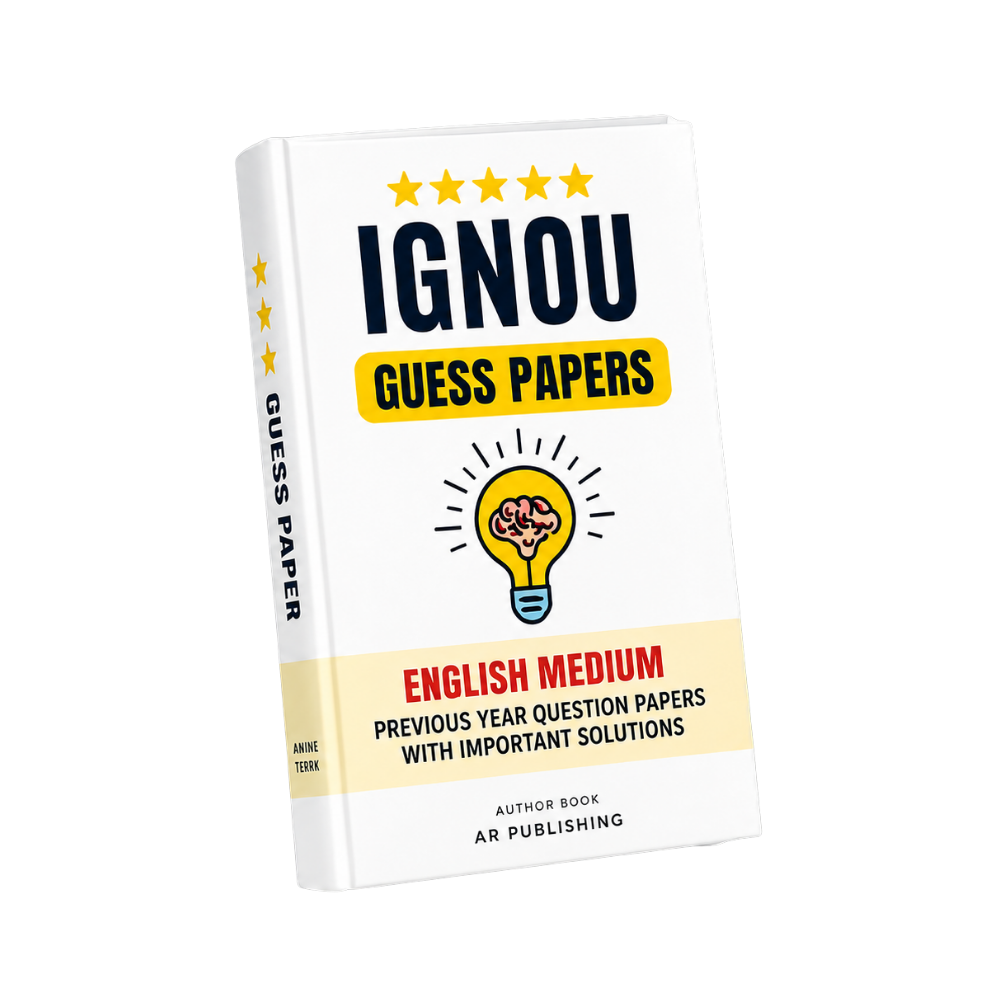
OEY-3 IGNOU Guess Paper 2026-27
Click to view offer details & terms
Get 10% OFF Instant Discount
Apply this coupon code at checkout to claim your academic discount instantly.
- Applicable on all university study materials
- Valid for up to 8 item(s) per order
- Valid till Oct 31, 2026
Enrolled in other IGNOU subjects?
Link your Enrollment No. to auto-map all your semester courses & free question papers.
Frequently Bought Together
Popular course materials frequently ordered together
Syllabus & Overview
OEY-3 IGNOU Guess Paper: Term-End Exam (TEE) Preparation Guide
This structured guess paper for OEY-3 (Organizational Effectiveness and Change Management) aligns with the official IGNOU curriculum, covering high-probability questions from previous years (June & Dec sessions) and strategic time management for the 3-hour exam. Below are key units, question patterns, and FAQs to optimize your preparation.
Core Syllabus Units & Expected Question Weightage
- Unit 1: Foundations of Organizational Effectiveness
- Key focus: Definitions, models (e.g., McGregor’s Theory X/Y, Likert’s Systems), and indicators of organizational health.
- Expected questions: Short-answer (3-5 marks) on efficiency vs. effectiveness and case-based analysis (10-15 marks) on diagnosing organizational performance.
- Unit 2: Change Management Theories and Processes
- Key focus: Lewin’s Change Model, Kotter’s 8-Step Process, resistance to change, and change agents.
- Expected questions: Long-answer (15-20 marks) on implementing change in hierarchical organizations and comparative analysis of theories (e.g., Lewin vs. Kotter).
- Unit 3: Strategic Human Resource Development
- Key focus: Link between HRD and organizational effectiveness, training needs analysis, and OD interventions (e.g., survey feedback, team building).
- Expected questions: Case studies (15-20 marks) on designing HRD programs for performance improvement and essay-type questions on alignment of HRD with strategic goals.
- Unit 4: Quality Management and Total Quality Approach
- Key focus: TQM principles, ISO standards, and quality circles. Emphasis on continuous improvement frameworks.
- Expected questions: Short-answer (5-10 marks) on TQM vs. Six Sigma and application-based questions on implementing quality initiatives in public/private sectors.
- Unit 5: Organizational Culture and Climate
- Key focus: Schein’s layers of culture, climate assessment tools, and cultural change strategies.
- Expected questions: Comparative analysis (10-15 marks) of strong vs. weak organizational cultures and role-play scenarios on managing cultural conflicts.
Exam Time Management Tips for OEY-3 (3-Hour Exam)
- Allocate 45 minutes for reading the question paper and planning answers (prioritize high-weightage units like Unit 2: and Unit 3).
- For short-answer questions (2-5 marks): Stick to structured bullet points (e.g., 3-4 key points for 5 marks) to save time.
- For long-answer questions (15-20 marks): Use case-based frameworks (e.g., ADKAR model for change management) and include real-world examples from IGNOU study material.
- Avoid spending more than 10 minutes per question in the initial 1.5 hours. Leave 30 minutes for reviewing answers.
Subject-Specific FAQs
- Q: Are numerical questions common in OEY-3?
No. OEY-3 primarily focuses on theoretical concepts, case studies, and analytical essays. Numerical questions (if any) are limited to quality management metrics (e.g., calculating customer satisfaction scores) and carry <5 marks.
- Q: How should I approach case-based questions?
Use the STAR method (Situation, Task, Action, Result) for structured responses. For example, in Unit 3 (HRD), describe a scenario where you diagnose training needs and propose solutions using Kotter’s change model.
Why buy from us?
-
Verified by top professors and 99th percentile students.
-
Always updated to the latest university curriculum.
-
High-quality, printable PDF formats with clear diagrams.
License & Terms
By purchasing this item, you agree to our standard academic license terms. You may use this product for personal study, but you may not resell or redistribute the files online.