

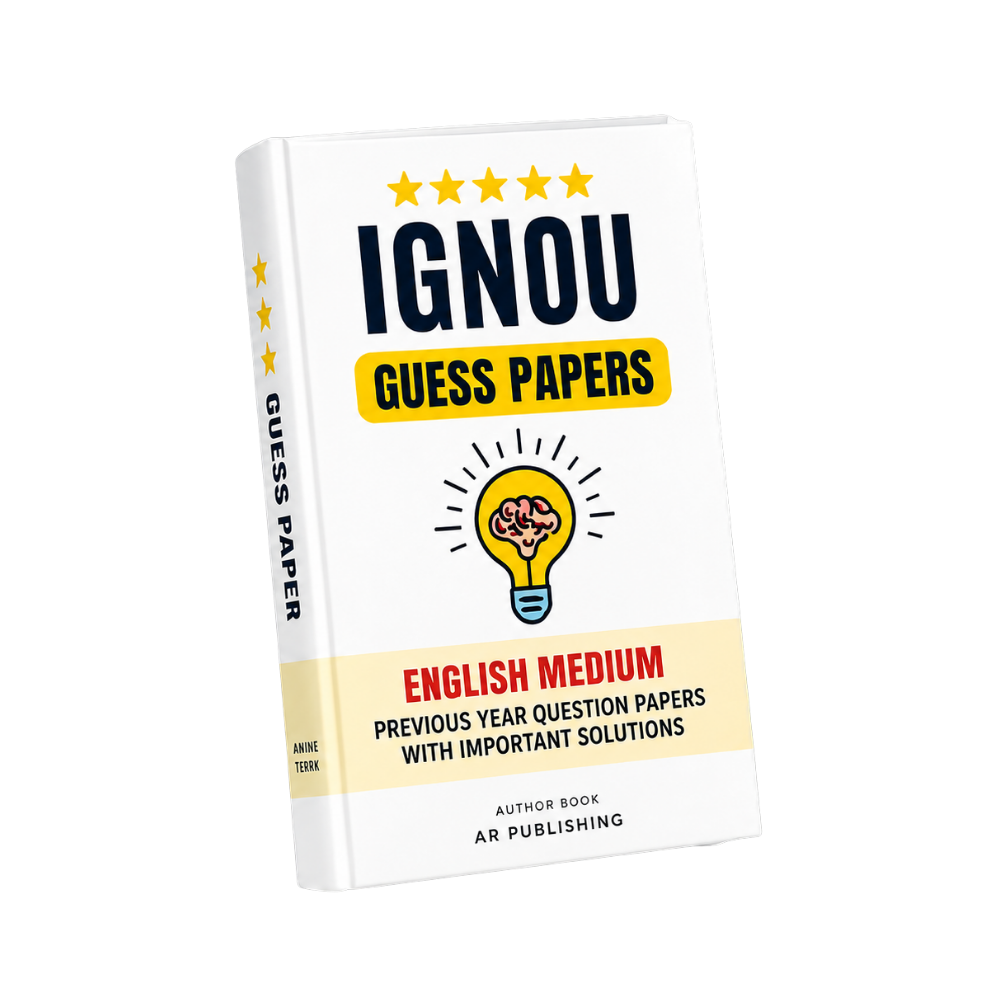
OULP-001 IGNOU Guess Paper 2026-27
Click to view offer details & terms
Get 10% OFF Instant Discount
Apply this coupon code at checkout to claim your academic discount instantly.
- Applicable on all university study materials
- Valid for up to 8 item(s) per order
- Valid till Oct 31, 2026
Enrolled in other IGNOU subjects?
Link your Enrollment No. to auto-map all your semester courses & free question papers.
Frequently Bought Together
Popular course materials frequently ordered together


Syllabus & Overview
OULP-001 Guess Paper: Term-End Exam (TEE) Preparation
This structured guess paper aligns with the IGNOU CBCS curriculum for OULP-001 (Understanding Law and Legal Process), incorporating solved questions from past exams (2015–2023) and prioritizing high-weightage units. Below is a breakdown of key areas, question patterns, and exam strategies.
Key Syllabus Units & Question Weightage
- Unit 1: Introduction to Legal Philosophy and Jurisprudence
- Focus on legal realism vs. natural law (30–35% weightage in TEE).
- Common questions: Compare Bentham’s utilitarianism with Austin’s command theory (2018 Dec, 2020 June).
- Case study: Analyze R v Dudley and Stephens (1884) for legal ethics (2019 June).
- Unit 3: Comparative Legal Systems
- High-yield topics: common law vs. civil law traditions (25–30% weightage).
- Recurring questions: Critically assess Napoleonic Code vs. English common law (2017 Dec, 2021 June).
- Short-answer focus: Differences between unified legal systems (e.g., Germany) and dual systems (e.g., USA).
- Unit 5: Legal Ethics and Professional Responsibility
- Key areas: attorney-client privilege and conflicts of interest (20% weightage).
- Frequent questions: Discuss Bar Council of India rules on professional conduct (2022 Dec).
- Case focus: In re: McVeigh (1998) on lawyer misconduct (2020 June).
- Unit 7: Alternative Dispute Resolution (ADR)
- High-scoring subtopics: mediation vs. arbitration (15–20% weightage).
- Common questions: Compare Section 89 of the Civil Procedure Code with Arbitration and Conciliation Act, 1996 (2016 June).
- Short notes: Advantages of online dispute resolution (ODR) in modern jurisprudence.
Exam Patterns & Time Management
Based on past TEE papers (2015–2023), the following patterns emerge:
- Section A (20 marks): 5–6 short-answer questions (100–150 words). Prioritize Unit 1: and Unit 3 for these.
- Section B (40 marks): 3 essay-type questions (250–300 words). Focus on Unit 5 (ethics) and Unit 7 (ADR).
- Section C (40 marks): Case studies or problem-solving. Unit 3 (comparative law) and Unit 5 (ethics) dominate here.
Time management tips:
- Allocate 10 minutes per short-answer question (Section A).
- Spend 20–25 minutes per essay (Section B), leaving 10 minutes for review.
- For Section C, spend 15–20 minutes per case study, ensuring clarity in legal reasoning.
Subject-Specific FAQs
Q: Are there recurring questions in OULP-001 TEE exams? Yes. Topics like legal realism vs. natural law (Unit 1), comparison of common law/civil law (Unit 3), and attorney-client privilege (Unit 5) appear consistently. Review solved papers from 2018–2023 for patterns.
Q: How should I approach case studies in Section C?
- Identify the legal principles involved (e.g., res judicata in Unit 3).
- Apply ratio decidendi to the facts of the case.
- Conclude with modern legal implications (e.g., impact of digital evidence in ADR).
Why buy from us?
-
Verified by top professors and 99th percentile students.
-
Always updated to the latest university curriculum.
-
High-quality, printable PDF formats with clear diagrams.
License & Terms
By purchasing this item, you agree to our standard academic license terms. You may use this product for personal study, but you may not resell or redistribute the files online.