

PHE-05 IGNOU Guess Paper 2026-27
Click to view offer details & terms
Get 10% OFF Instant Discount
Apply this coupon code at checkout to claim your academic discount instantly.
- Applicable on all university study materials
- Valid for up to 8 item(s) per order
- Valid till Oct 31, 2026
Enrolled in other IGNOU subjects?
Link your Enrollment No. to auto-map all your semester courses & free question papers.
Frequently Bought Together
Popular course materials frequently ordered together
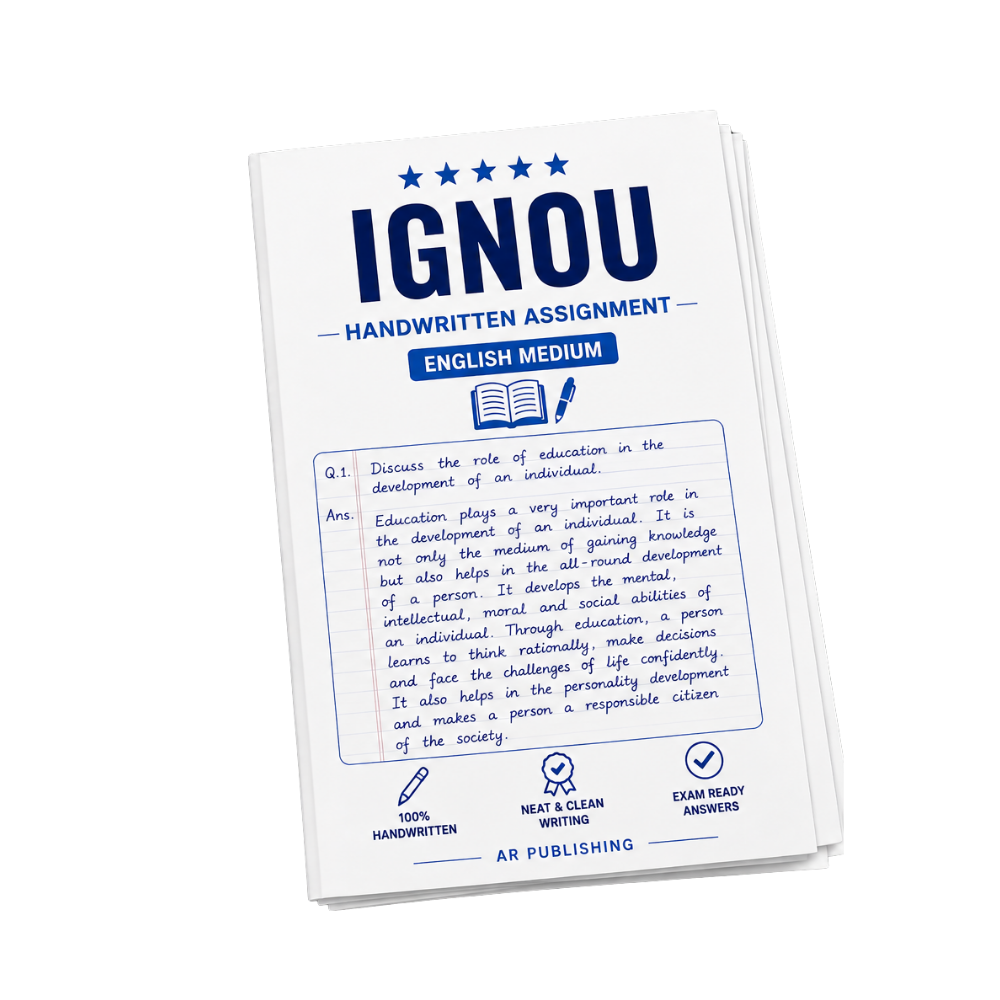
Syllabus & Overview
Course Scope and Syllabus Overview for PHE-05: Mathematical Methods in Physics II
PHE-05, Mathematical Methods in Physics II, is a core component of IGNOU’s Bachelor of Science (B.Sc.) curriculum under the School of Sciences, designed to deepen students’ analytical and problem-solving skills in advanced mathematical techniques essential for physical sciences. This course builds upon foundational concepts introduced in Mathematical Methods in Physics I (PHE-04), focusing on rigorous applications of differential equations—both ordinary and partial—that govern dynamic systems in physics. Through structured problem-solving and theoretical exploration, students develop expertise in modeling physical phenomena, preparing them for research, industry, or further academic pursuit in physics, engineering, or related disciplines.Key Syllabus Units and Topics
- Block-1: Ordinary Differential Equations: Covers first-order linear and nonlinear ODEs, exact and integrating factors, and solutions to second-order linear ODEs with constant coefficients, including applications to harmonic oscillators and damped systems.
- Block-2: Partial Differential Equations (PDEs): Introduces separation of variables, Fourier series, and solutions to the heat equation, wave equation, and Laplace’s equation, with emphasis on physical interpretations in heat transfer and wave propagation.
- Special Functions and Integral Transforms: Explores Bessel functions, Legendre polynomials, and Fourier transforms, critical for solving PDEs in cylindrical and spherical coordinates, as well as signal processing in quantum mechanics.
- Numerical Methods for Differential Equations: Discusses finite difference approximations, Euler’s method, and Runge-Kutta techniques for solving ODEs numerically, bridging theoretical analysis with computational physics.
- Applications in Physics: Integrates theoretical constructs with real-world scenarios, such as quantum harmonic oscillators, electromagnetic wave propagation, and diffusion processes, reinforcing interdisciplinary problem-solving.
Frequently Asked Questions
Q: What is the marking scheme for PHE-05’s Term-End Examination (TEE), and how are internal assignments weighted in the final grade?
A: The TEE for PHE-05 carries 100 marks, accounting for 70% of the total grade, while assignments contribute 30%. Focus on mastering core concepts from Blocks 1 and 2, as questions often align with these units.
Q: Are there recurring questions in past TEE papers for PHE-05, and how can I prioritize revision based on question weightage?
A: Approximately 40–50% of questions in recent TEE papers repeat annually, particularly from ODEs, PDEs, and Fourier transforms. Prioritize solving 5–10 years of past papers to identify high-yield topics and time management strategies.
Why buy from us?
-
Verified by top professors and 99th percentile students.
-
Always updated to the latest university curriculum.
-
High-quality, printable PDF formats with clear diagrams.
License & Terms
By purchasing this item, you agree to our standard academic license terms. You may use this product for personal study, but you may not resell or redistribute the files online.