

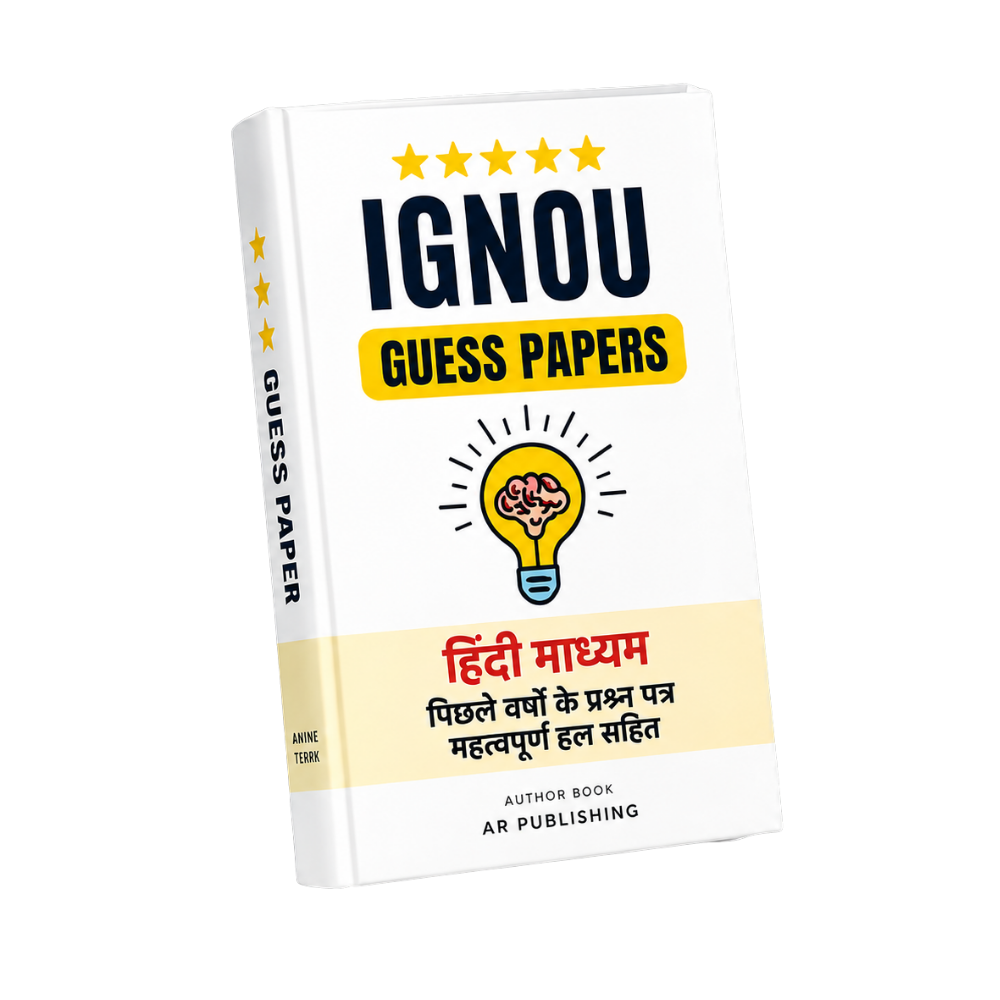
BCOG-172- IGNOU Guess Paper 2026-27
Click to view offer details & terms
Get 10% OFF Instant Discount
Apply this coupon code at checkout to claim your academic discount instantly.
- Applicable on all university study materials
- Valid for up to 8 item(s) per order
- Valid till Oct 31, 2026
Enrolled in other IGNOU subjects?
Link your Enrollment No. to auto-map all your semester courses & free question papers.
Frequently Bought Together
Popular course materials frequently ordered together
Syllabus & Overview
BCOG-172 (Indian Economy) Guess Paper for Term-End Exam (TEE)
This structured guess paper aligns with the IGNOU BCOMG curriculum for BCOG-172, prioritizing high-scoring units identified from past TEE papers (2018–2023). It includes chapter-wise question weightage, solved previous year patterns, and 3-hour exam time management tips.
Key Syllabus Blocks Covered
- Block-3: Issues in Indian Economy
- Poverty and unemployment trends (2026-27 data).
- Human Development Index (HDI) and its components (GDP, literacy, life expectancy).
- Case studies on regional disparities (e.g., BIMARU states vs. developed states).
- Block-4: Sectoral Development-I (Agriculture Sector in India)
- Green Revolution impact vs. its sustainability challenges.
- Government schemes (PM-KISAN, Soil Health Card) and their implementation gaps.
- Trade liberalization and agricultural exports (top 5 commodities).
- Block-5: Sectoral Development-II (Industrial & Services)
- Make in India: Progress in manufacturing (GDP contribution, FDI trends).
- Services sector growth (IT-BPM, tourism, financial services).
- MSME sector challenges (credit access, digitalization barriers).
- Block-7: Fiscal and Monetary Policy
- Budget 2026-27: Key allocations (infrastructure, healthcare, defense).
- Impact of RBI policies (repo rate, liquidity adjustments on MSMEs).
- Deficit financing and its macroeconomic implications.
Exam Strategy & Time Management
- Section-wise focus:
- Block-3 & Block-7 (40% weightage): Prioritize numerical problems (e.g., GDP growth calculations) and policy analysis.
- Block-4 & Block-5 (35% weightage): Focus on case studies and scheme evaluations (e.g., PM-KISAN impact).
- Block-1 & Block-2 (25% weightage): Master definitions (e.g., HDI, Human Poverty Index) and comparative analysis.
- Time allocation:
- First hour: Answer 2 long-answer questions (30 mins each).
- Second hour: Tackle 5 short-answer questions (15 mins each).
- Final 30 mins: Review answers and address partial credit opportunities.
Frequently Asked Questions (FAQs)
Q1: Are descriptive questions more important than numericals in BCOG-172?Descriptive questions (e.g., policy analysis, case studies) carry higher weightage (60–70%) in TEE papers. Numerical problems (e.g., GDP growth calculations) are 10–15% but critical for partial marks. Focus on both.
Q2: How to prepare for Block-6 (External Sector) if it’s less emphasized?Block-6 (External Sector) typically appears as 2 short-answer questions (10 marks each). Focus on:
- Trade deficit analysis (2026-27 data).
- Impact of global crises (e.g., COVID-19, Ukraine war) on Indian trade.
- Key trade partners (USA, UAE, China) and export/import trends.
Previous Year Paper Insights
Based on 5–10 years of TEE patterns, expect:
- 2 long questions (20 marks each) from Block-3 (Issues in Indian Economy) or Block-7 (Fiscal Policy).
- 5 short questions (10 marks each) from Blocks 4–6 (Sectoral Development + External Sector).
- 1 numerical problem (10 marks) from Block-1 or Block-2 (Economic Development Measurement).
Note: Avoid rote memorization; emphasize application-based answers
Why buy from us?
-
Verified by top professors and 99th percentile students.
-
Always updated to the latest university curriculum.
-
High-quality, printable PDF formats with clear diagrams.
License & Terms
By purchasing this item, you agree to our standard academic license terms. You may use this product for personal study, but you may not resell or redistribute the files online.