

BECC-104 IGNOU Guess Paper 2026-27
Click to view offer details & terms
Get 10% OFF Instant Discount
Apply this coupon code at checkout to claim your academic discount instantly.
- Applicable on all university study materials
- Valid for up to 8 item(s) per order
- Valid till Oct 31, 2026
Enrolled in other IGNOU subjects?
Link your Enrollment No. to auto-map all your semester courses & free question papers.
Frequently Bought Together
Popular course materials frequently ordered together
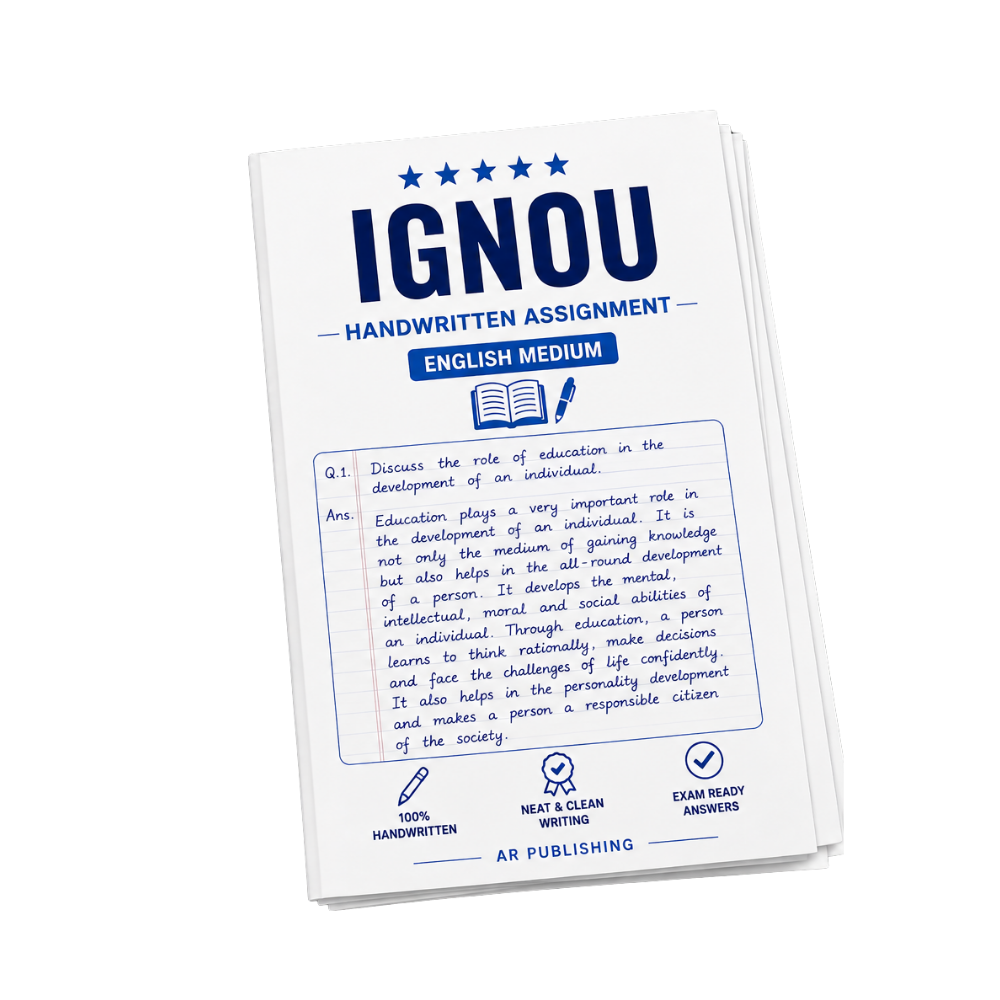
Syllabus & Overview
Course Scope & Syllabus Overview: BECC-104 Mathematical Methods in Economics-II
BECC-104 Mathematical Methods in Economics-II is a core course under the IGNOU Bachelor of Arts (Honours) Economics curriculum, designed to strengthen students' analytical and problem-solving skills in advanced economic modeling. This course builds upon foundational mathematical techniques, equipping learners with essential tools for optimizing economic functions, analyzing dynamic systems, and applying linear algebra to real-world economic scenarios. The syllabus integrates theoretical rigor with practical applications, ensuring students can interpret complex economic phenomena through rigorous mathematical frameworks.Key Syllabus Units & Topics
- Functions of Several Variables: Covers partial derivatives, implicit functions, and optimization techniques for multivariable economic models, including constrained and unconstrained optimization.
- Differential Equations: Explores ordinary differential equations (ODEs) and their applications in economic growth models, market equilibrium dynamics, and time-series economic analysis.
- Linear Algebra: Focuses on matrix algebra, eigenvalues, eigenvectors, and their role in input-output models, general equilibrium theory, and econometric systems.
- Multivariate Optimisation: Delves into Lagrange multipliers, convexity, and duality theory to solve optimization problems in resource allocation, production theory, and welfare economics.
- Mathematical Economics Applications: Bridges theory with practice by applying differential equations and optimization to real-world economic scenarios, such as cost minimization and profit maximization.
Frequently Asked Questions
Q: How are marks distributed in the BECC-104 Term-End Examination (TEE), and what weightage does each section carry?
A: The TEE for BECC-104 typically follows a 70% theory-based question paper (covering all four blocks) and 30% problem-solving sections, with internal weightage varying per unit but generally aligned to the syllabus proportion.
Q: Are there specific past-year questions that frequently repeat in BECC-104 exams, and how can students prioritize revision?
A: Repeated questions often appear in optimization problems (e.g., Lagrange multipliers) and differential equation applications (e.g., economic growth models), so students should prioritize solving 5–10 years of past papers to identify recurring patterns.
Why buy from us?
-
Verified by top professors and 99th percentile students.
-
Always updated to the latest university curriculum.
-
High-quality, printable PDF formats with clear diagrams.
License & Terms
By purchasing this item, you agree to our standard academic license terms. You may use this product for personal study, but you may not resell or redistribute the files online.