

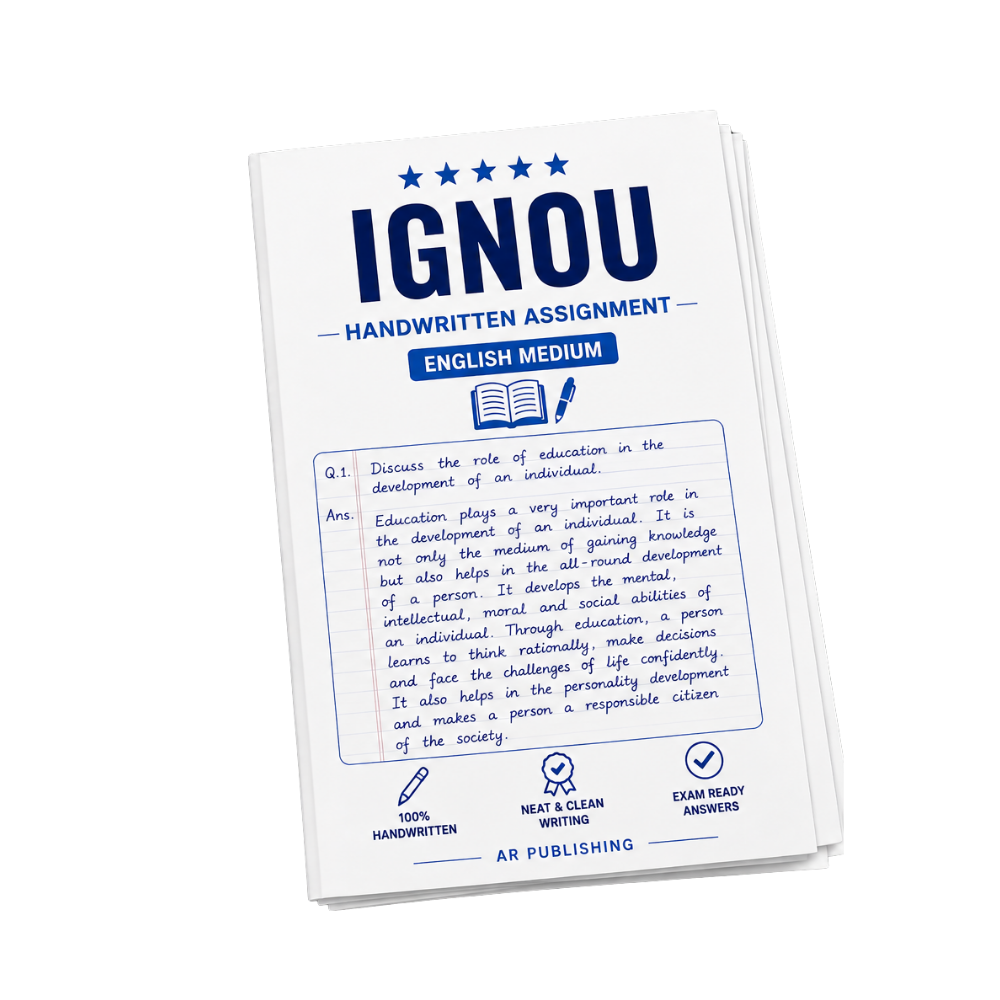
BPAC-131 IGNOU Handwritten Assignment 2026-27
Click to view offer details & terms
Get 10% OFF Instant Discount
Apply this coupon code at checkout to claim your academic discount instantly.
- Applicable on all university study materials
- Valid for up to 8 item(s) per order
- Valid till Oct 31, 2026
Enrolled in other IGNOU subjects?
Link your Enrollment No. to auto-map all your semester courses & free question papers.
Frequently Bought Together
Popular course materials frequently ordered together
Syllabus & Overview
Course Scope and Syllabus Overview for BPAC-131: Perspectives on Public Administration
BPAC-131: Perspectives on Public Administration is a core course under the Bachelor of Arts (BAM) programme offered by IGNOU’s School of Social Sciences. This course critically examines the evolution, theories, and contemporary challenges of public administration, equipping students with a multidisciplinary understanding of governance structures, policy formulation, and administrative practices. Through a structured analysis of classical, behavioural, and systemic perspectives, students develop analytical skills to evaluate administrative efficiency, ethical governance, and the role of public institutions in societal development. The curriculum aligns with the CBCS framework, ensuring a rigorous exploration of both theoretical frameworks and real-world applications, preparing students for roles in public service, policy analysis, and organizational management.Key Syllabus Units and Topics
- Block-1: Conceptual and Classical Perspectives: This block introduces foundational theories of public administration, including the bureaucratic model (Max Weber), the science of administration (Luther Gulick and Lyndall Urwick), and the role of public administration in democratic governance. Students analyze the historical evolution of administrative thought and its impact on modern governance systems.
- Block-2: Behavioural, Systems, and Socio-Psychological Perspectives: Focuses on human behaviour in organizations, leadership theories (e.g., Chester Barnard’s acceptance theory), and systems theory (Katz and Kahn). The unit explores how organizational culture, motivation, and communication influence administrative effectiveness and public service delivery.
- Block-3: Public Policy Perspective: Examines the policy-making process, including agenda-setting, formulation, implementation, and evaluation. Students study models like the rational-comprehensive approach and incrementalism (Charles Lindblom) while analyzing case studies of public policy failures and successes.
- Block-4: Political and Social Perspectives: Investigates the interplay between politics and administration, including political theories of administration (Woodrow Wilson), interest group dynamics, and the role of civil society in governance. The unit also covers administrative accountability and transparency mechanisms.
- Block-5: Contemporary Perspectives: Addresses emerging challenges such as digital governance, New Public Management (NPM), and global best practices in public administration. Students evaluate contemporary reforms, ethical dilemmas, and the impact of technology on administrative efficiency and citizen engagement.
Frequently Asked Questions
Q: What is the marking scheme for the BPAC-131 assignment, and how many questions are typically assigned?
A: The BPAC-131 assignment carries 30 marks and usually consists of 5–6 questions, combining short-answer and analytical questions. Each question is weighted proportionally, with a focus on conceptual clarity, critical analysis, and application of theories from the syllabus.
Q: What are the minimum pass marks required for BPAC-131, and how does the examination pattern differ from the assignment?
A: The minimum pass marks for BPAC-131 are 40% in the theory examination (100 marks) and 30% in the assignment. The examination includes objective and subjective questions, while the assignment assesses understanding through written responses based on the course material.
Why buy from us?
-
Verified by top professors and 99th percentile students.
-
Always updated to the latest university curriculum.
-
High-quality, printable PDF formats with clear diagrams.
License & Terms
By purchasing this item, you agree to our standard academic license terms. You may use this product for personal study, but you may not resell or redistribute the files online.