

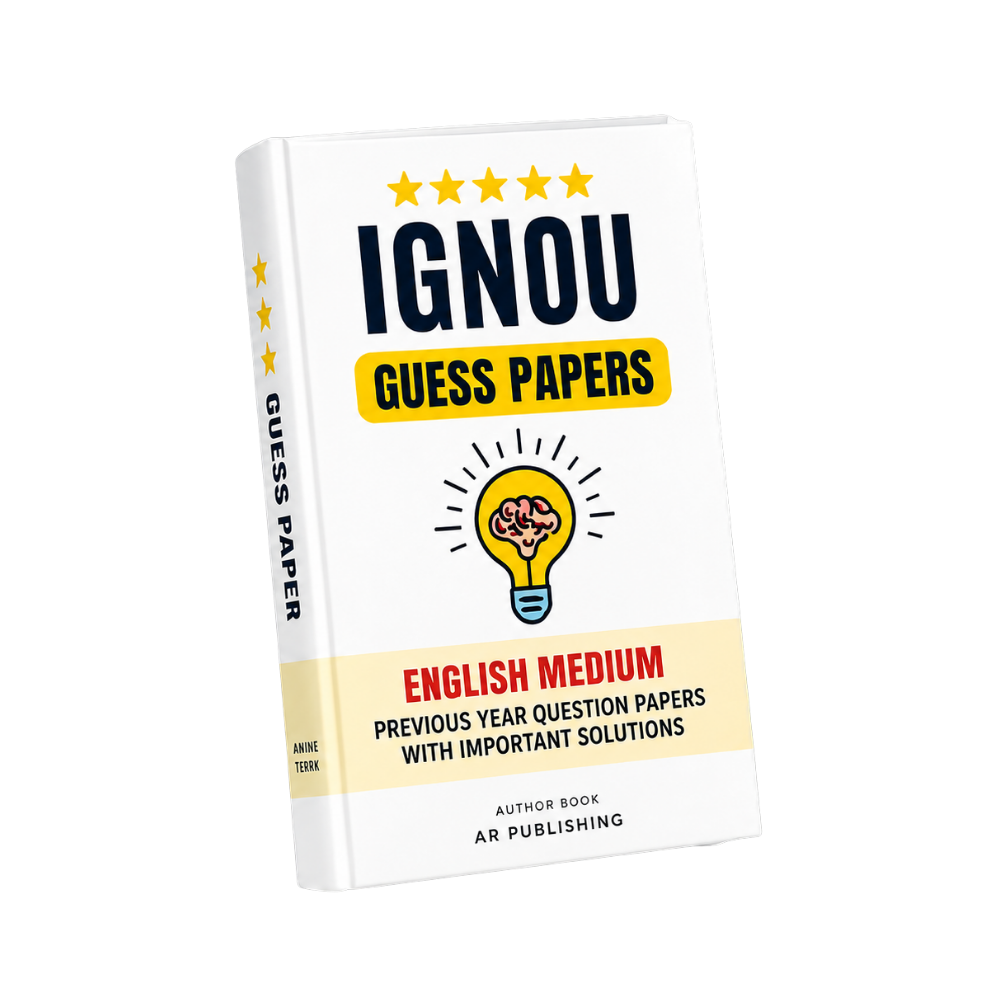
BPCG-171 IGNOU Guess Paper 2026-27
Click to view offer details & terms
Get 10% OFF Instant Discount
Apply this coupon code at checkout to claim your academic discount instantly.
- Applicable on all university study materials
- Valid for up to 8 item(s) per order
- Valid till Oct 31, 2026
Enrolled in other IGNOU subjects?
Link your Enrollment No. to auto-map all your semester courses & free question papers.
Frequently Bought Together
Popular course materials frequently ordered together
Syllabus & Overview
BPCG-171 Guess Paper General Psychology (Term-End Exam Preparation)
This structured guess paper aligns with IGNOU’s official BPCG-171 syllabus, covering critical topics from previous year exams (2018–2023) and time-tested question patterns. Optimized for 3-hour exams, it includes chapter-wise weightage, FAQs, and scoring strategies for high-yield blocks.
Key Syllabus Blocks & Weightage (TEE Focus)
- Block 1: Orientation to Psychology
- Definition and scope of psychology (20–25% weightage). Focus on historical perspectives (Wundt, James, Freud) and subfields (clinical, social, cognitive).
- Commonly asked: Compare structuralism vs. functionalism; role of psychology in behavioral sciences.
- Block 2: Psychology of Individual Differences
- Intelligence theories (Gardner’s multiple intelligences, Sternberg’s triarchic theory) and measurement (IQ tests, validity/reliability).
- Personality models: Big Five, Freud’s psychodynamic approach, and assessment tools (MMPI, Rorschach).
- Block 3: Developmental Processes
- Lifespan development stages (Piaget’s cognitive, Erikson’s psychosocial) with emphasis on critical periods.
- Common TEE questions: Compare nature-nurture debates; effects of attachment (Bowlby, Ainsworth).
- Block 4: Applications of Psychology
- Industrial/organizational psychology (motivation theories: Maslow, Herzberg) and workplace behavior.
- Social psychology: Conformity (Asch), obedience (Milgram), and cognitive dissonance (Festinger).
Exam Time Management (3-Hour Strategy)
Allocate time as follows for 100 marks (50 MCQs + 50 descriptive):
- First 45 minutes: Attempt all MCQs (1 mark each). Prioritize Blocks 1 and 3 (higher frequency in past papers).
- Next 60 minutes: Answer 3 descriptive questions (10 marks each) from Blocks 2 and 4, focusing on theories (e.g., explain Gardner’s MI theory) and case studies.
- Final 30 minutes: Review MCQs, correct guesses, and briefly outline descriptive answers for partial credit.
Frequently Asked Questions (FAQs)
- Q: Are case studies common in TEE?: Yes. Blocks 3 and 4 frequently include case-based questions (e.g., analyze a child’s developmental milestone or a workplace conflict scenario).
- Q: How to score in MCQs?: Focus on Blocks 1 and 2 (e.g., definitions, theories) as they appear consistently in past papers. Use elimination for ambiguous options.
Sample Question Patterns (Previous Years)
- Block 1: “Explain the contributions of Wundt and James to modern psychology” (2022 Dec).
- Block 2: “Compare and contrast Gardner’s and Sternberg’s theories of intelligence” (2021 June).
- Block 3: “Describe the stages of cognitive development in Piaget’s theory with examples” (2020 Dec).
- Block 4: “Discuss the applications of social psychology in workplace settings” (2019 June).
Note: Descriptive answers should include theory + examples + real-world applications for full marks.
Why buy from us?
-
Verified by top professors and 99th percentile students.
-
Always updated to the latest university curriculum.
-
High-quality, printable PDF formats with clear diagrams.
License & Terms
By purchasing this item, you agree to our standard academic license terms. You may use this product for personal study, but you may not resell or redistribute the files online.