

Instant PDF
Instant 24/7 Access
CBCS Verified
2026-27 Syllabus
100% Safe Pay
UPI, Cards & NetBanking
Student Support
WhatsApp Helpdesk
BPHCT-137 IGNOU Handwritten Assignment 2026-27
Enrolled in other IGNOU subjects?
Link your Enrollment No. to auto-map your semester courses & free question papers.
Frequently Bought Together
Popular course materials frequently ordered together


Syllabus & Overview
BPHCT-137: Comprehensive Handwritten Assignment (Waves and Optics)
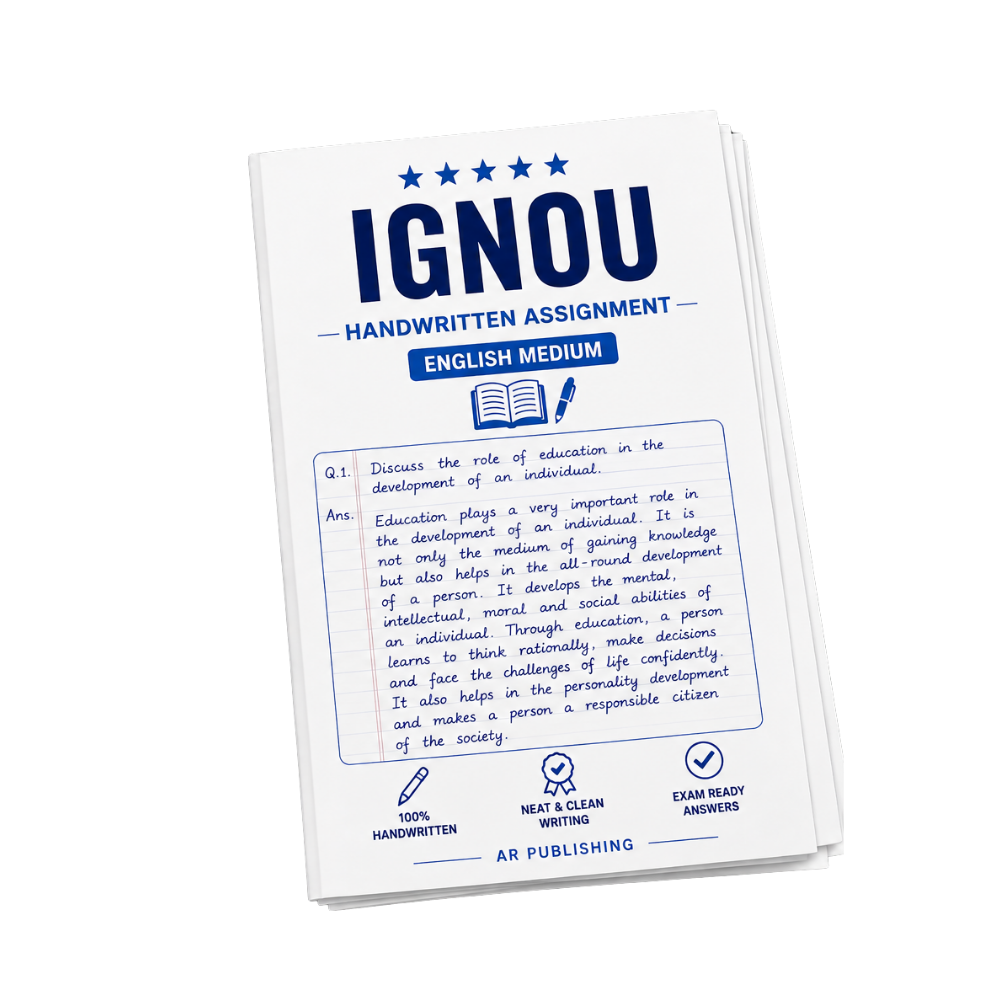
This physical hard copy assignment is tailored for BPHCT-137 (Waves and Optics), covering core units from the official IGNOU curriculum for BSc (General) students. Delivered on 80 GSM ruled A4 paper with neat handwriting, it includes an attached official IGNOU front page and printed question paper for seamless submission via Speed Post.
Key Syllabus Units Covered
- Unit 1: Wave Motion and Waves on Strings
Detailed explanation of transverse and longitudinal waves, wave equation derivation, and boundary conditions for waves on stretched strings. Includes numerical problems on wave velocity, reflection, and superposition.
- Unit 2: Sound Waves and Acoustics
Study of sound wave properties, Doppler effect, resonance, and standing waves in pipes. Covers practical applications like musical instruments and ultrasound.
- Unit 3: Electromagnetic Waves and Optics Fundamentals
Maxwell’s equations, Poynting vector, and polarization of EM waves. Introduction to geometric optics, refraction, and Snell’s law with solved examples.
- Unit 4: Interference and Diffraction
Young’s double-slit experiment, interference patterns, and diffraction gratings. Includes ray optics and Fresnel diffraction analysis.
- Unit 5: Optical Instruments and Modern Optics
Working principles of microscopes, telescopes, and spectrometers. Brief introduction to laser basics and holography.
Subject-Specific FAQs
- How is wave velocity calculated for a string under tension?
Wave velocity v on a stretched string is given by v = √(T/μ), where T is tension and μ is linear mass density. The assignment includes step-by-step derivations and numerical examples.
- What are the key differences between interference and diffraction?
Interference occurs due to the superposition of two or more waves from coherent sources, while diffraction involves the bending of waves around obstacles or apertures. The assignment provides comparative diagrams and solved problems.
Assignment Features
- 100% handwritten on high-quality 80 GSM ruled A4 paper.
- Includes official IGNOU front page and printed question paper.
- Delivered via Indian Speed Post to the student’s registered address.
- Strictly follows BPHCT-137 syllabus for BSc (General) School of Sciences.
Why buy from us?
-
Verified by top professors and 99th percentile students.
-
Always updated to the latest university curriculum.
-
High-quality, printable PDF formats with clear diagrams.
License & Terms
By purchasing this item, you agree to our standard academic license terms. You may use this product for personal study, but you may not resell or redistribute the files online.