

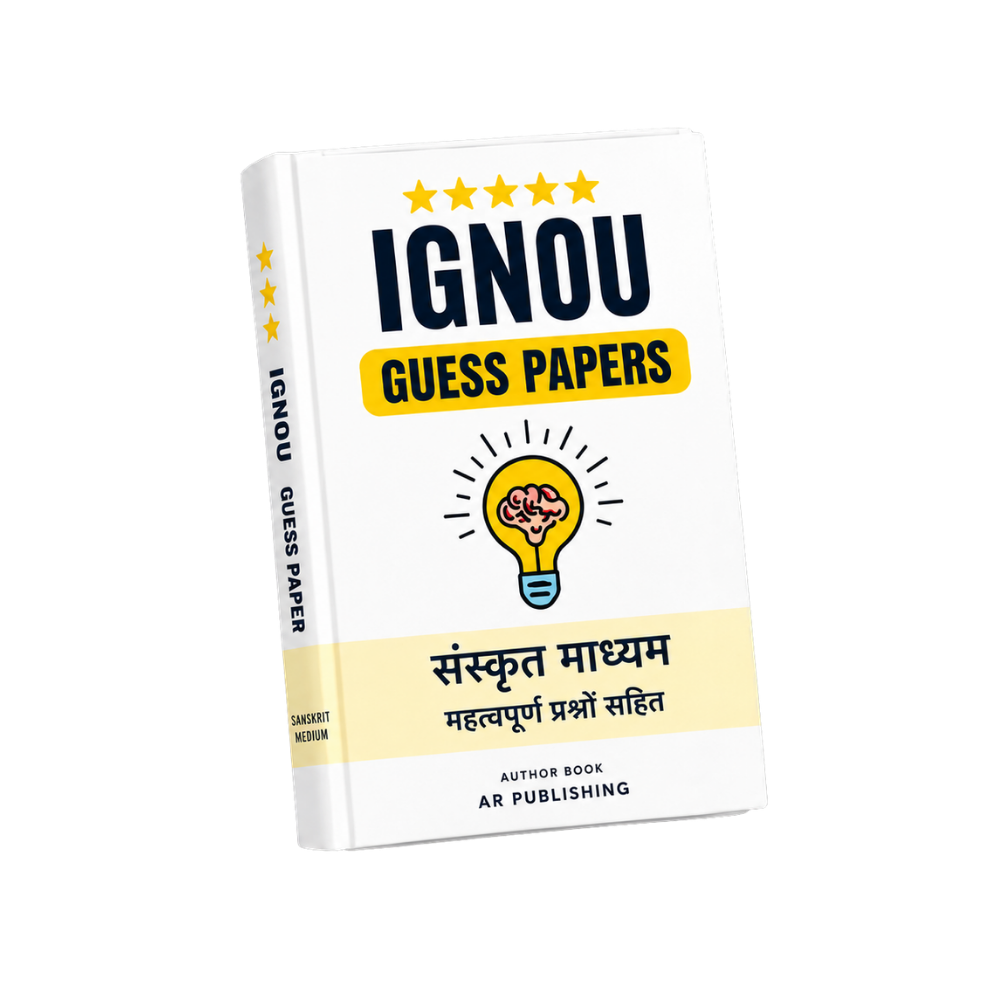
BSKC-108 IGNOU Guess Paper 2026-27
Click to view offer details & terms
Get 10% OFF Instant Discount
Apply this coupon code at checkout to claim your academic discount instantly.
- Applicable on all university study materials
- Valid for up to 8 item(s) per order
- Valid till Oct 31, 2026
Enrolled in other IGNOU subjects?
Link your Enrollment No. to auto-map all your semester courses & free question papers.
Frequently Bought Together
Popular course materials frequently ordered together
Syllabus & Overview
Course Scope & Syllabus Overview: BSKC-108
BSKC-108: is a specialized course under IGNOU’s Bachelor of Arts (Honours) Sanskrit curriculum, designed to equip students with in-depth knowledge of ancient Indian inscriptions, epigraphic studies, and chronological methodologies. This course bridges historical research and textual analysis, enabling learners to decode inscriptions, evaluate their linguistic and cultural significance, and apply chronological frameworks to reconstruct ancient Indian timelines. The syllabus integrates primary sources with academic rigor, fostering critical interpretation of epigraphic evidence to contextualize India’s pre-modern history.Key Syllabus Units & Topics
- -1 : Covers the foundational principles of epigraphy, including the classification of inscriptions, their linguistic diversity (Prakrit, Sanskrit, regional scripts), and methodologies for transcription and translation. Emphasizes the role of inscriptions as historical documents and their preservation challenges.
- -2 : Analyzes seminal inscriptions such as the Ashokan Edicts, Gupta-era pillars, and regional dynastic records (e.g., Rashtrakuta, Chalukya), highlighting their political, religious, and administrative content. Focuses on decoding royal proclamations, land grants, and devotional texts.
- -3 : Examines the evolution of Indian scripts (e.g., Brahmi, Kharosthi, Gupta, Nāgarī) and their regional variations. Discusses paleographic techniques, script evolution over time, and the transition from undeciphered to standardized epigraphic texts.
- -4 : Explores the epistemological value of inscriptions in historiography, including their use in dating historical events, validating chronicles, and cross-referencing with literary sources. Introduces chronological frameworks (e.g., regnal years, astronomical data) for reconstructing ancient calendars.
Frequently Asked Questions
Q: How is the BSKC-108 examination structured, and what is the weightage of internal and external assessments?
A: The TEE for BSKC-108 carries 100 marks, with no internal assignments. The exam emphasizes both theoretical understanding (50–60% weightage) and analytical interpretation of inscriptions (40–50%), including case studies and translation exercises.
Q: Are there specific chapters or units in BSKC-108 that frequently appear in repeated questions across TEE cycles?
A: Units -2 and -4 consistently feature in repeated questions, particularly the Ashokan Edicts, Gupta inscriptions, and chronological methodologies. Focus on decoding sample inscriptions and applying dating techniques for higher accuracy.
Why buy from us?
-
Verified by top professors and 99th percentile students.
-
Always updated to the latest university curriculum.
-
High-quality, printable PDF formats with clear diagrams.
License & Terms
By purchasing this item, you agree to our standard academic license terms. You may use this product for personal study, but you may not resell or redistribute the files online.