

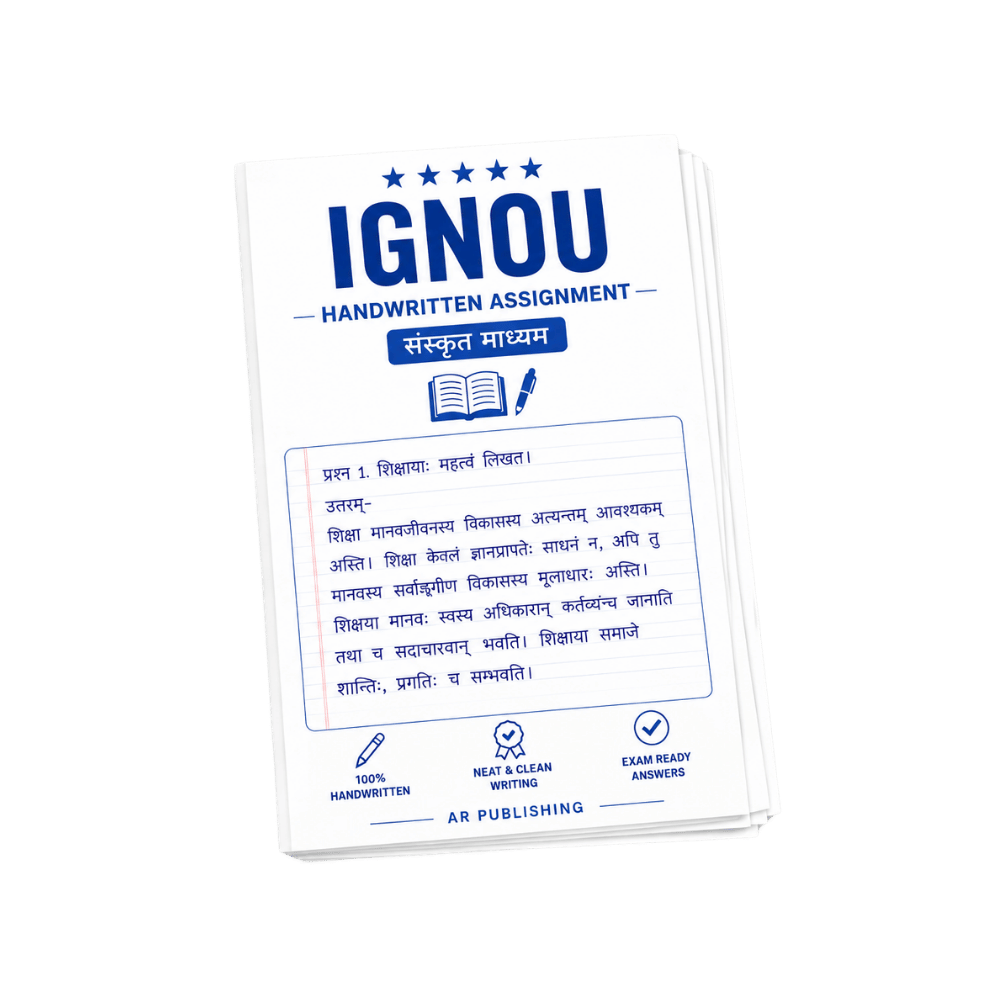
BSKG-172 IGNOU Handwritten Assignment 2026-27
Click to view offer details & terms
Get 10% OFF Instant Discount
Apply this coupon code at checkout to claim your academic discount instantly.
- Applicable on all university study materials
- Valid for up to 8 item(s) per order
- Valid till Oct 31, 2026
Enrolled in other IGNOU subjects?
Link your Enrollment No. to auto-map all your semester courses & free question papers.
Frequently Bought Together
Popular course materials frequently ordered together
Syllabus & Overview
BSKG-172: Handwritten Assignment Hard Copy Overview
Course Scope & Syllabus Overview
BSKG-172: is a core course under the IGNOU Bachelor of Arts (Honours) Sanskrit (BASKH) curriculum, designed to provide students with a structured understanding of foundational philosophical principles in Indian thought. This course systematically explores the epistemological, metaphysical, and ethical frameworks that define classical Indian philosophy, ensuring students engage deeply with primary texts and critical analyses. The syllabus integrates historical context with analytical rigor, enabling learners to grasp the evolution of key schools of thought—such as Nyaya, Vaisheshika, Samkhya, Yoga, and Vedanta—while fostering critical thinking about their relevance in contemporary intellectual discourse.Key Syllabus Units & Topics
- -1 : This unit examines the foundational tenets of Indian philosophy, including the nature of Atman, Brahman, and the relationship between Purusha and Prakriti, while analyzing the role of Vedas as the primary source of philosophical inquiry.
- -2 -1: Focuses on the Nyaya and Vaisheshika schools, dissecting their logical frameworks, pramanas (proofs), and metaphysical distinctions, alongside the Samkhya-Yoga synthesis of dualistic and non-dualistic perspectives.
- -3 -2: Delves into the Vedanta school, contrasting Advaita, Vishishtadvaita, and Dvaita philosophies, with emphasis on the Upanishads and their interpretations of liberation (Moksha) and divine consciousness.
- -4 : Addresses contemporary debates in Indian philosophy, such as the reconciliation of karma and free will, the critique of materialism, and the philosophical underpinnings of ethical systems like Dharma.
Frequently Asked Questions
Q: What is the marking scheme for the BSKG-172 assignment, and how many marks are allocated to each section?
A: The BSKG-172 assignment carries 30 marks, with specific weightage assigned to analytical responses, textual references, and critical reasoning. Each unit typically accounts for proportional marks, and adherence to prescribed word limits is mandatory for full credit.
Q: Are there any pass marks criteria for the BSKG-172 examination, and how does the assignment contribute to the final grade?
A: The BSKG-172 course requires a minimum of 40% marks in the assignment and 50% in the theory examination to pass. The assignment contributes 30% to the final grade, while the term-end exam accounts for the remaining 70%, ensuring comprehensive evaluation of conceptual understanding.
Why buy from us?
-
Verified by top professors and 99th percentile students.
-
Always updated to the latest university curriculum.
-
High-quality, printable PDF formats with clear diagrams.
License & Terms
By purchasing this item, you agree to our standard academic license terms. You may use this product for personal study, but you may not resell or redistribute the files online.