

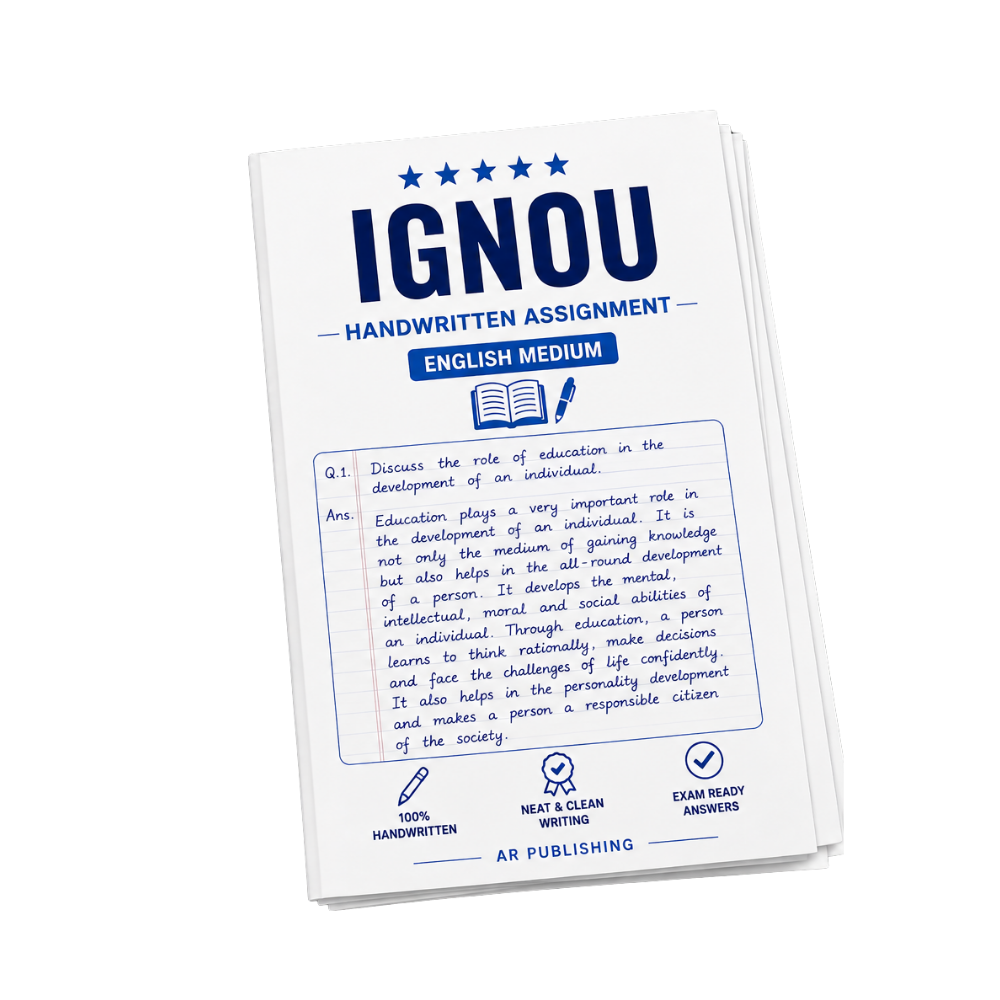
BSOE-142 IGNOU Handwritten Assignment 2026-27
Click to view offer details & terms
Get 10% OFF Instant Discount
Apply this coupon code at checkout to claim your academic discount instantly.
- Applicable on all university study materials
- Valid for up to 8 item(s) per order
- Valid till Oct 31, 2026
Enrolled in other IGNOU subjects?
Link your Enrollment No. to auto-map all your semester courses & free question papers.
Frequently Bought Together
Popular course materials frequently ordered together

Syllabus & Overview
Course Scope & Syllabus Overview
BSOE-142: Indian Sociological Traditions is a core course under the IGNOU Bachelor of Arts (BAG) programme, offering an in-depth exploration of India’s sociological thought from ancient texts to contemporary scholars. This course bridges historical analysis with theoretical frameworks, examining how Indian sociological traditions—rooted in philosophical, religious, and empirical traditions—have shaped modern social inquiry. Students engage with primary texts, critical debates, and comparative studies to understand the unique contributions of Indian sociologists to global sociology, while developing analytical skills to interpret social structures, cultural dynamics, and policy implications. The curriculum integrates historical context with contemporary relevance, ensuring students grasp the evolution of sociological perspectives in India, from early thinkers like M.N. Srinivas to modern scholars addressing caste, gender, and urbanization. Assignments are designed to foster critical engagement with these traditions, preparing students for rigorous academic and professional applications in sociology and social anthropology.Key Syllabus Units & Topics
- Block-1: History and Development of Indian Sociological Traditions: This unit traces the origins of sociological thought in India, analyzing classical texts like the Arthashastra and Manusmriti alongside early colonial critiques. It explores how indigenous philosophical traditions (e.g., Vedanta, Yoga) influenced early sociological concepts of society, hierarchy, and ethics.
- Block-2: Sociologists in India-1: Focuses on foundational figures such as G.S. Ghurye, Irawati Karve, and D.P. Mukerjee, examining their methodologies and contributions to caste studies, kinship systems, and rural sociology. The unit emphasizes empirical research and its role in shaping Indian sociology as a discipline.
- Block-3: Sociologists in India-2: Highlights modern scholars like M.N. Srinivas, Yogendra Singh, and Veena Das, analyzing their critiques of modernization, urbanization, and gender roles. Case studies on tribal societies, religious movements, and social reform movements illustrate the intersection of theory and practice.
Frequently Asked Questions
Q: What is the marking scheme for BSOE-142 assignments, and how many marks are allocated to each unit?
A: Assignments for BSOE-142 typically carry 30 marks, distributed equally across the three blocks (Block-1: 10 marks, Block-2: 10 marks, Block-3: 10 marks). Each unit’s assignment focuses on critical analysis of key themes, requiring students to demonstrate understanding of theoretical frameworks and empirical examples.
Q: What are the minimum pass marks required for BSOE-142, and how does the examination pattern work?
A: The course follows a pass/fail grading system for assignments (minimum 50% marks to pass) and a theory examination (30% weightage in the final grade). The theory exam consists of short-answer and long-answer questions, testing comprehension of historical contexts, theoretical debates, and case studies from the syllabus.
Why buy from us?
-
Verified by top professors and 99th percentile students.
-
Always updated to the latest university curriculum.
-
High-quality, printable PDF formats with clear diagrams.
License & Terms
By purchasing this item, you agree to our standard academic license terms. You may use this product for personal study, but you may not resell or redistribute the files online.