

Instant PDF
Instant 24/7 Access
CBCS Verified
2026-27 Syllabus
100% Safe Pay
UPI, Cards & NetBanking
Student Support
WhatsApp Helpdesk
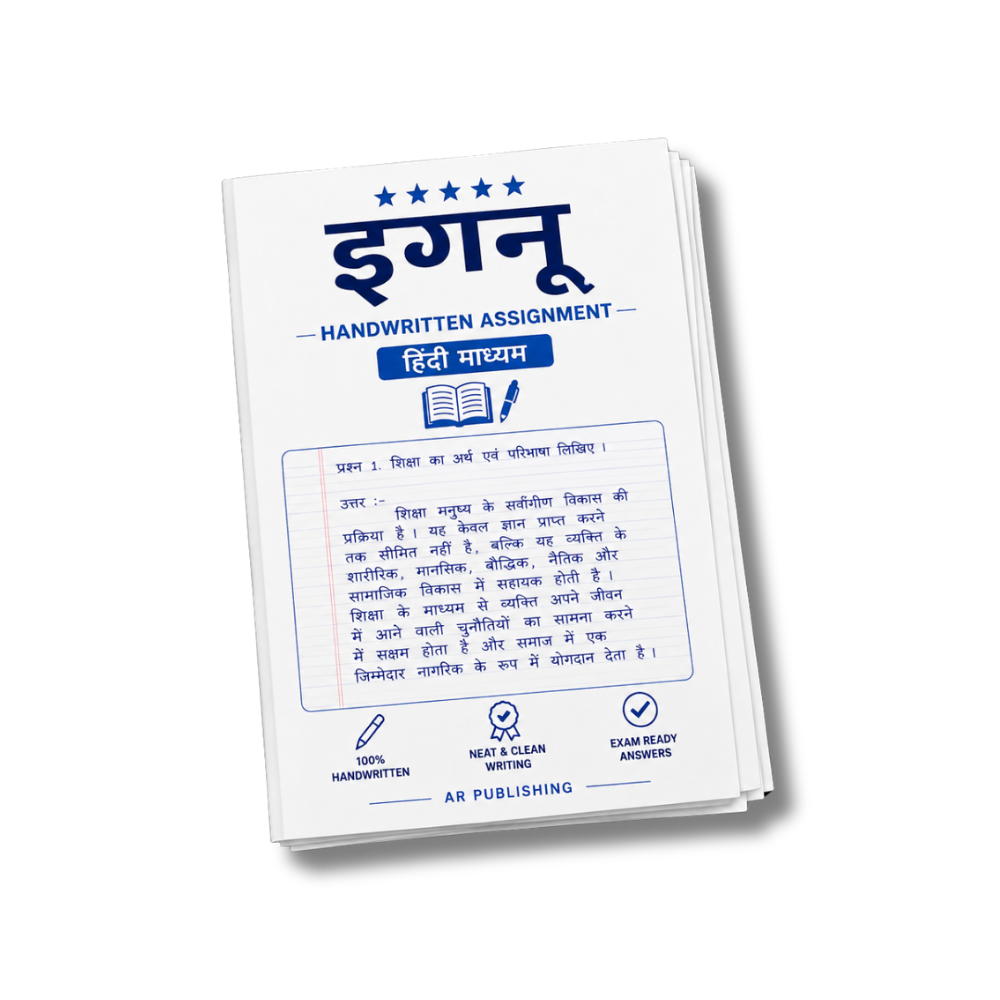
BSOE-142 IGNOU Handwritten Assignment 2026-27
Enrolled in other IGNOU subjects?
Link your Enrollment No. to auto-map your semester courses & free question papers.
Frequently Bought Together
Popular course materials frequently ordered together



Syllabus & Overview
Course Scope & Syllabus Overview for BSOE-142: Indian Sociological Traditions
BSOE-142: Indian Sociological Traditions is a core component of IGNOU’s Bachelor of Arts (BAG) curriculum under the School of Social Sciences, designed to critically examine the evolution of sociological thought in India. This course explores the historical, philosophical, and theoretical foundations of Indian sociology, tracing its development from pre-colonial traditions to contemporary perspectives. Students engage with foundational texts, indigenous methodologies, and the contributions of key Indian sociologists, fostering an understanding of how sociological inquiry has been shaped by India’s cultural, political, and social contexts. The curriculum emphasizes analytical rigor, interdisciplinary connections, and the application of sociological frameworks to contemporary Indian challenges, ensuring students develop a nuanced grasp of both traditional and modern sociological paradigms.Key Syllabus Units & Topics
- Block-1: History and Development of Indian Sociological Traditions: This unit traces the origins of sociological thought in India, analyzing pre-colonial philosophical texts like the Upanishads and Bhagavad Gita for early sociological insights. It examines the impact of colonialism on the emergence of modern sociology, including the role of British anthropologists and the adaptation of Western theories to Indian contexts.
- Block-2: Sociologists in India-1: Focuses on the contributions of pioneering Indian sociologists such as G.S. Ghurye, M.N. Srinivas, and Irawati Karve, dissecting their theoretical frameworks and empirical research. Topics include caste systems, kinship structures, and rural-urban dynamics, with emphasis on ethnographic methods and their application in Indian settings.
- Block-3: Sociologists in India-2: Explores contemporary sociological perspectives, including the works of Yogendra Singh, Andre Béteille, and Veena Das, who addressed issues like social change, gender, and marginalization. This unit also critiques post-colonial critiques of sociology, examining how Indian sociologists redefined global sociological discourse.
- Unit on Indigenous Methodologies: Investigates the use of oral traditions, participant observation, and qualitative methods in Indian sociology, contrasting them with Western positivist approaches. Students analyze case studies from tribal societies, urban marginalization, and religious communities to understand indigenous research paradigms.
- Unit on Sociology and Public Policy: Connects sociological theories to policy-making, examining how research informs government initiatives on education, healthcare, and social welfare. Case studies include the National Rural Employment Guarantee Act and gender-specific policy interventions.
Frequently Asked Questions
Q: What is the marking scheme for the term-end examination in BSOE-142, and how are assignments weighted?
A: The term-end examination carries 80% of the total marks, with assignments contributing 20%. Assignments are graded based on depth of analysis, adherence to academic standards, and relevance to the syllabus, while the examination tests theoretical knowledge, critical thinking, and application of concepts.
Q: Are there any specific pass marks required for BSOE-142, and how are internal assessments evaluated?
A: The minimum pass marks for BSOE-142 are 40% overall, including both the term-end examination and assignments. Internal assessments, such as assignments, are evaluated by IGNOU Study Centre coordinators using predefined rubrics, ensuring consistency in grading across regions.
Why buy from us?
-
Verified by top professors and 99th percentile students.
-
Always updated to the latest university curriculum.
-
High-quality, printable PDF formats with clear diagrams.
License & Terms
By purchasing this item, you agree to our standard academic license terms. You may use this product for personal study, but you may not resell or redistribute the files online.