

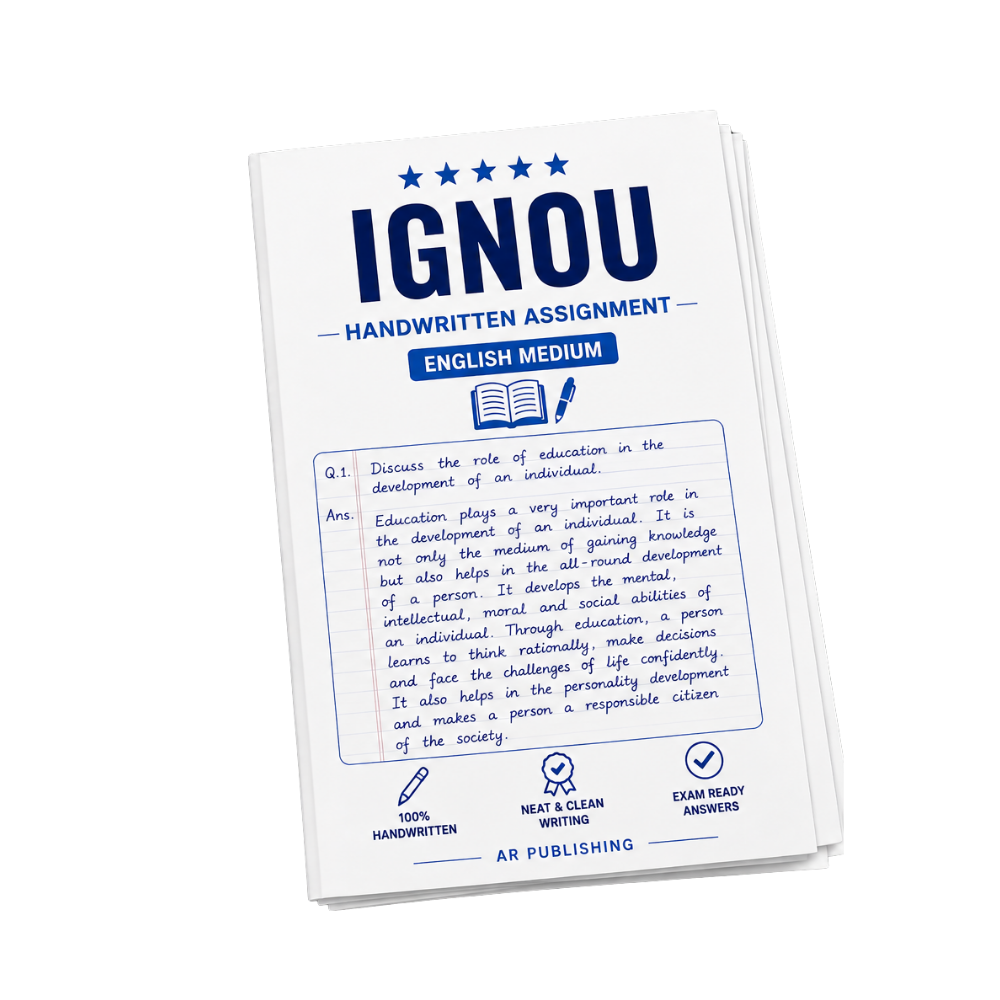
BSOG-171 IGNOU Handwritten Assignment 2026-27
Click to view offer details & terms
Get 10% OFF Instant Discount
Apply this coupon code at checkout to claim your academic discount instantly.
- Applicable on all university study materials
- Valid for up to 8 item(s) per order
- Valid till Oct 31, 2026
Enrolled in other IGNOU subjects?
Link your Enrollment No. to auto-map all your semester courses & free question papers.
Frequently Bought Together
Popular course materials frequently ordered together

Syllabus & Overview
Course Scope & Syllabus Overview for BSOG-171: Indian Society Images and Realities
BSOG-171: Indian Society: Images and Realities is a core Sociology elective under IGNOU’s CBCS curriculum, designed to critically examine the layered realities of Indian society through interdisciplinary lenses. This course bridges historical, anthropological, and sociological perspectives to dissect enduring structures like caste, class, and religion while analyzing their evolving dynamics in contemporary India. Students engage with theoretical frameworks—such as structural-functionalism, Marxist critiques, and postcolonial theories—to unpack how societal images (e.g., "Hindu Rashtra," "caste-free utopia") clash with lived realities. The syllabus emphasizes empirical case studies, policy debates, and comparative analyses, equipping learners with analytical tools to evaluate social change, modernization, and marginalization. By the end of the course, students develop nuanced insights into India’s pluralistic fabric, preparing them for rigorous academic and field-based research in sociology.Key Syllabus Units & Topics
- Block-1: Ideas of India: Explores foundational concepts of Indian society through colonial and indigenous narratives, including the construction of "Hinduism," "secularism," and "Indianness" in political and cultural discourses. Examines how these ideas shape national identity, citizenship, and social hierarchies.
- Block-2: Institutions and Processes: Analyzes core institutions—caste, class, tribe, and religion—as dynamic systems regulating power, inequality, and social mobility. Covers institutional reforms (e.g., anti-caste movements, reservation policies) and their contradictions in practice.
- Block-3: Critiques: Evaluates Marxist, feminist, and postcolonial critiques of Indian society, focusing on gendered divisions, economic exploitation, and the limits of liberal democracy. Includes discussions on Dalit studies, women’s agency, and subaltern resistance.
- Unit on Social Change & Modernization: Investigates the tensions between tradition and modernity, urbanization, and globalization’s impact on Indian social structures. Uses empirical data to assess whether modernization erodes or reinforces hierarchies.
- Family and Gender Dynamics: Deciphers the evolving roles of family systems (joint vs. nuclear) and gender norms under patriarchal and neoliberal influences, with case studies on dowry, honor violence, and women’s labor participation.
Frequently Asked Questions
Q: What is the marking scheme for BSOG-171 assignments, and how many marks are allocated to each question?
A: The BSOG-171 assignment carries 30 marks, distributed across 5–6 questions (typically 5 marks each). Each question requires a structured answer with theoretical references, case examples, and critical analysis—strict adherence to word limits (e.g., 200–250 words per question) is mandatory for full credit.
Q: Are there any pass marks for BSOG-171, and how does the examination pattern differ from assignments?
A: The course requires a minimum of 40% aggregate marks to pass, with assignments (30%) and the term-end exam (70%) contributing equally. The exam includes short-answer (20 marks), descriptive (30 marks), and essay-type (20 marks) questions, testing both conceptual clarity and application of sociological theories.
Why buy from us?
-
Verified by top professors and 99th percentile students.
-
Always updated to the latest university curriculum.
-
High-quality, printable PDF formats with clear diagrams.
License & Terms
By purchasing this item, you agree to our standard academic license terms. You may use this product for personal study, but you may not resell or redistribute the files online.