


Instant PDF
Instant 24/7 Access
CBCS Verified
2026-27 Syllabus
100% Safe Pay
UPI, Cards & NetBanking
Student Support
WhatsApp Helpdesk
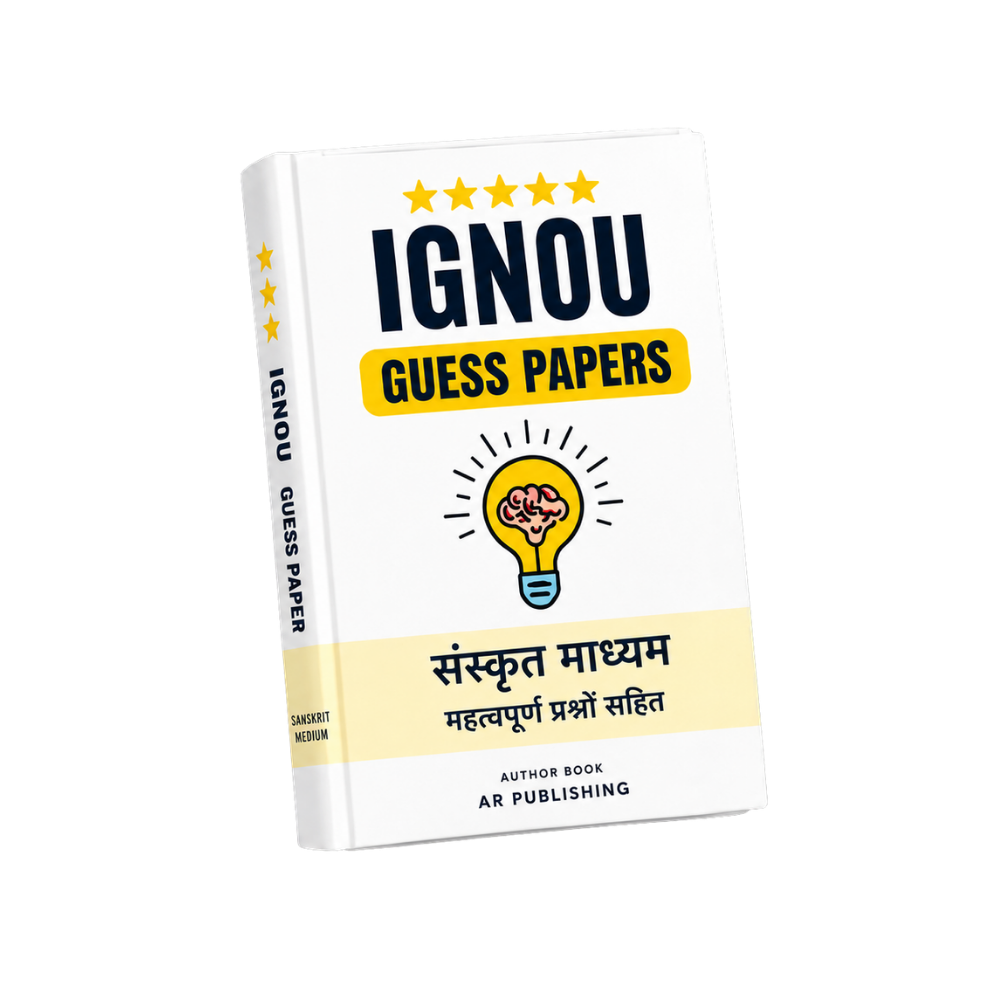
MGPE-1 IGNOU Guess Paper 2026-27
Enrolled in other IGNOU subjects?
Link your Enrollment No. to auto-map your semester courses & free question papers.
Frequently Bought Together
Popular course materials frequently ordered together
Syllabus & Overview
PAPER-2026 (Course Code PAPER-2026) Guess Paper 2026-27: TEE Exam Strategy
This structured guess paper aligns with the IGNOU Degree Programme curriculum for PAPER-2026, emphasizing high-yield topics from previous years' Term-End Exams (TEE). Below are key blocks with question weightage and 3-hour exam management tips.
Key Syllabus Blocks & Focus Areas
1. Unit I: Principles of Management
Focus on Taylor’s Scientific Management, Fayol’s 14 Principles, and Contemporary Management Theories. Previous years saw 15-20 marks allocated to case studies on span of control, delegation, and centralization.
- Expected Questions: Short answer on Taylor’s 4 Principles (10 marks). Long answer on comparison of Fayol’s and Weber’s theories (20 marks).
- Exam Tip: Use flowcharts for delegation hierarchy diagrams.
2. Unit III: Organizational Behavior
Prioritize Maslow’s Hierarchy of Needs, Herzberg’s Two-Factor Theory, and Conflict Resolution Models. Previous papers had 25-30 marks on behavioral case studies.
- Expected Questions: Short answer on Ohio State Leadership Studies (15 marks). Long answer on applying Herzberg’s theory to workplace motivation (30 marks).
- Exam Tip: Mention real-world examples (e.g., remote teams) for higher marks.
3. Unit V: Strategic Management
Key topics: SWOT Analysis, Porter’s Five Forces, and Corporate-Level Strategies. This unit carries 20-25% weightage in TEE.
- Expected Questions: Short answer on Porter’s Generic Strategies (10 marks). Case study on SWOT for a fictional startup (25 marks).
- Exam Tip: Use PESTLE framework alongside SWOT for depth.
4. Unit II: Organizational Structures & Design
Focus on Mechanistic vs. Organic Structures, Matrix Organizations, and Contingency Theory. Previous papers tested designing an organizational chart (20 marks).
- Expected Questions: Short answer on Chandler’s Stages of Growth (10 marks). Long answer on designing a flat vs. tall structure (30 marks).
- Exam Tip: Draw visual diagrams for clarity.
Exam Time Management (3 Hours)
1. Allocate 10 minutes to read the paper and prioritize sections (e.g., start with high-markage units like Unit III).
2. For short answers (10-15 marks): Spend 5-7 minutes per question, focusing on key definitions and examples.
3. For long answers (20-30 marks): Use 3-part structure (introduction, analysis, conclusion) and highlight case studies.
4. Leave 10 minutes for review, ensuring no blank spaces and logical flow.
Subject-Specific FAQs
Q: Are diagrams allowed in answers? Yes, but label them clearly (e.g., ‘Figure 1: Delegation Hierarchy’).
Q: How to score in case studies? Use real-world examples (e.g., Google’s flat structure) and link theories (e.g., Herzberg’s theory).
Why buy from us?
-
Verified by top professors and 99th percentile students.
-
Always updated to the latest university curriculum.
-
High-quality, printable PDF formats with clear diagrams.
License & Terms
By purchasing this item, you agree to our standard academic license terms. You may use this product for personal study, but you may not resell or redistribute the files online.