

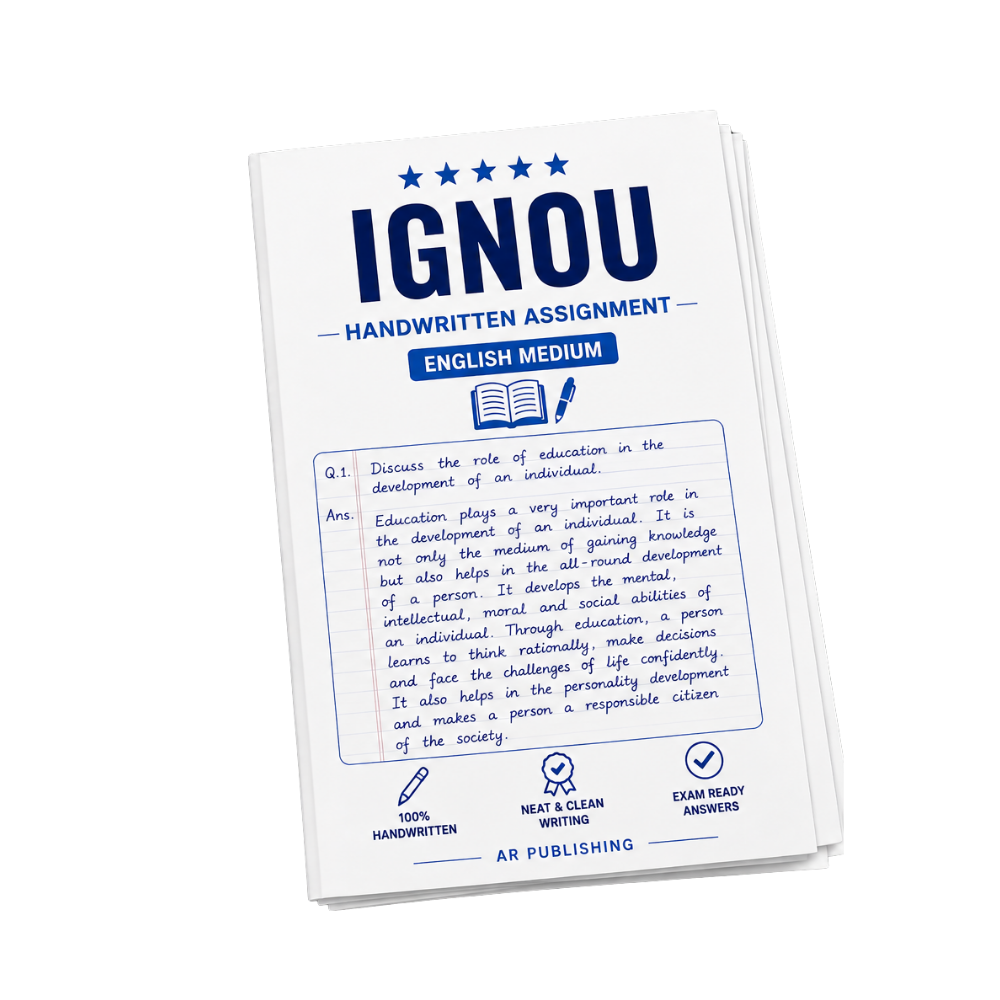
MHI-104 IGNOU Handwritten Assignment 2026-27
Click to view offer details & terms
Get 10% OFF Instant Discount
Apply this coupon code at checkout to claim your academic discount instantly.
- Applicable on all university study materials
- Valid for up to 8 item(s) per order
- Valid till Oct 31, 2026
Enrolled in other IGNOU subjects?
Link your Enrollment No. to auto-map all your semester courses & free question papers.
Frequently Bought Together
Popular course materials frequently ordered together
Syllabus & Overview
MHI-104: Handwritten Assignment Hard Copy Overview
Course Scope and Syllabus Overview
MHI-104: is a core component of IGNOU’s MAHI curriculum under the School of Social Sciences, designed to explore the evolution of political structures in India from ancient to colonial periods. This course examines the theoretical frameworks, institutional mechanisms, and socio-political dynamics that shaped governance across different historical eras. Through a structured analysis of primary sources and scholarly interpretations, students develop critical insights into the interplay between power, administration, and societal transformation—essential for understanding India’s political heritage. The syllabus integrates historical archaeology and political theory, ensuring students engage with real-world case studies while adhering to IGNOU’s CBCS guidelines. Assignments are crafted to reinforce analytical skills, requiring students to synthesize evidence from prescribed readings and field observations.Key Syllabus Units & Topics
- -2 7–13 . .: This unit dissects the political formations of early medieval India, including the rise of regional kingdoms, feudal structures, and the role of dynasties like the Rashtrakutas and Chalukyas in consolidating power through administrative innovations and military strategies.
- -3 1300–1800 . .: Focuses on the decentralized yet dynamic political landscape of the late medieval period, analyzing the governance models of the Vijayanagara Empire, Bahmani Sultanate, and Maratha confederacy, with emphasis on their fiscal systems, cultural policies, and responses to external pressures.
- -6 -I: Explores the institutional frameworks of pre-colonial India, including the functioning of royal courts, provincial governance, and the bureaucratic apparatus of empires like the Mughals, with attention to legal codes, revenue administration, and the role of religious institutions in statecraft.
- -8 : Examines the colonial disruption of indigenous political structures through British administrative reforms, the impact of the East India Company’s governance on local elites, and the emergence of hybrid political systems under direct and indirect rule.
- -5 : Traces the transition from trade-based colonialism to imperial administration, analyzing the political strategies of European powers, the evolution of colonial bureaucracies, and the resistance mechanisms employed by Indian states and communities.
Frequently Asked Questions
Q: What is the marking scheme for MHI-104 assignments, and how are they evaluated?
A: Assignments in MHI-104 are typically graded on clarity of argument, historical accuracy, and adherence to academic conventions. Each assignment carries 20 marks, with weightage given to analytical depth, use of prescribed references, and presentation standards as per IGNOU’s evaluation criteria.
Q: Are there specific pass marks or minimum requirements for submitting handwritten assignments in MHI-104?
A: IGNOU mandates that all assignments must be submitted in the prescribed format (80 GSM ruled paper, blue/black ink, proper margins) with no handwritten corrections. While there are no minimum word limits, assignments must demonstrate engagement with the syllabus and exhibit original analytical effort to meet the pass criteria.
Why buy from us?
-
Verified by top professors and 99th percentile students.
-
Always updated to the latest university curriculum.
-
High-quality, printable PDF formats with clear diagrams.
License & Terms
By purchasing this item, you agree to our standard academic license terms. You may use this product for personal study, but you may not resell or redistribute the files online.