

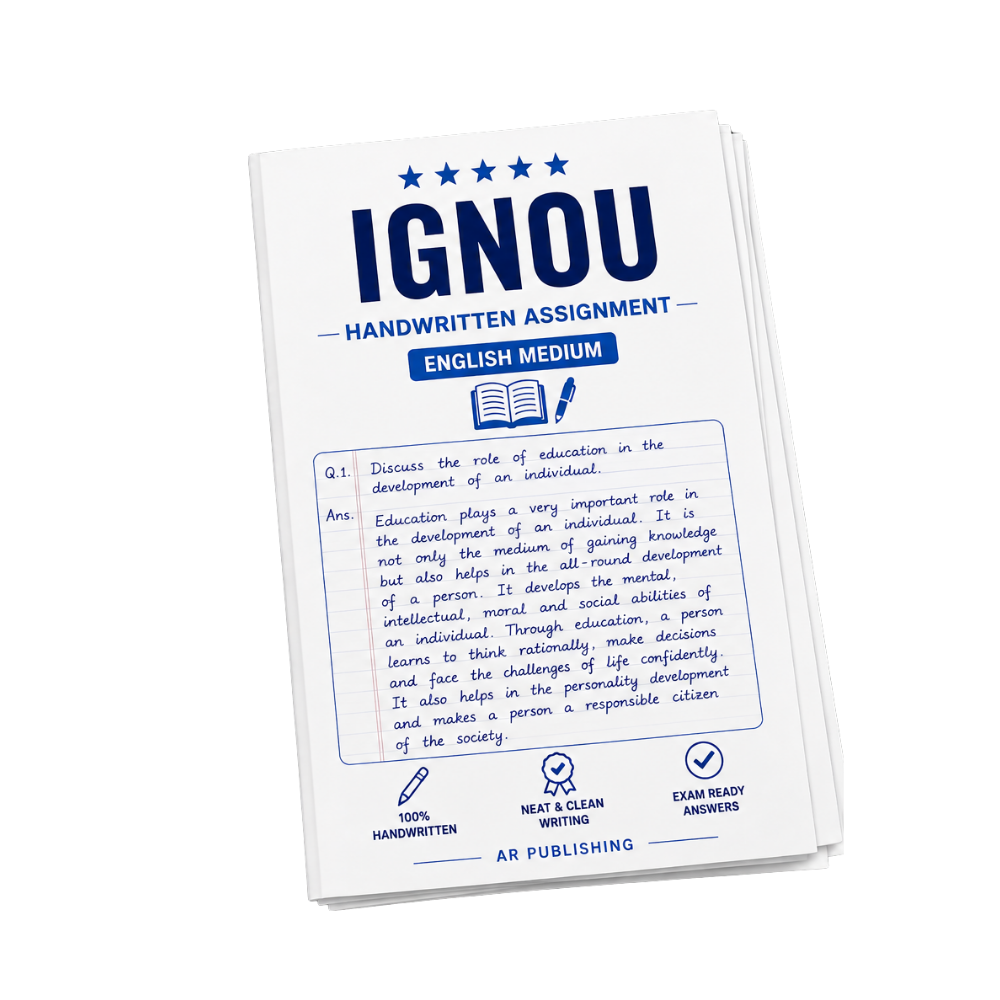
MHI-106 IGNOU Handwritten Assignment 2026-27
Click to view offer details & terms
Get 10% OFF Instant Discount
Apply this coupon code at checkout to claim your academic discount instantly.
- Applicable on all university study materials
- Valid for up to 8 item(s) per order
- Valid till Oct 31, 2026
Enrolled in other IGNOU subjects?
Link your Enrollment No. to auto-map all your semester courses & free question papers.
Frequently Bought Together
Popular course materials frequently ordered together
Syllabus & Overview
Course Scope and Syllabus Overview for MHI-106: Evolution of Social Structures in India through the Ages
MHI-106, a core component of the Master of Arts (History) curriculum under IGNOU’s School of Social Sciences, meticulously traces the dynamic evolution of India’s social frameworks from ancient civilizations to colonial transformations. This course integrates archaeological evidence, textual records, and anthropological insights to analyze caste systems, kinship networks, economic hierarchies, and political affiliations across pivotal historical phases. Students engage critically with primary sources—such as the Arthashastra, medieval chronicles, and colonial census data—to dissect how societal structures adapted to technological shifts, religious syntheses, and imperial expansions. The syllabus emphasizes interdisciplinary rigor, preparing students to contextualize India’s social evolution within broader global historiography while grounding analyses in empirical rigor.Key Syllabus Units and Topics
- Block-2 Cultures in Transition: Examines the socio-cultural shifts during the Vedic to Early Iron Age transitions (c. 1500–500 BCE), focusing on the emergence of varna stratification, ritual specialization, and the role of trade networks in redefining kinship systems.
- Block-3 Early Historic Societies (6th Century BCE–4th Century CE): Analyzes the socio-political implications of Mahavira’s Jainism and Buddha’s teachings on caste fluidity, alongside the Mauryan Empire’s bureaucratic centralization and its impact on rural-urban social divides.
- Block-5 Medieval Society-1: Historiography of the Rural Society: Deciphers agrarian economies in the Deccan and Bengal through land revenue records (patta systems), peasant rebellions (e.g., the Sanyasi-Fakir movements), and the role of temples as socio-economic hubs.
- Block-7 Modern Society: Investigates the colonial state’s categorization of "tribes" and "castes" via the 1871 Census, contrasting indigenous social mobility with British administrative classifications that institutionalized hierarchies.
- Block-8 Social Questions Under Colonialism: Explores the formation of nationalist discourse on untouchability (e.g., Phule’s Satya Shodhak Samaj), labor exploitation in plantations, and the paradox of British legal reforms (e.g., the 1892 Ilbert Bill) in perpetuating social inequalities.
Frequently Asked Questions
Q: What is the assignment weightage in MHI-106’s final evaluation, and how are marks allocated?
A: Assignments contribute 30% to the total marks for MHI-106, with each block’s assignment carrying equal weight. Marks are awarded for analytical depth, factual accuracy, and adherence to IGNOU’s prescribed structure, including proper referencing of sources.
Q: Are there any specific guidelines for citing primary sources in the handwritten assignments?
A: Students must cite all textual references (e.g., Manusmriti, Akbarnama) using parenthetical citations with author/editor names and publication details (e.g., Romesh Chander Dutt, ed., Akbarnama, 1922). Archaeological evidence (e.g., Harappan seals) should include site names and excavation reports from journals like Epigraphia Indica.
Why buy from us?
-
Verified by top professors and 99th percentile students.
-
Always updated to the latest university curriculum.
-
High-quality, printable PDF formats with clear diagrams.
License & Terms
By purchasing this item, you agree to our standard academic license terms. You may use this product for personal study, but you may not resell or redistribute the files online.