

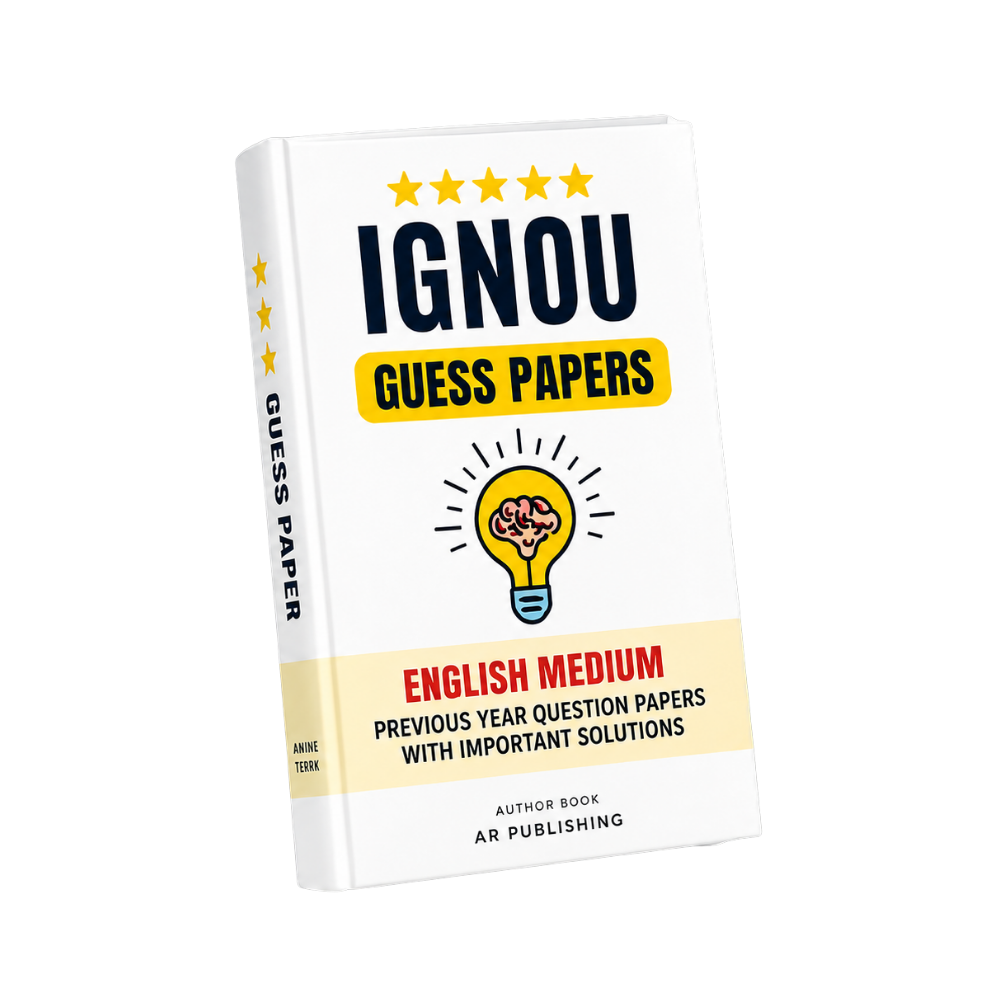
MPYE-7 IGNOU Guess Paper 2026-27
Click to view offer details & terms
Get 10% OFF Instant Discount
Apply this coupon code at checkout to claim your academic discount instantly.
- Applicable on all university study materials
- Valid for up to 8 item(s) per order
- Valid till Oct 31, 2026
Enrolled in other IGNOU subjects?
Link your Enrollment No. to auto-map all your semester courses & free question papers.
Frequently Bought Together
Popular course materials frequently ordered together
Syllabus & Overview
Course Scope & Syllabus Overview
This guide supports students of MPYE-7: Public Health Ethics and Policy within IGNOU’s Master’s Programme in Public Health (MPH), aligning with the CBCS curriculum. The course critically examines ethical frameworks, policy formulations, and governance models in public health, bridging theoretical principles with real-world applications. It prepares candidates to analyze bioethical dilemmas, evaluate health policies, and advocate for equitable health interventions, all while adhering to UN Sustainable Development Goals and national health regulations. The structured approach ensures students grasp key concepts—such as autonomy, justice, and utilitarianism in health systems—while applying them to case studies and policy critiques.Key Syllabus Units & Topics
- Ethical Foundations in Public Health: Explores core ethical theories (deontology, consequentialism) and their application in vaccine mandates, resource allocation, and pandemic response, referencing WHO guidelines and Indian Public Health Standards.
- Bioethics and Human Rights: Investigates ethical challenges in reproductive health, genetic engineering, and medical tourism, with a focus on the National Bioethics Framework and ICMR directives.
- Health Policy and Governance: Analyzes policy cycles, stakeholder dynamics, and implementation gaps in India’s National Health Mission, using frameworks like the Policy Cycle Model and participatory governance tools.
- Global Health Ethics: Compares ethical norms across low-, middle-, and high-income countries, emphasizing equity, cultural relativism, and the role of NGOs in global health governance (e.g., UNICEF and WHO collaborations).
- Case Studies in Public Health Ethics: Evaluates real-world scenarios like the COVID-19 vaccine rollout, organ transplantation ethics, and mental health stigma, applying critical thinking to ethical dilemmas and policy recommendations.
Frequently Asked Questions
Q: What is the marking scheme for MPYE-7’s Term-End Examination (TEE), and how are internal assignments weighted?
A: The TEE carries 100 marks, divided into 50% for theory (short answer/long answer questions) and 50% for case studies/policy critiques. Assignments (worth 30% of total marks) require submission via LMS within deadlines; late submissions incur penalties.
Q: Are there recurring themes in MPYE-7’s past question papers, and how can I prioritize revision topics?
A: Repeated themes include ethical frameworks in vaccine policies (20–25% weightage), policy analysis of NHM schemes (15–20%), and bioethical case studies (20%). Focus on these units while cross-referencing chapter-wise question distributions in solved papers for targeted revision.
Why buy from us?
-
Verified by top professors and 99th percentile students.
-
Always updated to the latest university curriculum.
-
High-quality, printable PDF formats with clear diagrams.
License & Terms
By purchasing this item, you agree to our standard academic license terms. You may use this product for personal study, but you may not resell or redistribute the files online.